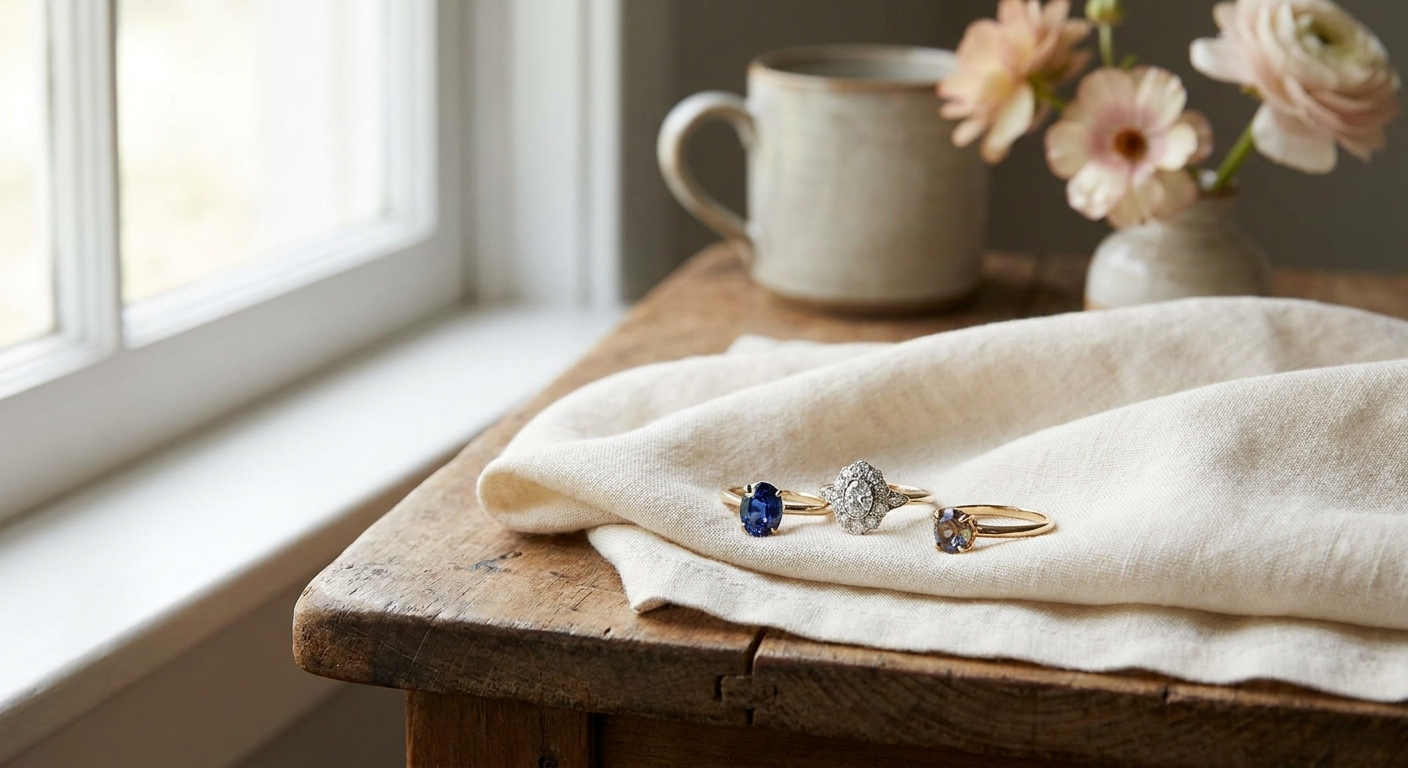
Choosing a ring for a second marriage in 2026 is a different exercise than shopping for a first one, and the jewelry industry is finally catching up: fewer solitaires, more color, more custom work, more rings that read as a fresh chapter instead of a rerun. This guide ranks the styles worth considering and tells you flat out what to skip.
- Colored gemstone rings and asymmetrical designs outrank traditional diamond solitaires for second marriage engagement rings in 2026 — Buy.
- Linked and stacking bands from designers like Spinelli Kilcollin work as a non-literal alternative to a single dominant stone — Buy.
- Mall-chain diamond solitaires that mimic a first ring are the most common regret purchase — Skip.
- Custom redesigns using inherited or existing stones score highest for sentimental buyers — Buy.
Why this matters
A second engagement ring carries different weight than a first one. Buyers are often older, have more defined taste, and are actively avoiding anything that echoes a previous marriage. That shifts demand away from the classic round-brilliant solitaire and toward pieces with personality — color, asymmetry, mixed metals, or a design built entirely around a story rather than a carat count.
Element 79 in Denver's Cherry Creek district carries artisan bridal lines built for exactly this kind of buyer, including Artëmer, Orly Marcel, Spinelli Kilcollin, and Petra Class — four designers whose work leans away from convention on purpose. That makes them a useful lens for ranking what actually works for a second-marriage ring versus what just looks good on a display case.
How we ranked
The ranking below weighs four factors that matter specifically for second-time buyers: how distinct the design is from a conventional solitaire, how well it wears daily (most second-marriage buyers are marrying later and want a ring that fits an established lifestyle), how easily it accommodates sentimental elements like inherited stones, and how it holds up against resale or upgrade comparisons down the line. Design categories are scored against these criteria rather than against price, since taste and budget both vary too widely for a single number to mean much.
The ranked list
1. Colored gemstone center stones — the color statement
Sapphires, emeralds, and morganite have moved from "alternative" to mainstream for second engagement rings in 2026. A colored center stone immediately separates the ring from a first marriage's diamond solitaire without requiring any justification. Designers like Orly Marcel build entire collections around saturated color paired with unexpected metal tones, which gives buyers a ring that reads as intentional rather than reactive. Verdict: Buy.
2. Linked and interlocking bands — the modern link
Spinelli Kilcollin popularized the interlocking-ring silhouette, and it solves a real problem for second marriages: it avoids a single dominant stone entirely while still signaling commitment. These pieces stack well with existing jewelry and don't compete visually with a first-marriage ring still worn for sentimental reasons on a necklace or the other hand. Gold purity matters here — look for 18k construction, since interlocking bands see more daily flex than a rigid shank. Verdict: Buy.
3. Asymmetrical and sculptural settings — the architect's pick
Artëmer's design language runs toward off-center stones, uneven prong work, and settings that look handmade rather than mass-produced. For a second-marriage buyer who wants something clearly personal, asymmetry does more work than a bigger stone ever could. The tradeoff is durability planning: an off-center setting needs a jeweler who checks prong tension on inspection, since the stress distribution differs from a centered solitaire. Verdict: Buy.
4. Granulated gold with natural, imperfect stones — the heirloom look
Petra Class works in richly textured 18k and 22k gold with stones chosen for character rather than perfect symmetry. This category appeals to buyers who want a ring that looks like it has history even when it's brand new — a specific ask from second-marriage clients who don't want anything that looks freshly boxed. It's a strong pick for someone marrying later in life with an established sense of style, less strong for someone who wants a ring that photographs identically from every angle. Verdict: Consider.
5. Custom redesign using existing stones — the sentimental remix
Taking a stone from a family ring, a first marriage, or an inherited piece and resetting it into new architecture is one of the fastest-growing requests at bridal counters in 2026. It keeps sentimental value while erasing the visual association with a past ring. A custom bridal consultation typically runs several weeks from design approval to delivery, so this route needs more lead time than a case purchase. Verdict: Buy.
6. Traditional round or princess-cut diamond solitaire — the classic reset
There's nothing wrong with a diamond solitaire on its own merits, and plenty of second-marriage buyers genuinely want one. The problem is comparison: if the new ring resembles the old one in cut, setting height, and metal, both the buyer and everyone who knew the first ring will notice. A solitaire works for a second marriage only when at least one variable — metal color, stone shape, or setting style — changes meaningfully from the original. Verdict: Hold.
7. Mass-market mall-chain solitaires — the impulse buy
Chain jewelers push a narrow catalog of near-identical solitaire mountings, and they're the most common source of second-marriage ring regret according to bridal counter feedback repeated across the industry in 2026. These rings solve nothing that a first marriage ring didn't already solve, they're built for volume rather than character, and they photograph as generic. Verdict: Skip.
“A second engagement ring doesn't have to apologize for existing next to a first one — it just has to look nothing like it.”
Comparison table
| Style | Best for | Standout designer | Verdict |
|---|---|---|---|
| Colored gemstone center | Buyers avoiding diamond comparisons | Orly Marcel | Buy |
| Interlocking/linked bands | Buyers who don't want a single dominant stone | Spinelli Kilcollin | Buy |
| Asymmetrical settings | Buyers who want a handmade look | Artëmer | Buy |
| Granulated gold, natural stones | Buyers marrying later with defined taste | Petra Class | Consider |
| Custom redesign | Buyers keeping sentimental stones | Varies by consultation | Buy |
| Traditional solitaire | Buyers who genuinely prefer classic | N/A | Hold |
| Mall-chain solitaire | No one, practically speaking | N/A | Skip |
Where to buy
Buy from a jeweler that carries independent artisan lines, not just house-brand solitaires — the whole point of a second-marriage ring is avoiding a design that looks interchangeable with the last one. Ask whether the piece can be customized in metal color or stone size before it's cast; most artisan bridal lines allow this at the consultation stage. And if a stone is being reset from an existing piece, confirm the jeweler inspects it for wear and re-certifies it before setting, since older stones sometimes need a fresh grading check.
Book a bridal consultation
See Artëmer, Orly Marcel, Spinelli Kilcollin, and Petra Class in person in Cherry Creek.
FAQ
What is the best engagement ring style for a second marriage in 2026?
Colored gemstone center stones and asymmetrical settings rank highest for second marriage engagement rings in 2026 because they read as a deliberate departure from a traditional diamond solitaire. Interlocking band designs are a close second for buyers who want to avoid a single dominant stone entirely.
Is it wrong to choose a diamond solitaire for a second engagement ring?
No, but a diamond solitaire that closely matches a first marriage ring in cut and setting invites direct comparison. Changing the metal color, stone shape, or setting height solves this without abandoning the classic look.
Can I reuse a diamond from my first engagement ring?
Yes, resetting an existing stone into new architecture is one of the fastest-growing bridal requests in 2026. Plan for several weeks of lead time between design approval and delivery for a custom reset.
Should the ring finger or hand change for a second marriage?
There's no rule requiring a change, but many buyers move a second-marriage ring to a different hand or finger to visually separate it from a ring still worn for sentimental reasons. This is a personal choice, not a jewelry standard.
Are colored gemstones durable enough for daily wear as an engagement ring?
Sapphires rank near the top of the hardness scale and hold up well to daily wear, making them a practical choice for a second-marriage engagement ring. Softer stones like emerald or morganite need more careful handling and periodic prong checks.
What metal works best for a second marriage engagement ring?
18k gold in rose, yellow, or white tones is the most common choice for artisan bridal pieces in 2026, offering more durability under daily wear than 22k while still reading as substantial. Platinum remains the higher-durability option for buyers who prioritize longevity over metal color options.
How long does a custom engagement ring redesign take?
A custom bridal redesign using an existing stone typically takes several weeks from design approval to delivery in 2026, depending on the complexity of the new setting. Rush timelines are sometimes available but should be confirmed at the consultation.
Do second marriage engagement rings need to be less traditional?
No, but the highest-ranked styles for second marriages in 2026 tend to skip the standard round-brilliant solitaire in favor of color, asymmetry, or custom elements. The goal is distinction from a previous ring, not rejecting tradition outright.
One last thing
The detail most second-marriage buyers skip is prong inspection timing: an asymmetrical or interlocking setting sees different stress points than a centered solitaire, so it needs a check-up sooner than the standard annual jewelry cleaning cycle. Ask for a six-month inspection on any non-traditional setting purchased in 2026 — it catches loosening before it costs you the stone.