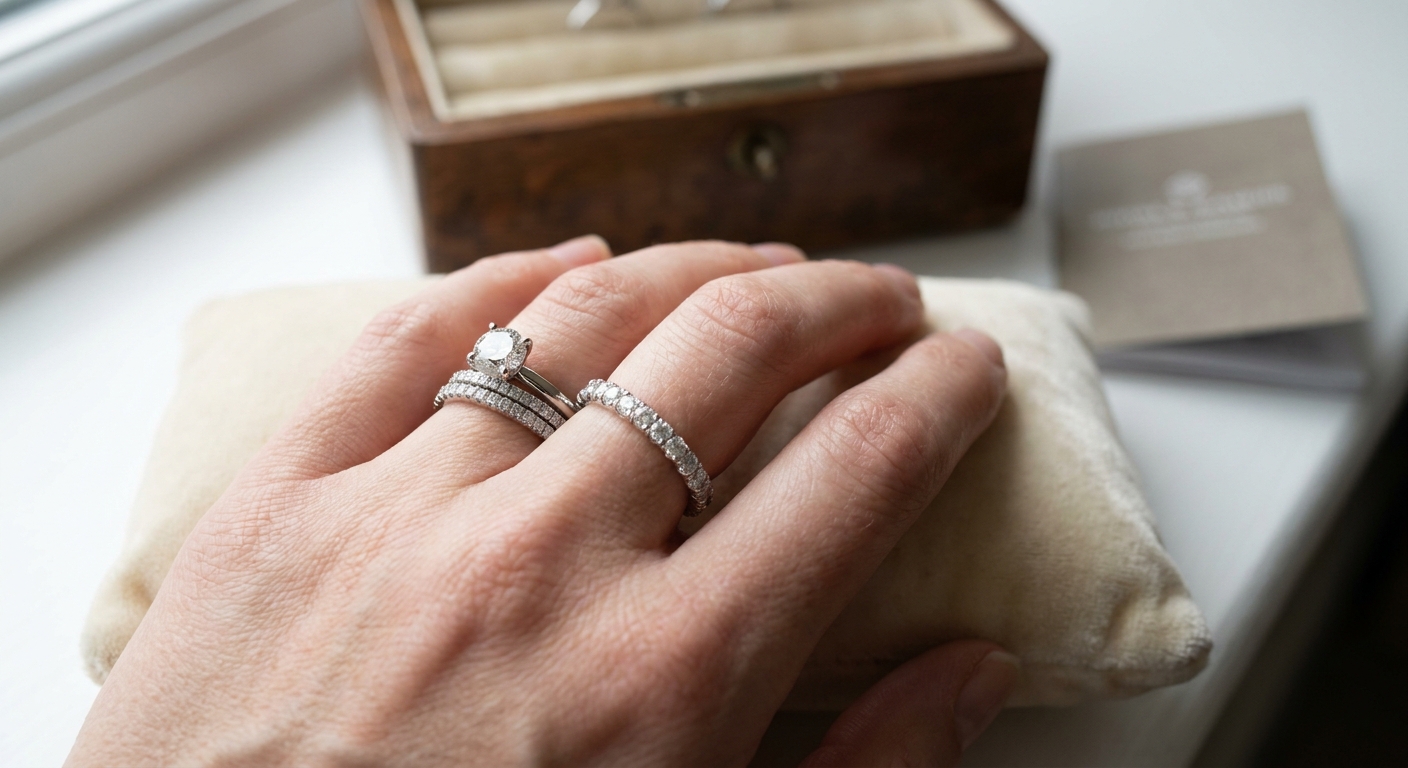
Stacked diamond rings only look effortless when the order, width, and metal tones are locked in — get any of the three wrong and you're re-stacking your hand by lunch. This guide breaks down the exact sequence jewelers use to build a stack that holds its position through a full day, from foundation band to top-finger accent.
- Set your widest, plainest band closest to the knuckle first — it anchors everything above it.
- Match metal tones (not just colors) or the stack visibly separates within a week of wear in 2026.
- Rings under 1.5mm width spin the most; pair them with a wider neighbor to lock rotation.
- Tension-set and cage rings work as anchors, not fillers — stack them last, never first.
- Stackable diamond rings under 2mm in a mismatched metal mix are the top cause of shifting stacks.
Why this matters
A stack that shifts isn't a styling problem, it's a physics problem. Fingers taper, knuckles are wider than the base, and every ring you add changes the pressure distribution on the ones below it. In 2026, stacking multiple bands per finger is still the dominant way people wear engagement and wedding rings alongside stand-alone pieces, but most shifting complaints trace back to two mistakes: stacking by look alone instead of by width, and mixing metal finishes that catch on each other.
Get the order right once and you stop touching your rings all day. That's the whole goal here.
What you'll need
- A ring sizer or a set of rings you already own, sized correctly
- 3-5 bands of varying widths (1.5mm to 4mm is a workable range)
- At least one wider "anchor" band, ideally 3mm or more
- A soft cloth for cleaning between fittings
- 10 minutes with your hand at rest and moving (typing, gripping a mug) to test the fit
- Optional: a jeweler's loupe or good light to check finish and stone alignment
If you're starting from scratch, browse stackable diamond rings for everyday wear before you buy anything — width and metal tone matter more than the individual design at this stage.
The steps
1. Set your foundation band first
Your foundation band sits closest to the knuckle and carries the most pressure from the rings above it. Pick your widest, plainest band for this spot — anything thinner than 3mm here tends to get pushed up by everything stacked on top. Slide it on and check that it sits flush against your knuckle without a gap.
Common mistake: starting with your most delicate ring "because it's the sentimental one." Sentiment doesn't hold a stack together; width does.
2. Match metal tones before you match styles
Two yellow golds from different brands can still read as "off" next to each other because alloy mixes vary. Hold your rings together in daylight and check if the tones genuinely match, not just the metal type on the tag. Mismatched tones don't cause physical shifting, but they make a stack look accidental instead of built.
If you're working with mixed metals on purpose, keep at least two rings in the same tone to anchor the eye — full mixed-metal stacks with no repeated tone tend to look busy rather than intentional.
3. Vary band widths to lock proportions
A stack built entirely from thin bands (all under 2mm) has nothing to grip against, so the rings slide past each other and rotate independently. Alternate a wide band, then a thin one, then a medium one. The width variation creates friction points where rings catch against each other instead of spinning freely.
Expected outcome: when you make a fist, the rings should move together as one unit, not independently.
4. Test the stack through a full range of motion
Don't just look at the stack while your hand is flat and relaxed — that's not how you actually live in it. Type for two minutes, grip a mug, wash your hands. Watch which ring rotates first; that's the one that needs a wider neighbor or a different position in the stack.
This step catches 90% of shifting problems before you've committed to wearing the stack out the door.
5. Reserve tension-set and cage-style rings for anchor spots, not fillers
Tension rings and open cage designs rely on precise finger pressure to sit correctly — stack them in the middle of a loose combination and they'll rotate constantly because nothing is holding them in place. Put them at the base, next to your foundation band, where the pressure from the rings above keeps them oriented.
6. Fuse or solder bands that repeatedly rotate out of position
If two rings keep sliding past each other no matter how you order them, a jeweler can solder them into a single unit — this is common for an engagement ring and wedding band worn together daily. It's a permanent step, so only do it with the combination you're certain you'll wear long-term. Ask about it specifically when you're choosing a designer engagement ring if you already know you want a soldered set from day one.
7. Clean and re-check the stack every few weeks
Oils, lotion, and daily wear change how bands grip each other over time. Clean the stack with a soft cloth and warm water every two to three weeks in 2026, then re-check the order — knuckle swelling from temperature or activity can shift which band needs to sit where.
See stacking-ready designs in person
Visit the Cherry Creek boutique to try width and metal combinations before you buy.
Troubleshooting
Rings spin so the diamonds face my palm. Add a wider band directly next to the spinning ring — thin bands under 1.5mm rotate freely without a neighbor to catch against.
There's a visible gap between my knuckle and the stack. Your foundation band is too narrow for that position. Swap in something 3mm or wider at the base.
The stack feels bulky or catches on gloves and pockets. You likely have three or more rings over 3mm each. Drop to one wide anchor band and fill the rest with 1.5-2mm bands.
Rings scratch each other's finish over time. Mixed hardness metals (platinum next to softer gold alloys) wear unevenly. Separate them with a mid-width band, or accept a brushed finish will show more wear.
My hand swells in heat and the whole stack feels tight. Remove the outermost ring during hot weather or exercise rather than forcing the full stack — repeated forcing distorts softer bands over months.
I keep forgetting which ring goes in which order. Photograph the stack once it's right. It sounds basic, but it's the fastest way to rebuild it correctly after cleaning or travel.
Tools and resources
- Stackable diamond rings for everyday wear — width and finish options built for daily stacking
- Best stackable diamond rings for building a ring stack — ranked picks by width and anchor role
- A jeweler's loupe for checking metal tone matches in natural light
- A soft polishing cloth for the every-few-weeks cleaning step above
What to do next
Once your stack holds through a full day without adjustment, the next decision is whether your engagement ring anchors the whole combination or sits separately. If you're still choosing that piece, the guide on designer engagement rings for a modern bride walks through how the center ring should relate to whatever you plan to stack around it later.
FAQ
How do you stack diamond rings so they don't shift?
Set your widest, plainest band closest to the knuckle as the foundation, then alternate widths above it so each ring catches against its neighbor instead of spinning freely. Test the full stack through gripping and typing motions before wearing it out for the day.
What order should stacked rings go in?
Widest and plainest at the base, tension-set or cage-style rings next to the base where pressure holds them in place, and thinner accent bands toward the top. This order distributes pressure so nothing rotates independently.
Can you stack rings of different metals?
Yes, but match at least two rings in the same metal tone to anchor the combination. Fully mixed stacks with no repeated tone tend to look scattered rather than intentional in 2026's stacking trends.
Why do my stacked rings keep spinning?
Bands under 1.5mm wide have nothing to grip against and rotate freely on the finger. Add a wider neighboring band directly next to the thin one to create friction and stop the spin.
Should you solder stacked rings together?
Solder only the combination you're certain you'll wear permanently, typically an engagement ring and wedding band worn daily. It's a one-way step, so confirm the pairing with a jeweler before committing.
How many rings can you stack on one finger?
Three to four rings per finger is the practical limit before a stack feels bulky against gloves, pockets, and daily tasks. Beyond that, distribute rings across two fingers instead of forcing them onto one.
Do stacking rings need to be the same width?
No — varying width is what keeps a stack in place. A mix of one wide anchor band with thinner accent bands above it holds better than several same-width bands, which slide past each other.
How often should you clean a ring stack?
Clean stacked rings every two to three weeks in 2026 with a soft cloth and warm water, since oils and lotion buildup change how bands grip each other over time.
One last thing
The single biggest fix people skip: testing the stack while gripping something, not just looking at it flat on the counter. A stack that looks perfect at rest and spins the second you make a fist isn't finished — it's missing a width transition somewhere in the middle. Fix that one gap and the whole combination stops needing daily adjustment.