Building a stack means committing to a system, not just buying pretty rings one at a time — and in 2026, the stackable diamond ring market has split hard between minimalist linked bands and sculptural, mixed-metal statements. This guide ranks the styles worth building around and tells you which ones actually wear well together over years, not just in a single photo.
- Spinelli Kilcollin's linked-chain rings win for effortless stacking — buy them as your anchor piece.
- Artëmer's sculptural pavé bands are the boldest stackable diamond rings on this list — consider, don't lead with them.
- Petra Class's organic bands add texture without fighting your diamonds — a strong supporting pick.
- Skip uniform 2.5mm bands bought all at once; mismatched widths from 1.5mm to 3mm stack more naturally.
- Element 79 in Cherry Creek, Denver carries a rotating edit of all four designer lines referenced here.
Why this matters
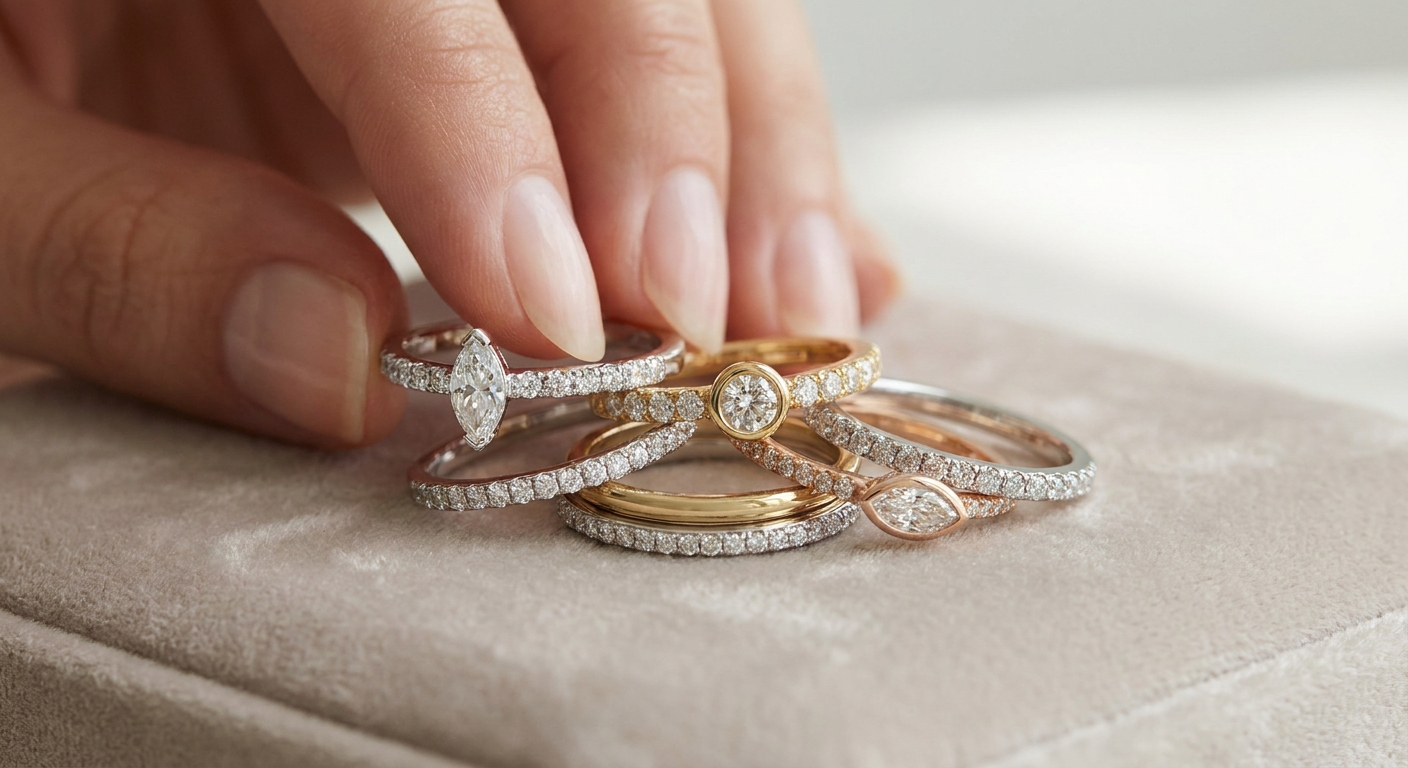
Most people ruin a ring stack the same way: they buy three identical bands in one sitting and end up with something that reads as one wide, boring ring instead of a stack. The best stackable diamond rings in 2026 are chosen for contrast — in width, in metal tone, in how the diamonds sit — not for matching.
Element 79's Cherry Creek boutique carries a rotating edit of Spinelli Kilcollin, Artëmer, Orly Marcel, and Petra Class, four designer lines built around exactly this kind of contrast stacking. Browse the current edit at Element 79 before you commit to a system, because seeing pieces side by side on a hand changes what looks good more than any product photo will.
A stack is a long-term project. You're not buying a ring, you're buying a starting point you'll add to over months or years, so the first two or three pieces need to hold their own individually and still leave room to grow.
How we ranked
Each pick below is judged on four things: how well it anchors a stack versus how well it fills a stack, whether the band width creates visual contrast against typical engagement ring profiles, metal-tone flexibility across yellow, white, and rose gold, and how the diamond setting reads at a distance versus up close. Designer construction quality and setting style come from publicly documented brand catalogs and industry-standard stacking conventions used by fine jewelry retailers in 2026 — not lab testing. Verdicts reflect what holds up as a long-term stack component versus what looks best as a single statement piece.
The ranked list
1. Spinelli Kilcollin linked-chain rings — the connector pick
Spinelli Kilcollin built its entire reputation on interlocking ring systems, and that's exactly why it anchors this list. The linked construction lets two or three bands move as one unit on the finger, which solves the biggest stacking problem: rings that spin out of alignment by midday.
A typical linked piece pairs a diamond-set band with one or two plain gold rings connected by soldered links, so the stack stays oriented without you touching it. This is the piece to buy first, before anything else in your stack, because everything else gets built around it. Verdict: Buy.
2. Artëmer sculptural pavé bands — the textural pick
Artëmer's diamond bands lean into irregular, sculptural settings rather than a straight line of stones, which gives a stack a focal point instead of another flat row of pavé. These read as fine jewelry with intention, not filler.
The catch: a sculptural band this expressive can crowd a stack if you already have two or three bold pieces in rotation. It works best as your second addition, once a simpler anchor ring is already in place. Verdict: Consider.
3. Orly Marcel asymmetrical diamond bands — the modern minimalist pick
Orly Marcel's asymmetrical settings put diamonds off-center or in a diagonal line rather than a symmetric row, which is exactly the kind of detail that keeps a stack from looking uniform. Next to a straight eternity band, an asymmetrical piece creates the contrast a stack needs to look assembled rather than accidental.
These bands run narrower than most statement pieces, typically closer to a 1.5mm to 2mm profile, so they layer without adding bulk. Verdict: Buy.
4. Petra Class organic diamond bands — the handcrafted pick
Petra Class works in a hand-hammered, organic aesthetic that reads as artisan-made rather than mass-produced, and that texture does real work in a stack: it breaks up the shine of polished bands sitting next to it. This is the piece that keeps a stack from looking like it came out of one display case.
The tradeoff is scale. Organic textured bands can look busy stacked more than two-deep, so treat this as a supporting player, not your third or fourth addition. Verdict: Consider.
5. Classic pavé eternity band — the safe pick
A straight pavé eternity band is the connective tissue of most ring stacks in 2026 — it's the piece that sits between bolder designs and gives the eye somewhere to rest. It's also the easiest piece to buy without seeing it in person, since the format barely varies across designers.
The risk is buying this first and stopping there. A single eternity band isn't a stack, it's a wedding band, so treat it as filler between two more distinctive pieces. Verdict: Buy.
6. Uniform-width matching sets sold as "instant stacks" — the wildcard
Some retailers sell pre-matched three-ring sets marketed as an instant stack solution. They photograph well and solve the decision fatigue of building one piece at a time.
The problem is permanence: once soldered or sized as a set, you can't swap pieces as your taste or budget changes, and matched-width sets tend to read flat rather than built. If you want a stack that evolves, this format works against you. Verdict: Wait.
See the current stacking edit
Browse Spinelli Kilcollin, Artëmer, Orly Marcel, and Petra Class in Cherry Creek.
Comparison table
| Pick | Best Role in Stack | Typical Band Width | Verdict |
|---|---|---|---|
| Spinelli Kilcollin linked rings | Anchor | 2mm–2.5mm | Buy |
| Artëmer sculptural pavé | Second addition | 2mm–3mm | Consider |
| Orly Marcel asymmetrical band | Contrast piece | 1.5mm–2mm | Buy |
| Petra Class organic band | Texture layer | 2mm–2.5mm | Consider |
| Classic pavé eternity band | Filler | 1.5mm–2mm | Buy |
| Matched three-ring set | Starter (limited) | Uniform 2mm | Wait |
Where to buy
- See pieces in person before you build a stack. Designer bands from Spinelli Kilcollin, Artëmer, Orly Marcel, and Petra Class vary in how they sit on the hand far more than product photography shows.
- Buy your anchor piece first, then add one ring at a time. Building a full stack in a single order removes the flexibility that makes stacking worth doing in 2026.
- Check current availability and pricing directly with a boutique that carries multiple designer lines, since sizing and metal options shift by season.
FAQ
What are the best stackable diamond rings in 2026?
Spinelli Kilcollin's linked-chain rings and Orly Marcel's asymmetrical bands lead the category in 2026 because they're built to layer without spinning or crowding other pieces. Both work as either a first or second ring in a growing stack.
How many rings should be in a diamond ring stack?
Most stacks work best at three to five rings, mixing at least one plain band with one or two diamond pieces. Beyond five, stacks tend to look cluttered rather than curated.
Should stacking rings match in width?
No — matching widths is the most common stacking mistake. Varying band widths from about 1.5mm to 3mm creates the visual contrast that makes a stack look assembled rather than accidental.
Can you mix metal tones in a ring stack?
Yes, mixing yellow, white, and rose gold within one stack is standard practice in 2026 and helps each ring read as its own piece. Designers like Petra Class specifically work in mixed-metal, hand-textured finishes for this reason.
Is Spinelli Kilcollin good for stacking rings?
Spinelli Kilcollin is built specifically for stacking, using linked-chain construction that keeps multiple rings oriented together on the finger. It's a strong anchor piece for anyone starting a stack from scratch.
What order should you build a ring stack in?
Start with one anchor piece, add a contrast band next, then fill in with a plain or eternity band. Buying all pieces at once in a matched set limits your ability to adjust the stack later.
Do stacking rings need to be soldered together?
No, most stacking rings are worn loose and unsoldered so they can be rearranged or added to over time. Soldering is only worth it once a stack is finalized and won't change.
How wide should a stacking diamond band be?
Most stackable diamond rings run between 1.5mm and 3mm wide, with narrower bands doing double duty as filler pieces between bolder statement rings. Wider bands over 3mm work better as a single anchor than as a repeated element.
One last thing
The stacks that hold up over years almost always have one thing in common: they were built two or three pieces at a time over several months, not purchased complete in a single order. If you're starting from zero in 2026, buy one anchor ring, wear it alone for a few weeks, and let that decide what the second piece needs to be.
Element 79's Cherry Creek boutique carries designer stacking pieces from Spinelli Kilcollin, Artëmer, Orly Marcel, and Petra Class — book an appointment to see how they sit together on your hand.