Element 79 curates stackable diamond rings for everyday wear from designers who build their collections around mixing, layering, and daily rotation rather than single showpieces. This guide breaks down what actually holds up to a decade of daily wear versus what only photographs well.
- Spinelli Kilcollin's interlocking rings are the wildcard for stackable diamond rings for everyday wear in 2026 — Buy.
- Band width under 2mm keeps a stack low-profile enough for gloves, keyboards, and gym bags.
- 14k gold outlasts 10k for daily-wear stacks; 18k scratches faster but polishes back easily.
- Bezel-set stones survive daily knocks better than prong settings on a stack you never take off.
Why this matters
A stack you wear every day takes more abuse in a month than a special-occasion ring takes in five years — dishwater, gym bars, car doors, keyboards. The wrong band width, the wrong prong height, or the wrong metal purity turns a beautiful stack into a bent, scratched mess by spring 2026. Getting the criteria right up front saves you from re-buying the same three rings twice.
Who this is for
This is for the buyer who wants jewelry that works with a laptop bag and a barre class in the same day — not a single anniversary ring pulled out for dinner. If you're building a stack piece by piece rather than buying one statement ring, Element 79 carries the designer range this guide draws from, including Spinelli Kilcollin, Artëmer, Orly Marcel, and Petra Class.
What to look for in stackable diamond rings for everyday wear
Band width and profile
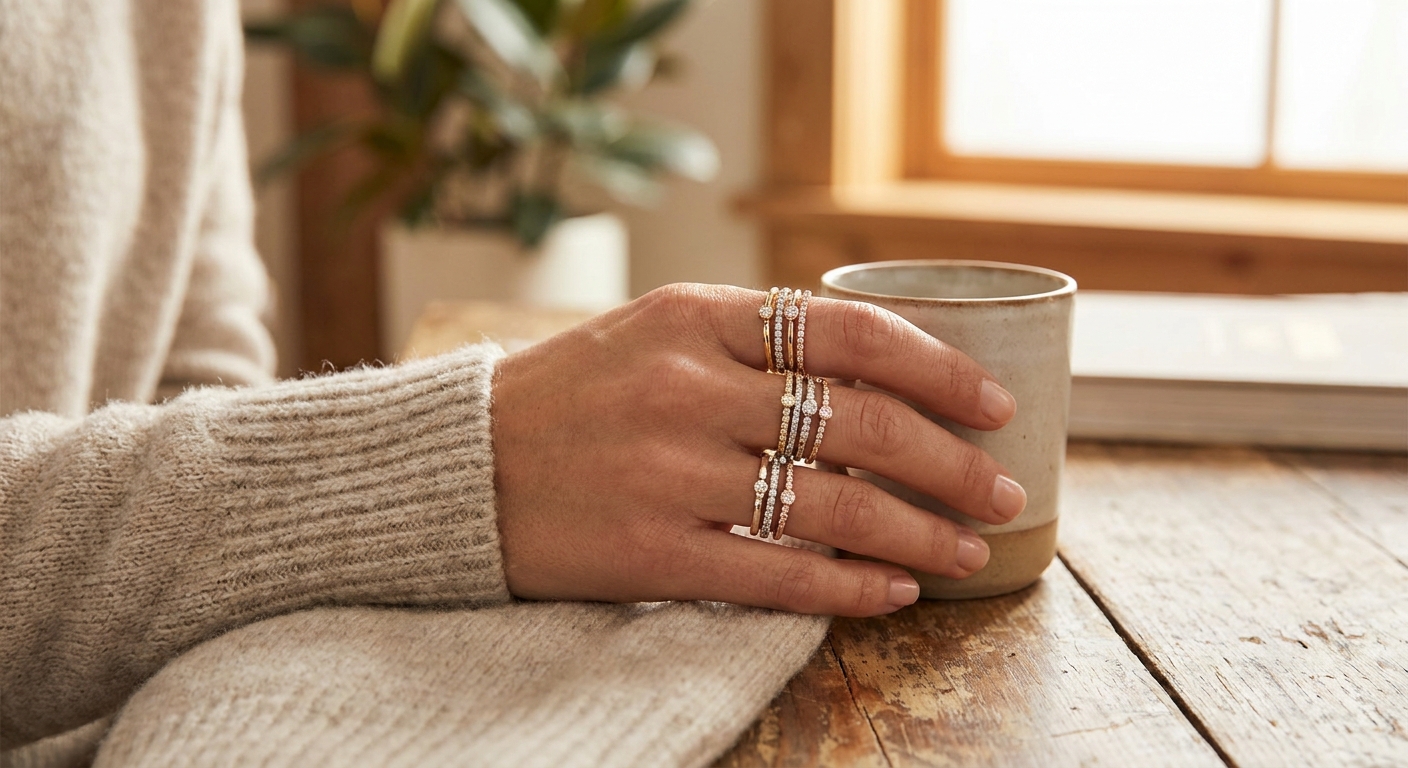
Thin bands, generally under 2mm, sit flatter against each other and against your skin, which matters when you're typing, gripping a steering wheel, or pulling on gloves all day. Wide bands look substantial in a single-ring photo but crowd a stack and catch on fabric within weeks. If you're stacking three or more rings, width discipline matters more than any single design detail.
Metal purity and daily durability
14k gold is the daily-wear standard because it resists bending and scratching better than 18k while still reading as fine jewelry rather than costume metal. 18k gold is softer and shows wear faster on a ring that never comes off, though it polishes back to a shine more easily at a jeweler. Sterling silver and gold-plated pieces do not belong in an everyday stack — plating wears through in months, not years.
Stone setting security
Bezel and flush settings protect diamonds from daily impact better than high prongs, which snag on sweaters and loosen faster with repeated knocks. A stack you wear to the gym or while doing dishes needs settings that sit close to the band, not stones perched high enough to catch on everything. Ask specifically about setting height before buying a stacking piece with a diamond you plan to wear daily.
Mixing metals and finishes
A stack that mixes yellow, white, and rose gold reads as intentional and current in 2026, but only if the pieces share a similar band width and finish quality. Matte and hammered finishes hide daily scratches better than high-polish bands, which show every mark within the first month of wear. Designers built around mixed-metal stacking, rather than single-metal collections, tend to solve this proportion problem for you.
Ring size and finger tolerance
Fingers swell throughout the day and across seasons, so a stack sized perfectly in the morning can feel tight by evening. Leave slightly more room on stacking bands than you would on a single ring, since three snug rings compound into real pressure on the knuckle. If you're stacking on multiple fingers, expect to size each ring independently rather than assuming one size fits all your fingers.
Top picks for everyday stacking
Spinelli Kilcollin — the wildcard. Interlocking, linked ring designs are the brand's signature, meaning the rings move and rotate together rather than sitting as separate static bands. That mechanical construction is exactly what an everyday stack needs: less shifting, less gapping, fewer rings that spin around to the wrong side of your finger by noon. Verdict: Buy if you want a stack that behaves like one engineered piece instead of three loose rings.
Artëmer — the sculptural pick. Hand-carved textures and unexpected compositions give Artëmer pieces a dimensional look that reads as more than a plain band without adding bulk. The texture also does double duty hiding the fine scratches that accumulate on any ring worn daily. Verdict: Buy for a stack that wants visual interest without a big stone doing all the work.
Orly Marcel — the minimalist pick. Clean, low-profile bands built for layering make Orly Marcel pieces easy to combine with other designers without visual competition. The restraint here is the point — these rings are meant to sit quietly under three or four others. Verdict: Buy as the foundation layer of a mixed stack.
Petra Class — the statement pick. Bold, mixed-metal compositions with more visual weight per ring make Petra Class pieces stand out even as a single addition to a stack. That same boldness means fewer of them work in an everyday rotation — one Petra Class piece anchors a stack, three of them fight each other for attention. Verdict: Consider as an accent piece, not as the bulk of a daily stack.
Build your stack in person
See band widths and metal finishes side by side at the Cherry Creek boutique.
What to avoid
- High-prong statement rings marketed as "stackable." A tall prong setting snags on sweaters and gets knocked loose faster than a bezel, no matter how the listing describes it.
- Gold-plated stacking sets. Plating wears through at contact points — exactly where stacked rings rub against each other — within months of daily wear.
- Mismatched band widths sold as a "curated stack." If one ring is 4mm and the next is 1.5mm, the thin one gets buried and the wide one dominates; proportion, not just style, has to match.
Verdict comparison
| Designer | Band profile | Best for daily wear | Verdict |
|---|---|---|---|
| Spinelli Kilcollin | Linked, low-profile | Yes — engineered to move together | Buy |
| Artëmer | Textured, mid-profile | Yes — hides daily scratching | Buy |
| Orly Marcel | Thin, minimal | Yes — foundation layer | Buy |
| Petra Class | Bold, sculptural | As an accent only | Consider |
FAQ
What is the best band width for stackable diamond rings for everyday wear?
Bands under 2mm work best for daily stacking because they sit flat against each other without crowding your finger or catching on gloves and fabric. Wider bands can anchor a stack but should be limited to one per hand.
Is 14k or 18k gold better for a daily stack?
14k gold holds up better to daily knocks and bending because it's a harder alloy than 18k. 18k gold is softer and shows scratches sooner but polishes back easily at a jeweler.
Can you mix metals in a stack?
Yes, mixing yellow, white, and rose gold is a common and current look for 2026 stacks. Keep band widths and finish quality consistent across the mixed pieces so the stack reads as intentional.
How many rings should be in an everyday stack?
Most everyday stacks run three to five rings per hand before bulk and weight become impractical for daily tasks. Start with two or three low-profile bands and add pieces over time.
Do bezel settings work for stacking rings?
Bezel and flush settings are the safer choice for daily-wear stacks because they sit close to the band and resist snagging. High prong settings look elegant but loosen faster under daily impact.
Should stacking rings be sized differently than a single ring?
Yes, leave slightly more room than you would for a single ring, since three snug bands compound pressure on the knuckle by the end of the day. Each ring in a multi-finger stack should be sized independently.
Are gold-plated stacking rings worth buying for daily wear?
No, gold-plated rings wear through at contact points within months when worn daily and stacked against other rings. Solid 14k or 18k gold holds finish and value far longer.
One last thing
The rings that survive a decade of daily stacking are rarely the ones that photographed best in the store — they're the ones with the plainest bands and the lowest-set stones, the pieces that let the other rings in the stack do the talking. Buy the quiet one first; add the statement piece once you know how your hand actually wears a stack day to day.