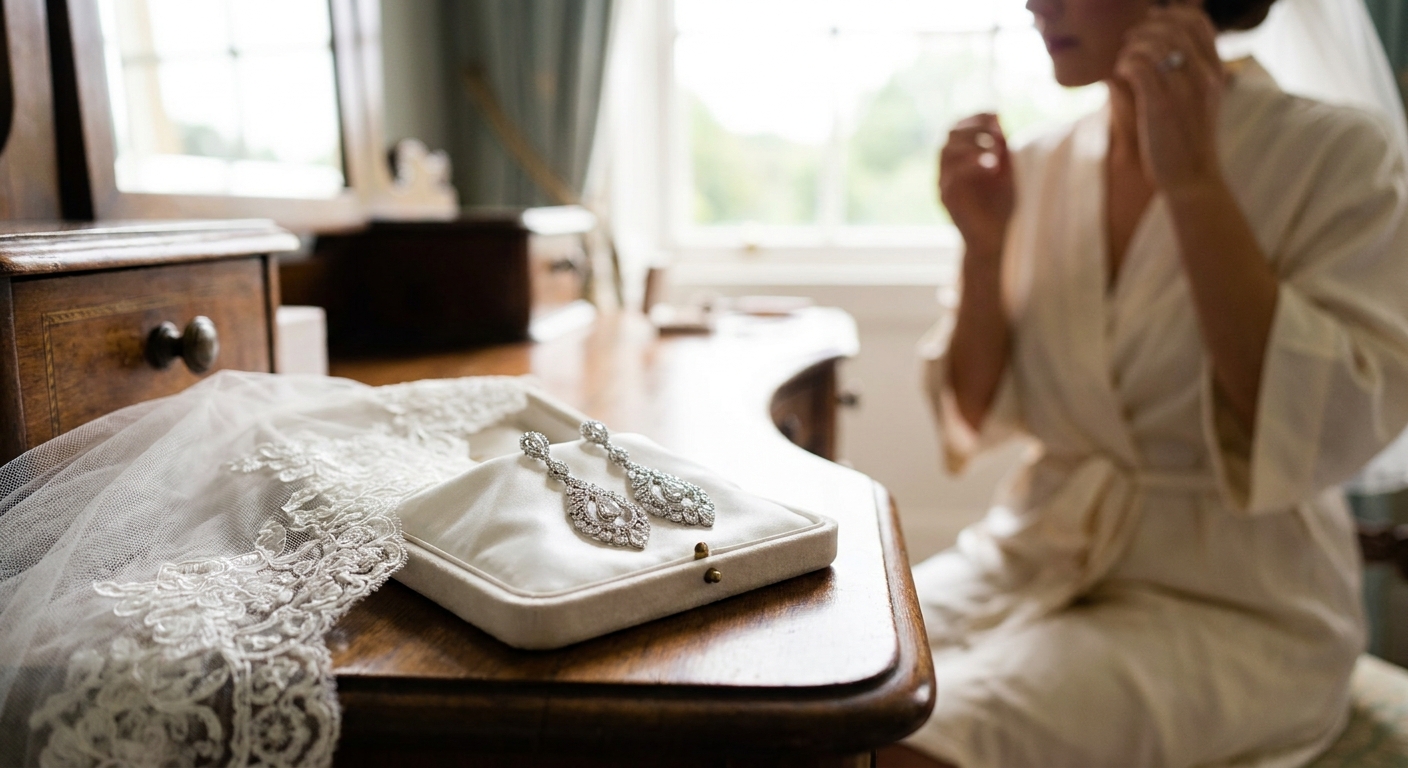
Wedding day earrings sit under a veil, inside a dozen close-up photos, and on your ears for 12 hours straight from getting-ready shots to the last dance — the wrong pair chafes, slips, or disappears in flash photography. This guide breaks down what actually matters when picking designer diamond earrings for a wedding day, and which styles hold up past hour six.
- Diamond studs at 0.5 to 1.5 carats total weight are the safest designer diamond earrings for a wedding day: Buy.
- Huggie hoops under 10mm move with hair and veil without snagging: Buy for ceremonies with movement or wind.
- Chandelier drops over 2 inches photograph beautifully but pull on the earlobe past hour six: Consider only for short receptions.
- Cluster and halo styles echo a diamond ring's sparkle at a lower cost per carat: Buy for brides matching a halo engagement ring.
Why this matters
A bride tries on rings for months but often picks earrings the week of the wedding, which is backwards. Earrings are in more photos than the ring — every close-up, every profile shot, every moment someone leans in during the ceremony. At a Cherry Creek, Denver boutique built around custom bridal pieces, the earring conversation usually comes down to three things: will it hurt by cocktail hour, will it read well in photos, and does it match the metal already committed to on the hand. Get those three right and the rest is styling. Element 79's collection leans toward designer pieces built for exactly this kind of long-wear, high-visibility day.
Who this is for
This guide is for a bride choosing earrings for her own ceremony and reception — not a guest, not a bridesmaid buying a gift. It assumes a wear window of 8 to 14 hours, a photographer capturing close-ups, and a preference for designer fine jewelry over costume pieces that tarnish or lose stones by the second dance. It also assumes the earrings need to coexist with an engagement ring, a veil or updo, and possibly a family heirloom already in the mix.
What to look for in designer diamond earrings for a wedding day
Wear time comfort
A 12-hour day means the earring backing matters more than the stone. Push-back posts and secure 4-prong settings hold up better than screw-backs that loosen with head movement, and lever-back designs stay put through a first dance without re-tightening. Anything that pinches in the store will pinch worse by hour eight.
Clarity and cut for flash photography
VS1-VS2 clarity diamonds in a round or cushion cut throw more light back at a camera flash than lower-clarity stones, which matters more for earrings than for a ring worn at arm's length. A well-cut stone at 0.5 carats can outperform a poorly cut 1-carat stone in every photo from the day.
Setting security
Bezel settings protect the stone during a hug-heavy reception; open prong settings show more sparkle but catch on veils, hair, and stray fingers. For a wedding day specifically, security beats maximum shine — nobody wants to search a dance floor for a loose diamond.
Proportion to face and veil
Larger drop earrings compete with a cathedral veil or a high neckline for visual attention in photos. Studs and small huggies let the veil and dress lead, while drops work better with hair worn up and a simpler neckline.
Metal match to the ring stack
Earrings in a different metal than the engagement ring photograph as a mismatch in every close-up shot. If the ring is platinum or white gold, the earrings should follow, and the same goes for yellow or rose gold. Pairing decisions get easier once the ring metal is locked, which is one reason to settle on designer engagement rings for a modern bride before finalizing earrings.
Versatility after the wedding
A $2,000+ pair of earrings worn once is a harder purchase to justify than one that works for a 20th anniversary dinner or a client meeting in 2027. Studs and small huggies win here; oversized chandeliers rarely leave the jewelry box again.
Top picks by style
Classic diamond studs — the safe pick. A 4-prong martini setting at 0.5 to 1.5 carats total weight reads clean in every photo angle and never snags on a veil. They transfer straight into everyday wear after the wedding, unlike anything more dramatic. Buy.
Diamond huggie hoops — the all-day pick. Anything under 10mm in diameter sits close enough to the earlobe that it survives hair changes, a first dance, and a veil removal without catching. Brides doing an outdoor ceremony with wind should default here over dangles. Buy.
Diamond drop or dangle earrings — the photography pick. A 1 to 2 inch drop length catches camera flash better than a stud and frames the jawline in profile shots. They work best with an updo and a simpler neckline, since a high collar competes with the movement. Consider — skip if hair is worn down or the dress has a high neckline.
Chandelier diamond earrings — the statement pick. These run 2+ inches with more gram weight than a stud, and they photograph as the boldest option in the group. Past a five-hour reception, most brides report ear fatigue and end up switching to a smaller pair before the dance floor opens. Consider for short receptions, Skip for anything over six hours.
Cluster or halo diamond earrings — the budget-flexible pick. Smaller center stones surrounded by a halo read larger than their actual carat weight and echo a halo engagement ring without matching its price. This is a natural pairing for anyone building toward designer engagement rings for a modern bride style stacking. Buy for brides who want ring-and-ear cohesion on a tighter budget.
“If the earring swings past your jaw when you shake your head, it wasn't made for a 12-hour wedding day.”
What to avoid
- Screw-back clips marketed as "secure": they loosen with repeated head movement over a full day and often need re-tightening by the reception, which nobody wants to do mid-photo.
- Asymmetrical or mismatched fashion earrings: trendy in 2026 editorial spreads, distracting in a hundred family photos where consistency reads better than novelty.
- Oversized statement earrings under a cathedral veil: the veil and the earring both want to be the focal point, and in photos neither wins.
Book a bridal fitting
Try on designer diamond earrings against your ring stack before the big day.
Verdict comparison
| Style | Wear comfort (12hr) | Photo impact | Post-wedding wear | Verdict |
|---|---|---|---|---|
| Classic studs | High | Strong, clean | Daily | Buy |
| Huggie hoops | High | Moderate | Daily | Buy |
| Drop/dangle | Moderate | Strong | Occasional | Consider |
| Chandelier | Low past 6hrs | Strongest | Rare | Consider/Skip |
| Cluster/halo | High | Strong | Daily | Buy |
For pairing logic once the ring is settled, how to choose a designer engagement ring walks through the same metal-and-setting decisions that apply to earrings.
FAQ
What's the best carat weight for wedding day diamond earrings?
Most brides land on 0.5 to 1.5 carats total weight per pair in 2026, which reads clearly in photos without adding noticeable ear weight over a 12-hour day. Larger stones photograph well but add fatigue by the reception.
Are diamond studs or hoops better for a wedding?
Studs are the safer pick for maximum photo consistency and post-wedding wear, while huggie hoops under 10mm work better for outdoor ceremonies with wind or movement. Both outperform larger dangles on comfort.
Should wedding earrings match the engagement ring metal?
Yes — earrings in a different metal than the ring create a visible mismatch in close-up photos. Matching platinum, white gold, yellow gold, or rose gold across ring and earrings keeps every shot cohesive.
How much do designer diamond earrings for a wedding cost?
Pricing varies widely by designer, carat weight, and setting complexity, so check current pricing directly with the boutique rather than relying on a general estimate. Cluster and halo styles typically cost less per visual carat than solitaire studs of the same size.
Is it better to buy or rent diamond earrings for a wedding day?
Buying makes more sense for a piece that gets years of repeat wear, like classic studs or small huggies, since rentals rarely offer designer fine jewelry with the same setting security. Rare or one-time statement pieces are the only case where renting is worth considering.
Do drop earrings work with a veil?
Drop earrings work best with a veil when hair is worn up and the neckline is simple, since a high collar or heavy veil competes visually with a longer earring. Studs or huggies are the safer default under a full cathedral veil.
What setting is most secure for a full wedding day?
Bezel settings and secure push-back or lever-back posts hold up best over 12+ hours of hugging, dancing, and veil changes. Open prong settings show more sparkle but catch more easily on hair and fabric.
Can the same earrings work for the ceremony and reception?
Yes, and most brides in 2026 choose one pair for the entire day rather than swapping mid-event, which is another reason comfort matters more than maximum drama. Studs, huggies, and cluster styles all hold up across both parts of the day.
One last thing
The earring decision that gets overlooked most: trying pieces on with the actual hairstyle and veil, not just in a mirror at a counter. A stud that looks understated alone can disappear completely under a veil, while a drop earring that looks dramatic on its own can look perfectly balanced once hair is pinned back. Bring a photo of the planned hairstyle to the fitting — it changes the recommendation more than any spec sheet does.