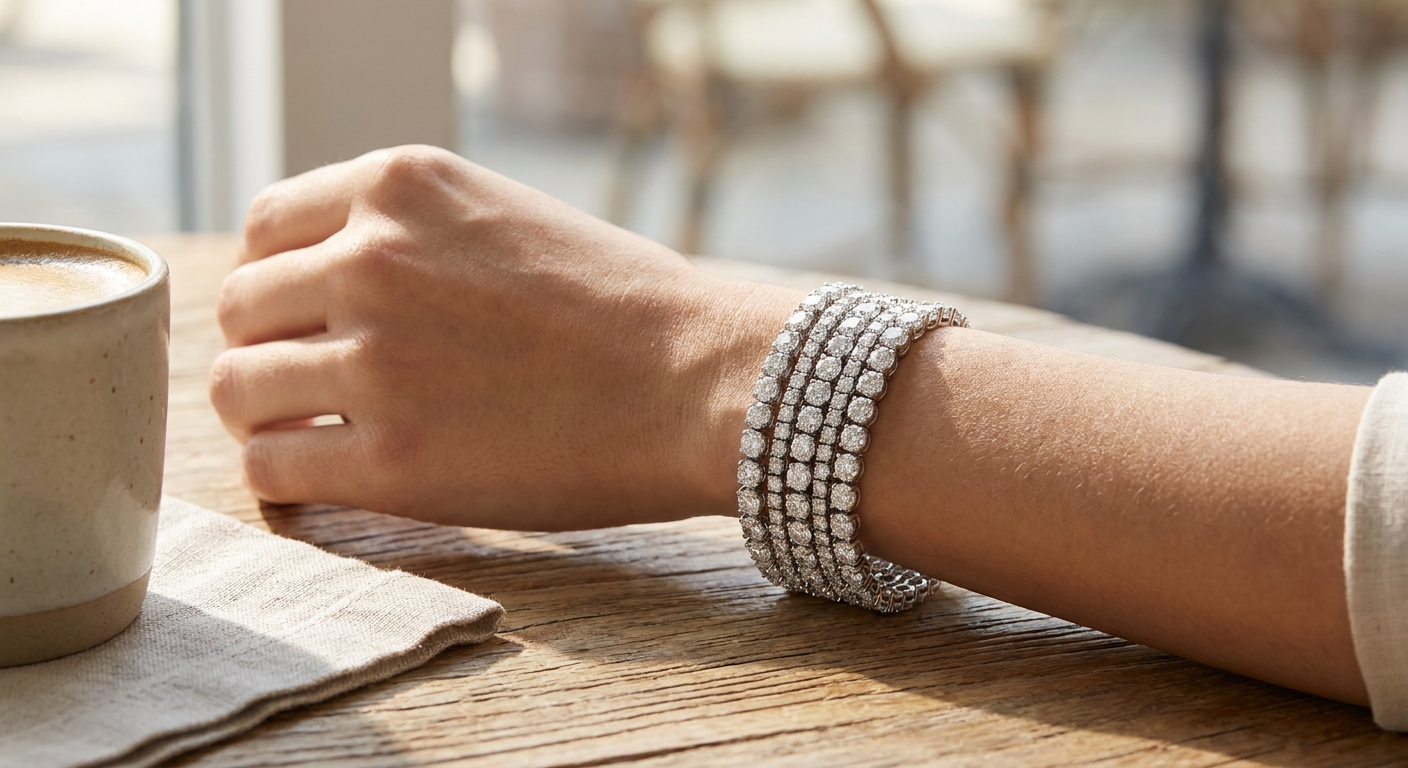
A diamond tennis bracelet is the one piece that goes from a Tuesday coffee run to a black-tie dinner without a wardrobe change, and Element 79 keeps a working eye on which settings actually hold up to daily wear versus which ones look right in a case and loosen within a year.
- Four-prong diamond tennis bracelets from designer lines like Artëmer or Petra Class hold up best for daily wear in 2026 — Buy.
- Shared-prong settings shave cost but expose more metal to scratching; fine for occasional wear only.
- A box clasp with a safety latch is non-negotiable for anyone wearing the bracelet more than twice a week.
- Total carat weight between 3 and 7 carats reads as everyday luxury without dominating a stacked wrist.
- Mixed-metal tennis bracelets pair cleanly with Spinelli Kilcollin stacking rings for a modern, unmatched-metal look.
Who this is for
This guide is for someone who already owns a stack of rings or a favorite pair of hoops and wants a diamond tennis bracelet that earns its keep — worn at the desk, at dinner, on a plane — not a piece that lives in a safe deposit box. If you're shopping for a single statement bracelet for one gala, the calculus changes; this is for the buyer who wants daily rotation.
Why this matters
A tennis bracelet that isn't built for daily wear fails in predictable ways: prongs bend, clasps pop, and the line stretches unevenly at the wrist crease within 12 to 18 months. Fine jewelry retailers see the same repair patterns every year — the bracelet gets worn constantly, nobody removes it for the gym or the shower, and the weakest link in the chain (literally) gives out first. Buying with everyday wear in mind up front costs less than a repair cycle later.
What to look for in diamond tennis bracelets for everyday luxury
Setting style
Four-prong settings distribute stress evenly across each stone and are the standard for bracelets meant to be worn daily rather than saved for occasions. Shared-prong and channel settings look sleeker but concentrate wear on fewer contact points, so a snagged sleeve or a hard bump against a desk edge does more damage. If daily wear is the goal, prong count matters more than the cut of the diamond itself.
Diamond cut and total carat weight
Round brilliant and cushion cuts hide small chips better than emerald or baguette cuts, which show damage along sharp edges. For an everyday piece, a total carat weight in the 3-to-7 range reads as polished without turning into a piece you're afraid to bump against a doorframe — heavier lines start to feel like special-occasion jewelry again, both in weight and in the psychology of wearing them out.
Metal and clasp durability
White gold and platinum both wear well daily, but platinum resists the thinning that white gold prongs can show after several years of contact with skin oils and repeated on-off cycles. Whatever the metal, the clasp is the actual weak point on a tennis bracelet — a plain box clasp with no safety latch is the number one reason bracelets end up lost.
Clasp security
A box clasp paired with a figure-eight safety catch is the standard for daily-wear tennis bracelets in 2026, and it's worth checking for on any piece before buying. Bracelets with only a single clasp mechanism are more prone to slipping open during normal hand motion — reaching into a bag, typing, gripping a steering wheel.
Flexibility and articulation
A well-articulated line drapes around the wrist bone instead of sitting rigid, which matters more than people expect until they've worn a stiff bracelet for a full workday. Test this by trying the bracelet on and making a fist — a flexible line moves with the hand, a rigid one digs into the wrist crease.
Stack compatibility
If you already wear rings or bangles daily, check how the tennis bracelet's prongs interact with adjacent metal. Sharp-set stones can snag on open-back ring settings or looped bangles, so a slightly more rounded prong profile is worth prioritizing if the bracelet is joining a busy wrist rather than standing alone.
Top picks for everyday-luxury diamond tennis bracelets
The safe pick — classic four-prong line. A traditional four-prong diamond tennis bracelet in the 3-to-5 carat range is the version most likely to survive years of daily wear without a repair visit, and it pairs with nearly anything already on the wrist. Element 79's designer bracelets for a stacked wrist collection is built around exactly this kind of daily-rotation piece. Verdict: Buy.
The wildcard — mixed-metal line. Pairing a white gold diamond line with yellow or rose gold accents breaks the matchy-matchy rule and photographs better against warmer skin tones. It takes more confidence to style than a single-metal piece and looks intentional only when the rest of the stack commits to the mix. Verdict: Consider.
The occasion-leaning piece — heavier carat line. A tennis bracelet north of 8 carats total weight reads as event jewelry rather than daily wear, no matter how good the setting is — the visual weight alone signals "special occasion" before anyone even asks about the diamonds. Fine for a bridal look or a milestone anniversary gift, less practical for a Tuesday. Verdict: Skip for daily wear, Consider for gifting — Element 79's fine jewelry gifts for a milestone anniversary guide covers this exact use case.
The layering companion — slim shared-prong line. A thinner, lower-carat shared-prong bracelet works well as a second or third piece stacked with a heavier four-prong line, adding sparkle without adding bulk. On its own as a daily-wear-only piece it's more fragile than the four-prong pick above. Verdict: Consider as a stacking add.
What to avoid
- Bracelets with no safety clasp. A single box clasp with no secondary latch is the most common reason tennis bracelets end up lost at the bottom of a bag or on a bathroom floor.
- Ultra-thin channel settings marketed as "everyday." Channel settings look delicate and modern in a case but chip faster under daily contact than prong settings, despite often being marketed toward daily wearers.
- Bracelets sized too loose "for movement." A line that swings freely looks elegant standing still but catches on sleeves, bag straps, and doorknobs constantly through a normal day — proper daily-wear sizing sits snug enough not to rotate past the wrist bone.
Book a fitting for your tennis bracelet
See settings and clasp options in person at the Cherry Creek boutique.
Verdict comparison
| Pick | Carat range | Best for | Verdict |
|---|---|---|---|
| Classic four-prong line | 3-5 ct | Daily wear, first tennis bracelet | Buy |
| Mixed-metal line | 3-5 ct | Styling with an existing mixed-metal stack | Consider |
| Heavier carat line (8ct+) | 8+ ct | Milestone gifting, occasion wear | Consider for gifting |
| Slim shared-prong line | 1-3 ct | Layering with a primary bracelet | Consider as add-on |
A diamond tennis bracelet earns its place in daily rotation when the clasp holds and the prongs don't snag your other pieces — everything else is styling preference.
Once the bracelet is settled, the rest of the wrist and ears tend to follow. Element 79's best designer diamond earrings for everyday luxury guide covers the same daily-wear logic for studs and hoops, and pairing a tennis bracelet with a layered necklace stack rounds out the look without overdoing it — see layering necklaces for everyday wear for the styling rules.
FAQ
What's the best diamond tennis bracelet for everyday wear in 2026?
A four-prong tennis bracelet in the 3-to-5 carat range with a box clasp and safety latch is the best choice for daily wear in 2026. It distributes wear evenly across prongs and the safety clasp prevents loss during normal hand movement.
Is a bezel-set or prong-set tennis bracelet better for daily wear?
Prong-set tennis bracelets, specifically four-prong settings, hold up better to daily wear than bezel or channel settings. Bezel settings protect the stone edges but show wear on the metal rim faster with constant contact.
How many carats should an everyday tennis bracelet have?
A total weight between 3 and 7 carats works best for daily wear, staying substantial without reading as occasion-only jewelry. Anything above 8 carats tends to shift the piece into special-event territory both visually and practically.
Can you wear a diamond tennis bracelet every day?
Yes, a well-constructed tennis bracelet with a secure clasp and four-prong settings is designed for daily wear. Removing it for activities like swimming or heavy manual work still extends its lifespan.
What clasp is safest for a tennis bracelet worn daily?
A box clasp with a figure-eight safety latch is the standard for daily-wear tennis bracelets in 2026. A single clasp mechanism without a safety catch is the leading cause of lost bracelets.
Should a tennis bracelet be tight or loose?
A tennis bracelet should sit snug enough that it doesn't rotate past the wrist bone during normal movement. Too loose and it swings and catches on sleeves and bag straps constantly through the day.
Can you stack a tennis bracelet with other bracelets?
Yes, a slimmer shared-prong or lower-carat line stacks well alongside a primary four-prong tennis bracelet. Check that the prong profiles are rounded enough not to snag on adjacent pieces.
What metal holds up best for a daily-wear tennis bracelet?
Platinum resists thinning better than white gold over years of daily contact with skin oils and repeated wear. White gold is still a solid daily-wear choice but may need re-plating sooner.
One last thing
The detail most buyers skip is testing the clasp one-handed before buying — if you can't open and close it yourself without help, you won't wear the bracelet daily no matter how much you love the setting. That single test filters out more "beautiful but impractical" tennis bracelets than any carat or cut consideration.