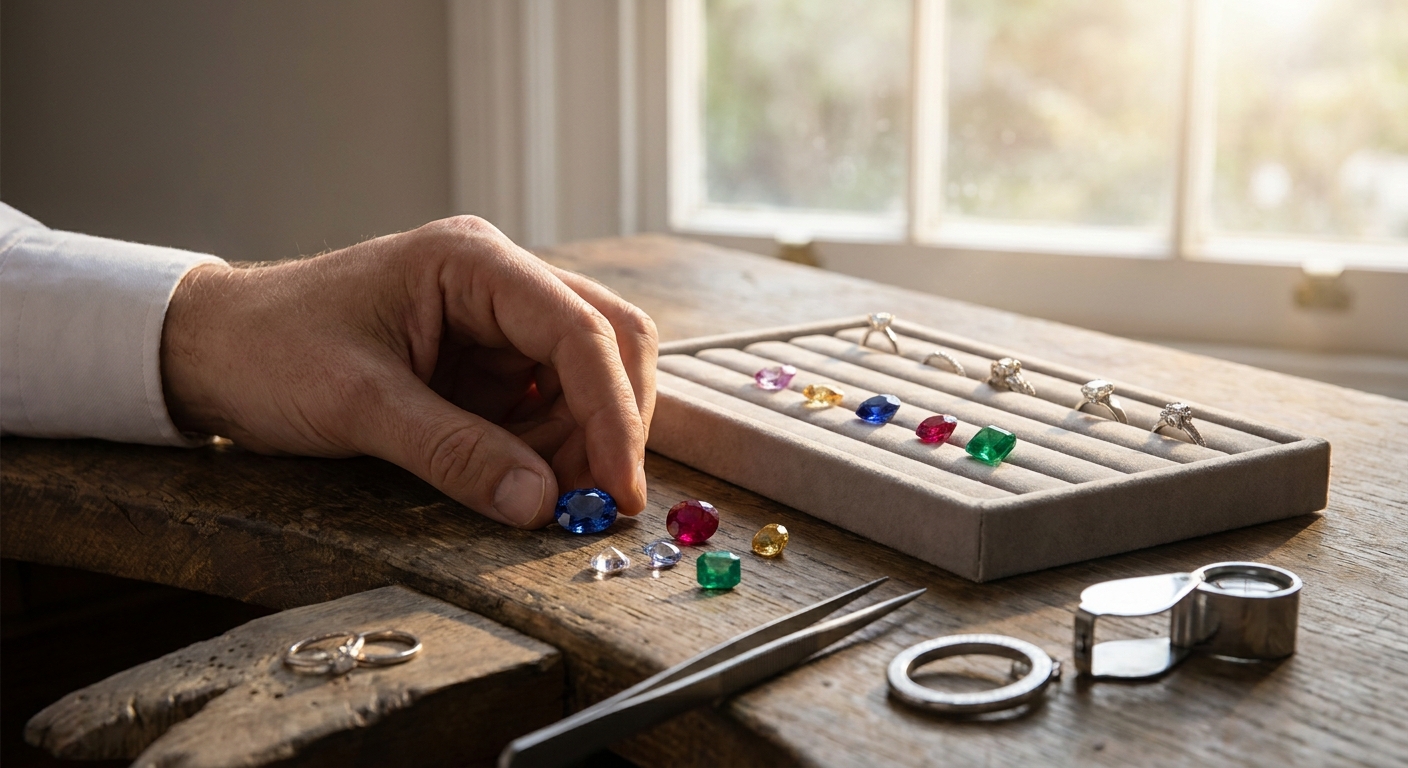
Choosing a gemstone for an engagement ring means balancing four things at once: how hard the stone is, how it reads in daylight versus lamplight, what it does to your budget, and whether it still looks right in ten years of everyday wear. This guide walks through the decision step by step so you don't end up re-selecting a stone six months after the ring is set.
- Diamond and sapphire (Mohs 9-10) hold up best for daily wear; morganite and opal need a protective setting.
- Color and clarity move the price more than carat weight in 2026 — a 1.2ct near-colorless stone often beats a flawless 1.5ct.
- Colored stone engagement rings from designers like Orly Marcel and Petra Class are the fastest-growing request at Element 79 in 2026.
- Get any stone over $2,000 independently appraised before the wedding, not after.
Why this matters
A gemstone is the one part of an engagement ring you can't easily swap later without resetting the whole piece. Pick a stone that's too soft for how someone actually lives and you're looking at chips or clouding inside two years. Pick a color that photographs badly under office lighting and every anniversary photo argues with you about it.
Element 79 works with couples in Cherry Creek who come in set on a diamond and walk out with a sapphire, or the reverse, once they see the stones side by side in daylight. The right choice depends on wear pattern, skin tone, and how much of the budget is earmarked for the stone versus the setting — not on what's trending on social media in 2026.
What you'll need
- A realistic budget split: stone versus setting (stones typically run 40-70% of total cost)
- A sense of daily wear habits — gym, manual work, an office job that's mostly typing
- Skin tone and existing jewelry metal preference (yellow gold, white gold, platinum)
- 30-45 minutes to view stones under both daylight and indoor lighting
- A grading report (GIA or equivalent) request ready for any stone over 1 carat
- Patience for at least two viewing sessions before deciding
The steps
1. Rank hardness against how the ring will actually be worn
The Mohs scale runs from 1 to 10, and it's the single best predictor of long-term wear. Diamond sits at 10, sapphire and ruby at 9, moissanite around 9.25 — all safe for someone who wears the ring cooking, gardening, or at the gym. Morganite, opal, and emerald fall between 6.5 and 8, which is fine for someone with a desk job but risky for anyone using their hands hard daily. The common mistake here is falling for a soft stone's color and skipping this check entirely — ask directly how the wearer spends their hands during a typical week before falling in love with a stone.
2. Decide traditional versus colored before you start browsing
Diamonds and sapphires cover roughly 70% of engagement ring requests walked in the door in 2026, but colored stones from designers like Orly Marcel and Petra Class have grown fastest as a category this year. Deciding this upfront saves an entire viewing session — a colored-stone shopper looking at traditional diamond solitaires is browsing the wrong case. If a colored centerpiece with a modern setting is the direction, designer engagement rings for a modern bride is the faster starting point than a generic diamond search.
3. Weigh color and clarity over carat weight
Carat weight is the number everyone fixates on, but color grade (D-Z) and clarity (FL-I3) move price and visual impact more per dollar. A well-cut 1.2 carat stone graded G-H color, VS2 clarity, often looks brighter and cleaner than a poorly cut 1.5 carat stone with warmer color. Expected outcome: you land on a stone that photographs white and clean rather than one that's simply bigger. The mistake to avoid is comparing two stones by carat alone without asking for the cut grade.
4. Check the stone under two lighting conditions
Jewelry store lighting is engineered to make every stone sparkle — it's not a fair test. Ask to step outside or near a window for 60 seconds with each finalist stone, then compare again under regular indoor lighting. A stone that looks icy blue-white in the store can read slightly yellow in daylight, and that's information you need before, not after, purchase.
5. Match the setting to the stone's hardness, not just its looks
A prong setting exposes more of a soft stone to knocks; a bezel setting protects it. Sapphire and diamond tolerate prongs fine at 9-10 Mohs hardness. Morganite or opal at 6.5-7.5 do better in a bezel or halo that shields the girdle edge. Skipping this step is the number one reason soft-stone rings come back for repair within the first year.
6. Set the budget split before falling for a specific stone
A common ratio in 2026 is 50-60% of total ring budget on the stone, 40-50% on setting and metal — though custom bridal work can shift that depending on the design. Decide this split in dollars before viewing stones, or the highest-color, highest-clarity option in the case will always look like the right answer regardless of price.
7. Get a grading report and appraisal before the wedding
Any stone over roughly $2,000, and every diamond over 0.75 carats, should come with an independent grading report — GIA is the standard reference in the US. Request the appraisal at purchase, not six months later when it's harder to track down documentation. Expected outcome: a paper trail for insurance and resale that matches exactly what's set in the ring.
See the stones in person
Compare diamond, sapphire, and colored stone options side by side in Cherry Creek.
Troubleshooting
- Stone looks different at home than in the store. Store lighting is designed to maximize sparkle. Always check a finalist stone in daylight and under a regular lamp before committing.
- Partner hints they wanted a different stone after the proposal. Custom resetting is common in 2026 bridal work — a colored stone can often be reset into a new design without starting from scratch on the metal band.
- Budget won't stretch to the desired carat weight. Drop carat weight slightly and hold color and clarity grade steady; a smaller, cleaner stone reads better than a larger stone with visible inclusions.
- Stone shows wear (chips, cloudiness) within the first year. This almost always traces back to a hardness mismatch with lifestyle — a softer stone in a high-impact daily setting. A bezel reset reduces future risk.
- Ring looks smaller than expected once set. Setting style changes perceived size more than actual carat weight — a halo setting adds visual size around a smaller center stone without changing the budget much.
Tools and resources
- GIA or equivalent grading report for any stone purchase over roughly $2,000
- A jeweler's loupe (10x) for checking clarity yourself before purchase
- How to choose a designer engagement ring for setting and metal decisions once the stone is set
- Two lighting environments (daylight plus indoor lamp) for the final comparison
- A written budget split between stone and setting before the first viewing appointment
What to do next
Once the stone and setting style are decided, the next decision is design direction — classic solitaire versus a sculptural, modern build. That comparison lives in the guide to picking a full ring design rather than just a stone, and it's worth reading before locking in a final choice for 2026.
FAQ
What's the best gemstone for an everyday engagement ring?
Diamond and sapphire are the best gemstones for everyday wear because both sit at 9-10 on the Mohs hardness scale and resist chipping under daily impact. Moissanite, at roughly 9.25, is a durable and less expensive alternative to diamond.
Is sapphire better than diamond for an engagement ring?
Neither is universally better — sapphire offers color variety and typically costs less per carat than a comparable diamond, while diamond offers maximum brilliance and the widest resale market. The right pick depends on whether color or classic sparkle matters more to the wearer.
How much does a gemstone engagement ring cost in 2026?
Cost varies widely by stone type, size, and grade, with the stone typically representing 40-70% of total ring price in 2026. Colored stones from designer collections often cost less per carat than an equivalent-quality diamond.
Are colored gemstones durable enough for engagement rings?
It depends on the specific stone — sapphire and ruby at 9 Mohs hardness are as durable as diamond, while morganite and opal at 6.5-7.5 need a protective bezel setting to avoid daily wear damage.
Should carat weight or clarity matter more when choosing a gemstone?
Clarity and color grade affect visual quality more than carat weight per dollar spent. A smaller, well-cut, high-clarity stone typically looks brighter than a larger stone with visible inclusions.
Can a gemstone be reset into a new ring later?
Yes, most gemstones including diamonds and sapphires can be removed and reset into a new design without damage, which is common practice in custom bridal work in 2026.
What setting protects a soft gemstone best?
A bezel setting, which wraps metal around the stone's edge, protects softer gemstones like morganite and opal better than an open prong setting exposes the girdle to daily knocks.
Do I need an appraisal for an engagement ring gemstone?
Yes, any stone over roughly $2,000 should have an independent grading report and appraisal at time of purchase for insurance and resale documentation, not requested later.
One last thing
The stone that photographs best under a phone camera's flash is rarely the stone that looks best in person under daylight — check both before deciding, since most 2026 proposals get documented within minutes of happening. If the choice is close between two stones, pick the one that held up better outdoors, not the one that sparkled hardest under the store's spotlights.