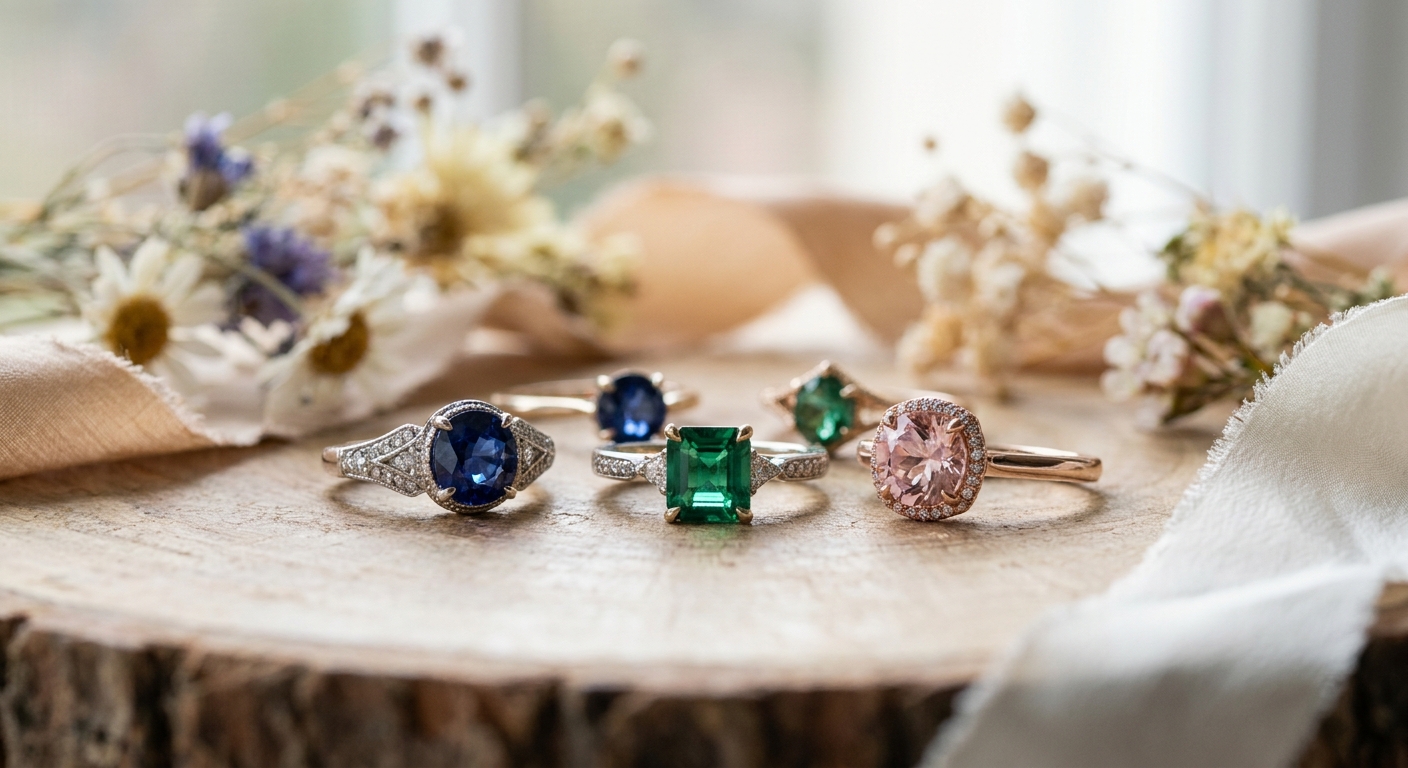
Non-diamond brides in 2026 want a center stone with personality, not just sparkle, and picking the right gemstone means weighing durability against color against how the ring will actually hold up after five years of daily wear.
- Sapphire is the best gemstone engagement ring for daily wear at Mohs 9 hardness — buy it in 2026.
- Moissanite beats diamond on refractive brilliance and costs a fraction as much — buy it for budget-conscious brides.
- Emerald and morganite need protective settings; both score 7.5-8 on the Mohs scale — consider, don't rush.
- Aquamarine is the wildcard: gorgeous color, softer stone — wait unless it's a special-occasion ring.
- Element 79 works with artisan designers like Petra Class and Artëmer for custom gemstone bridal settings.
Why this matters
A diamond isn't automatically the safe choice, and a colored stone isn't automatically fragile — the gap between the two comes down to hardness, treatment, and how the setting protects the stone. Brides picking a best gemstone engagement ring in 2026 are choosing a piece meant to survive dishwashing, gym sessions, and forty years on one hand, so the stone's Mohs rating matters more than its Instagram appeal. Choosing a designer engagement ring starts with understanding which stones can take that kind of daily abuse and which ones are better suited to occasion pieces.
Color also isn't a personality quiz — it's chemistry. Corundum (sapphire and ruby) and moissanite sit at the top of the hardness scale; beryls (emerald, morganite, aquamarine) sit a full point and a half lower. That gap explains almost every durability complaint jewelers hear from colored-stone brides five years into wearing the ring.
How we ranked these gemstones
Each stone below is scored against the GIA-standard Mohs hardness scale, typical treatment disclosure practices in 2026, relative cost per carat against diamond, and how each performs specifically in a ring worn daily versus a ring reserved for evenings out. This isn't a beauty contest — a stone can be gorgeous and still rank low here if it chips on a doorframe. Durability for daily wear carries the most weight, because an engagement ring gets worn every day, not just on the wedding day.
The ranked list
1. Sapphire — the safe non-diamond pick
Sapphire sits at Mohs 9, one step below diamond's 10, which makes it the most durable colored stone available for daily wear. Blue is the classic choice, but sapphire comes in pink, yellow, and green varieties too, giving brides color options without sacrificing toughness. Treated sapphires (heat-treated to improve clarity) are standard in the trade in 2026 and should be disclosed by any reputable dealer.
Verdict: Buy. Sapphire is the closest thing to a diamond substitute that still reads as intentionally different.
2. Moissanite — the budget-conscious sparkle
Moissanite scores Mohs 9.25, technically harder than sapphire, and has a higher refractive index than diamond, which means more fire and rainbow flash under light. Lab-grown moissanite runs a fraction of diamond's per-carat cost at equivalent size, which is why it's become the go-to for brides who want a bigger stone on a tighter number. Some brides love the extra sparkle; others find it too flashy next to a diamond's cooler brilliance.
Verdict: Buy for anyone prioritizing size and durability over a traditional diamond look.
3. Emerald — the statement stone
Emerald ranks 7.5-8 on the Mohs scale, softer than sapphire and moissanite, and almost always contains natural inclusions jewelers call "jardin" (garden) — a fingerprint of the stone's formation rather than a flaw to hide. That internal structure makes emerald more prone to chipping on a sharp hit, so the setting has to do real protective work: bezel or half-bezel settings with a low profile perform far better than exposed prong settings for everyday wear. The green saturation on a top emerald is unmatched by any other stone on this list.
Verdict: Consider — stunning in a protective setting, risky in an exposed one. Designer engagement rings for a modern bride covers setting styles that work specifically for softer center stones.
4. Morganite — the romantic blush pick
Morganite shares emerald's beryl family hardness at 7.5-8, but its pale pink-to-peach color has made it one of the fastest-growing requests among non-diamond brides through the mid-2020s. The color reads soft and romantic under warm light and pairs especially well with rose gold settings. It's more forgiving on inclusions than emerald, so clarity issues are less of a concern at the point of purchase.
Verdict: Consider for brides prioritizing color and softness over maximum durability.
5. Ruby — the bold red statement
Ruby is corundum, the same mineral family as sapphire, which puts it at Mohs 9 — genuinely tough enough for daily wear. Pigeon's-blood red rubies command premium pricing at larger carat weights, often exceeding comparable diamonds per carat once you cross the two-carat mark. Below one carat, ruby remains one of the more accessible colored stones for the hardness it delivers.
Verdict: Buy under one carat; Hold and budget carefully above it.
6. Aquamarine — the wildcard
Aquamarine's pale blue color feels bridal without being predictable, but it shares the 7.5-8 hardness of its beryl relatives, sitting a step and a half below sapphire and ruby. Large, clean aquamarines are relatively affordable compared to sapphire at the same size, which makes big center stones tempting. That size, combined with lower hardness, is exactly why aquamarine performs better as a right-hand or occasion ring than a daily-wear engagement ring.
Verdict: Wait on aquamarine for an everyday engagement ring — better suited to a piece worn less often.
Talk through gemstone options
See custom bridal settings from Artëmer, Petra Class, and Spinelli Kilcollin.
Comparison table
| Gemstone | Mohs Hardness | Best For | Verdict |
|---|---|---|---|
| Sapphire | 9 | Daily wear, classic color options | Buy |
| Moissanite | 9.25 | Maximum sparkle on a budget | Buy |
| Ruby | 9 | Bold color, small-to-mid carat | Buy under 1ct |
| Emerald | 7.5-8 | Statement color in protective settings | Consider |
| Morganite | 7.5-8 | Soft, romantic color palettes | Consider |
| Aquamarine | 7.5-8 | Occasion pieces, not daily rings | Wait |
Brides who want the color commitment of a gemstone but the practicality of a daily-wear setting often land on stackable diamond rings worn alongside a colored center stone — the diamond band absorbs the daily knocks while the gemstone stays the focal point.
What to avoid
- Untreated, uncertified rubies and sapphires sold at diamond-adjacent prices. Ask for a lab report every time — treatment disclosure is standard practice in 2026, and its absence is a red flag, not an oversight.
- Prong-heavy settings on emerald or morganite. These stones chip at the edges; a protective bezel or halo does more for longevity than a higher-carat stone in a fragile setting.
- Skipping the resize-and-inspect conversation. Colored stones react differently to heat and pressure during resizing than diamonds do — any jeweler resizing the ring later needs to know exactly what stone they're working around.
For brides set on something genuinely one-of-a-kind, the guide to unique proposal rings walks through sourcing considerations specific to non-traditional center stones.
Where to buy
- Work with a boutique that discloses origin and treatment on every colored stone, not just the ones you ask about directly.
- Ask whether custom bridal work is available. Element 79 in Cherry Creek, Denver, works directly with artisan designers including Artëmer, Orly Marcel, Spinelli Kilcollin, and Petra Class on custom bridal pieces, which matters when a standard prong setting won't protect a softer stone.
- Get the Mohs hardness and treatment history in writing before final purchase, not verbally at the counter.
FAQ
What is the best gemstone engagement ring that isn't a diamond?
Sapphire is the best gemstone engagement ring for most brides in 2026, scoring Mohs 9 for durability while offering color options beyond classic blue. Moissanite is the runner-up for brides prioritizing size and sparkle over a traditional diamond look.
Is sapphire more durable than emerald?
Yes, sapphire scores Mohs 9 versus emerald's 7.5-8, making sapphire noticeably more resistant to daily chipping and scratching. Emerald can still work as an engagement ring stone, but it needs a protective bezel or half-bezel setting.
How much does a moissanite engagement ring cost compared to diamond?
Moissanite typically costs a fraction of a diamond's price at the same visual carat size, which is the main reason it has grown in popularity through 2026. It also outperforms diamond on refractive brilliance, giving it more colored flash under light.
Are colored gemstone engagement rings less durable than diamond rings?
It depends entirely on the stone. Sapphire, ruby, and moissanite all score Mohs 9 or higher, matching diamond-adjacent durability, while emerald, morganite, and aquamarine sit at 7.5-8 and need more protective settings.
What's the best gemstone for a ring worn every single day?
Sapphire and moissanite are the best gemstones for daily wear because both score above Mohs 9, resisting scratches from keys, countertops, and gym equipment. Softer stones like morganite or aquamarine hold up better as occasion rings worn less frequently.
Can I get a custom gemstone engagement ring made?
Yes, custom bridal work is available through boutiques that partner directly with artisan designers rather than selling only mass-produced settings. Element 79 in Cherry Creek, Denver works with designers like Petra Class and Spinelli Kilcollin on custom gemstone bridal pieces.
Is morganite a good stone for an engagement ring?
Morganite works well for brides who prioritize its soft pink-to-peach color over maximum hardness, scoring 7.5-8 on the Mohs scale. It performs best in protective settings and pairs particularly well with rose gold.
Does ruby cost more than diamond in an engagement ring?
Above roughly two carats, fine pigeon's-blood ruby can cost more per carat than a comparable diamond, while smaller rubies under one carat remain more accessible. Ruby's Mohs 9 hardness makes it genuinely durable enough for daily engagement ring wear at any size.
One last thing
The stone most non-diamond brides overlook entirely is spinel — Mohs 8, comes in nearly every color sapphire does, and has none of the price inflation that decades of marketing put on ruby and sapphire. It's not on most bridal radar yet in 2026, which is exactly why the brides who find it end up with the most distinctive ring in the room.