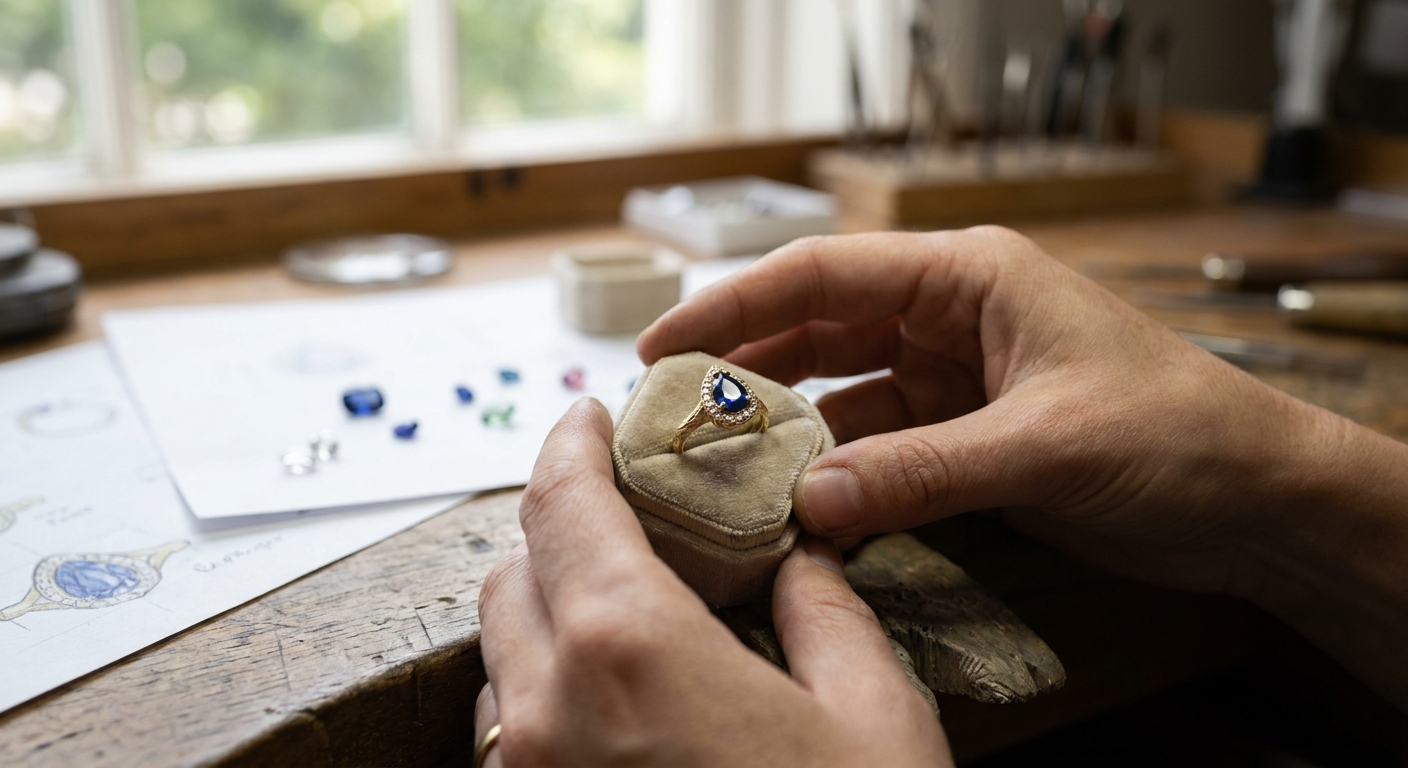
A custom engagement ring means the setting gets built around a stone you actually chose, not pulled from a case with a SKU number. This guide covers what separates a real custom build from a relabeled catalog ring in 2026, and which routes are worth taking for a proposal that isn't generic.
- Custom engagement rings work when the gemstone is picked first and the setting is built around it — Buy that order.
- Spinelli Kilcollin's connected-ring architecture stacks without a custom build at all — Consider before commissioning anything.
- Skip 'semi-custom' settings that only swap a stone size — that's resizing, not custom work.
- A real custom build needs 6-10 weeks in 2026 for a wax mockup and a fitting, not a rush job.
- Sapphire and emerald builds need a setting rated for daily wear, not just display.
Why this matters
Most people searching "custom engagement ring" in 2026 get sold a stock setting with a different name on the invoice. That's not a criticism of the jeweler — it's a definition problem. A genuinely custom engagement ring starts with a conversation about the stone, the hand, and the story, then gets drawn, cast, and fitted specifically for that ring. Element 79 works this way with artisan lines like Artëmer, Orly Marcel, Spinelli Kilcollin, and Petra Class, which matters because the difference between custom and semi-custom shows up in how the ring wears five years out, not on the day you propose.
Who this is for
This is for couples who've already decided a mass-market solitaire won't do — you want a stone with color, a setting nobody else's cousin has, or a design that references something specific between the two of you. It's also for the partner planning the proposal solo, without the other person's input on the exact ring, who needs a process that can move on a deadline without cutting corners on the build.
What to look for in a custom engagement ring
The gemstone drives the design, not the other way around
A real custom process starts with the stone — cut, color, and clarity — and the setting gets engineered around those specific proportions. If a jeweler shows you setting options before you've picked a stone, you're being sold a template. Understanding how to choose a gemstone for an engagement ring before you talk settings puts you in control of the build order, not the other way around.
A setting built for daily wear, not just the proposal photo
Some stones look dramatic in renderings but need serious metal support to survive a decade of daily wear. Sapphire rates a 9 on the Mohs hardness scale, which makes it one of the few colored stones that holds up next to a diamond in daily use — emerald sits closer to 7.5-8 and needs a protective setting style. Ask for the specific setting style (bezel, halo, cathedral) and why it fits the stone's hardness, not just its color.
Metal that works with future stacking
If either of you already wears rings daily, or plans to add a wedding band later, the custom build needs to account for how it sits against other pieces. Rings built with wide shoulders or high domes can crowd a wedding band and shift out of alignment within months. This matters even more if you're building toward a stacked look over time rather than a single ring forever.
A design process with real revisions, not a one-shot form
A custom build should include at least one round of sketches or CAD revisions before casting — a jeweler who casts straight from your first description isn't doing custom work, they're doing a rush order. Ask specifically how many revision rounds are included and at what stage changes stop being free.
A timeline that actually matches your proposal date
A legitimate custom engagement ring build runs 6 to 10 weeks in 2026 once the stone is sourced — that covers CAD, wax mockup, casting, stone setting, and a fitting. If a jeweler quotes two weeks for a fully custom piece with a fitting included, something in that process is being skipped, and it's usually the mockup stage.
Top picks for a unique proposal
The color-first pick. Building around a colored gemstone instead of a diamond changes the whole conversation with a jeweler — you're now designing around a specific hue and cut rather than the four Cs of a colorless stone. Sapphire and emerald both work in 2026 designs that skip the traditional solitaire entirely. Buy if you want the ring to read as unmistakably custom the moment someone sees it.
The unique-proposal build. For couples who want the setting itself to be the unusual part — sculptural bands, asymmetric prongs, mixed metal accents — the designer engagement rings for a unique proposal route works from a base design that still gets customized to the stone and hand size. Buy if you want less lead time than a fully from-scratch build but still want a one-of-one result.
The stackable modern pick. Spinelli Kilcollin's connected-ring architecture is built to interlock without a custom commission — you can build a stack over years instead of committing to one ring's final look on day one. Consider this route if the proposal ring is meant to be the first piece in a longer stack, not the finished statement.
The non-traditional stone pick. A sapphire build sidesteps the diamond conversation entirely and gives you a stone hard enough for daily wear at a fraction of the size premium diamonds carry at equivalent carat weight. Consider if color matters more to your partner than brilliance.
The heirloom remount. Taking a family stone and building a new custom setting around it sounds simple but requires the jeweler to assess the stone's condition before design starts — some older stones have inclusions that limit setting style options. Skip rushing this option; get the stone evaluated at least 8 weeks before you need the ring.
Start your custom ring design
Book a consultation to plan a build around your stone and timeline.
What to avoid
- "Semi-custom" settings marketed as bespoke. If the only variable is stone size on a fixed template, that's resizing, not a custom engagement ring — ask directly whether the CAD file is unique to your build or reused.
- Renderings with no physical mockup step. A CAD image looks finished but tells you nothing about how the ring sits on an actual hand. Insist on a wax or 3D-printed mockup before casting, especially for anything with asymmetric prongs.
- Compressed timelines under four weeks for a from-scratch build. Anything faster than that on a genuinely custom piece usually means the stone-setting and quality-control steps got shortened, not eliminated.
Verdict comparison
| Pick | Gemstone flexibility | Stack-ready | Timeline fit (2026) |
|---|---|---|---|
| Color-first custom build | High | Moderate | 6-10 weeks |
| Unique-proposal designer build | Moderate | Moderate | 4-6 weeks |
| Spinelli Kilcollin stack | Low (fixed line) | High | 1-3 weeks |
| Sapphire non-traditional build | High | Low | 6-8 weeks |
| Heirloom remount | Fixed (existing stone) | Low | 8+ weeks |
FAQ
What's the best gemstone for a custom engagement ring in 2026?
Sapphire is the most practical choice for daily wear in 2026, rating a 9 on the Mohs hardness scale, just below diamond. Emerald and other softer stones work but need a protective setting style like a bezel.
Is a custom engagement ring better than a designer ring off the shelf?
A custom ring is better if you want a specific stone and design nobody else has; a designer ring off the shelf is faster and still one-of-one if it comes from an artisan line rather than mass production. Both routes can be genuinely unique — the difference is build time.
How long does a custom engagement ring take to build?
A fully custom engagement ring takes 6 to 10 weeks in 2026, covering CAD design, a wax mockup, casting, stone setting, and a final fitting. Rushing this timeline usually means skipping the mockup stage.
Can I use a family heirloom stone in a custom setting?
Yes, but the stone needs a condition assessment before design starts since older stones can have inclusions that limit setting options. Get this evaluation at least 8 weeks before you need the finished ring.
Do custom engagement rings cost more than standard rings?
Cost depends on the stone and metal chosen more than the fact that it's custom — check current options directly with a jeweler rather than assuming a flat markup. The build process itself is the main added time, not necessarily the main added cost.
What's the difference between custom and semi-custom engagement rings?
A custom ring is designed and built around your specific stone from scratch, while semi-custom usually means resizing or minor tweaks to an existing template. Ask whether the CAD file is unique to your build to tell the two apart.
Are sapphire engagement rings a good non-traditional option?
Sapphire works well as a non-traditional engagement ring choice because it's hard enough for daily wear and available in colors beyond the traditional blue. It also sidesteps the size-for-price comparison that diamonds carry.
How many design revisions should a custom ring build include?
A legitimate custom process includes at least one full round of CAD or sketch revisions before casting begins. Ask upfront how many rounds are included and at what point additional changes carry extra cost.
One last thing
The detail most people skip: ask what happens to the wax mockup after casting. A jeweler who keeps it on file can rebuild or resize the exact design years later without starting the custom process from zero — one who doesn't means you're redesigning from scratch if anything ever needs to change.