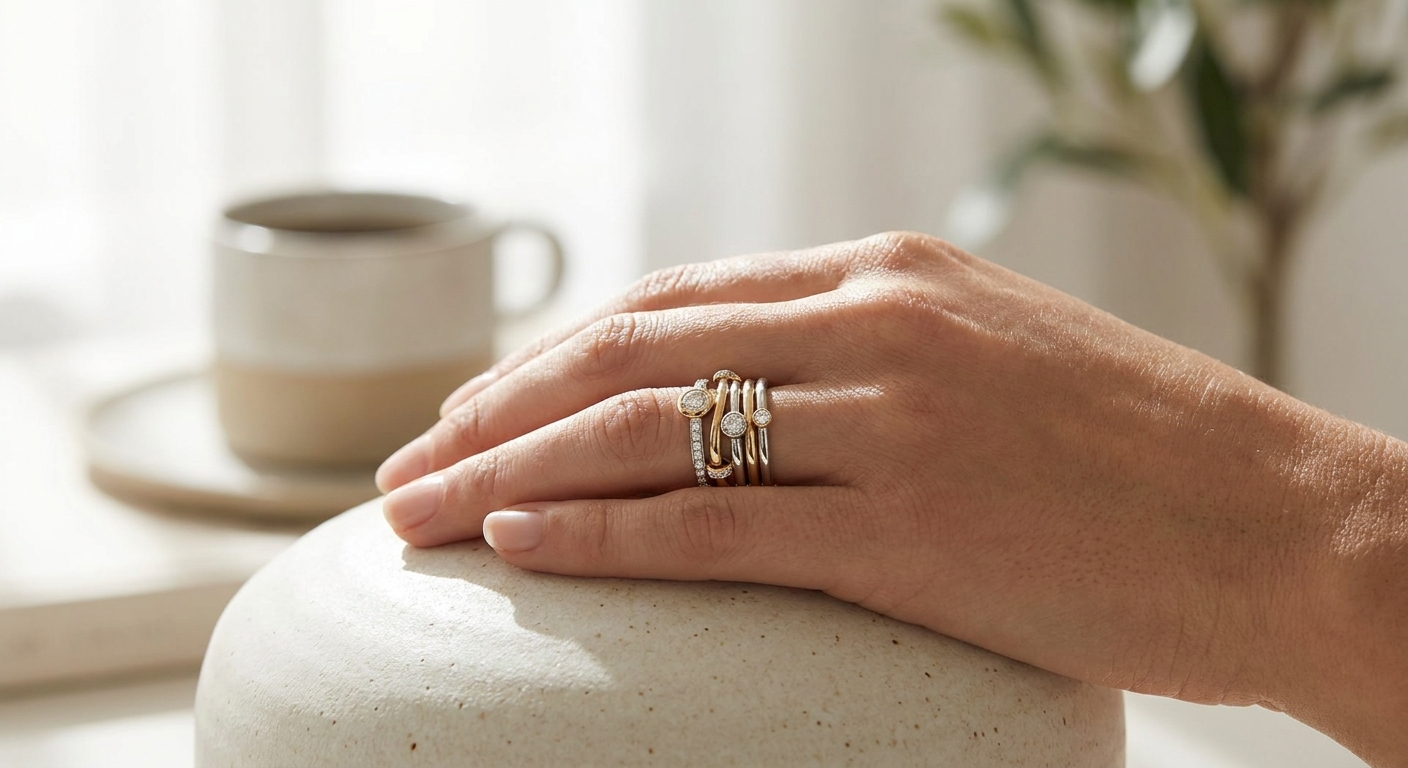
Spinelli Kilcollin rings turn a jewelry box into a linked-metal wardrobe, and in 2026 they're the anchor piece for anyone building a modern ring stack instead of settling for one ring and calling it finished.
- Spinelli Kilcollin rings anchor a modern ring stack with linked, interchangeable bands — buy the connector piece before anything else.
- 18k gold in mixed finishes outperforms matched-metal sets for daily stacking in 2026.
- Pave-diamond bands work as accents, not anchors — Buy for texture, Consider before your first purchase.
- Six rings at the same width reads cluttered in 2026 — three to four pieces at varied widths reads intentional.
Why this matters
Ring stacking stopped being a bridal-only habit years ago. By 2026, style-conscious buyers wear three, four, sometimes five rings across one hand as a daily habit, and the pieces that hold up to that kind of wear are built differently than a single cocktail ring bought to stand alone. Spinelli Kilcollin built its design language around exactly this problem: connected bands, mixed metals, and pieces meant to be worn together rather than in isolation.
That's a different engineering problem than assembling a set of stackable diamond rings for everyday wear and hoping they sit well against each other. Spinelli Kilcollin rings are built to link, layer, and hold their shape under years of daily contact. If you're assembling a stack rather than picking one ring, that construction matters more than any other spec on this page — more than the carat weight of any single stone, and more than which finish looks best under studio lighting.
Who this is for
This guide is for the buyer who already owns fine jewelry and wants to build on it, not start over. Picture someone with one or two staple pieces already in rotation — a signet ring, a thin gold band — looking to add three or four more without buying a matched set off a mall counter. Newly engaged women layering a Spinelli Kilcollin piece next to a solitaire fit here too, and so does the shopper who treats jewelry as a collection assembled over years rather than a single purchase every few years.
This isn't a guide for someone buying their first fine jewelry piece. If you don't already own at least one ring you wear daily, start there before you start stacking — a stack needs an established habit of daily wear to make sense of the investment.
What to look for in Spinelli Kilcollin rings for a modern stack
Linked construction over stand-alone bands
Spinelli Kilcollin's reputation rests on rings built to connect to each other — worn as a fused unit across two or three fingers, then separated later if you want to redistribute them. A ring built to link holds its position in a stack instead of sliding around your finger by midafternoon. If a ring can't physically interact with its neighbors, it's competing with the stack instead of completing it.
Metal purity and finish consistency
Most Spinelli Kilcollin pieces run 18k gold across yellow, rose, and white finishes, and mixing all three inside one stack reads as intentional in 2026 rather than mismatched. Consistency in karat weight matters more than matching color — an 18k rose band worn against a 14k yellow band wears unevenly over a decade of daily contact. Check the karat stamp on every ring before it joins the stack, not just the finish color.
Band width and stacking order
A stack built from five rings at the same 2mm width blurs into one thick band instead of reading as five distinct pieces. Vary width by at least a millimeter between neighbors — a 1.5mm linked band next to a 3mm pave piece keeps each ring legible on its own. Order thinner bands toward the knuckle and heavier pieces toward the base of the finger so the stack follows your hand's natural taper instead of fighting it.
Stone placement and how it plays with neighbors
A pave-set band sitting between two plain gold links will catch and scratch its neighbors over months of daily wear, so check where the stones sit relative to the rings on either side before committing. Flush-set or bezel-set stones sit safer inside a dense stack than raised prongs do. If you're layering four or five rings daily, keep prong-set stones on the outside edge of the stack rather than buried in the middle.
Sizing flexibility across multiple rings
Some Spinelli Kilcollin designs size slightly loose on purpose, so linked rings can rotate and settle instead of binding against each other. A stack sized too tight across every piece restricts movement and speeds up wear on the metal. Ask specifically how each ring is meant to fit before buying more than two at once — sizing logic changes once rings start touching each other daily.
Durability against everyday wear
A ring stack takes more abuse in a week than a single special-occasion ring takes in a year — typing, dishes, gym sessions, all of it. Designer pieces cut in solid 18k gold hold their polish and shape through that abuse better than plated or hollow-core alternatives, which is worth factoring in before choosing a piece purely on look. Ask specifically about the construction — solid versus hollow — before adding any ring to daily rotation.
Top picks for building a Spinelli Kilcollin stack
The Anchor: linked-band sets
Spinelli Kilcollin's linked designs are the piece to buy first, not third. A connector ring worn across two fingers sets the width and metal tone for everything you add later, and most linked sets fuse two to three rings into one unit. Buy this before anything else — it's easier to build a stack around a linked anchor than to retrofit one around loose singles you already own, and the guide to building a ring stack walks through the order to add pieces from there. Verdict: Buy.
The Wildcard: mixed-metal combinations
Yellow, rose, and white 18k gold worn together in one stack is the boldest move on this list, and it's the one most shoppers hesitate on before buying. It works because Spinelli Kilcollin cuts each metal to matching finish weight, so nothing reads as an afterthought. Consider this if your other jewelry already mixes metals; skip it if your everyday pieces run one tone — three mismatched metals against a monochrome bracelet stack reads busy instead of intentional. Verdict: Consider.
The Diamond Accent: pave-set thin bands
A single pave band at 1.5mm to 2mm wide adds texture without taking over the stack, and it's typically the piece buyers add second or third rather than first. It's not a load-bearing piece — it's punctuation. Buy this once two plain bands are already in place; buying it as your only Spinelli Kilcollin ring wastes the brand's linked-construction strength entirely. Verdict: Consider.
The Bridal Crossover: stacked wedding bands
Spinelli Kilcollin rings work as a wedding-band alternative stacked next to a solitaire rather than replacing it, and couples shopping designer engagement rings for a modern bride increasingly build the whole hand this way instead of buying one traditional band. The linked construction keeps the wedding side from sliding under the engagement ring during the day. Buy this if your engagement ring is a stand-alone solitaire; skip it if your engagement ring is already a stacked design, since you'll double up on the same visual idea. Verdict: Buy.
The Long Hold: heavier-gauge gold pieces
Rings cut from a heavier gauge of 18k gold cost more upfront and hold their shape and finish across decades of daily wear, which matters if this stack is something you expect to still wear in 2036. Building a Spinelli Kilcollin stack rewards patience over impulse buying, the same logic that drives luxury fashion as investment thinking in ready-to-wear and handbags — pieces get added deliberately instead of all at once. Verdict: Buy, but pace the purchases.
See the current Spinelli Kilcollin selection at Element 79 before committing to an order — availability shifts piece by piece since these are limited production runs, not a standing catalog. A stack built around pieces you can actually see and try on beats one assembled from photos alone, since width and weight read completely differently in person than on a screen.
Ready to start your ring stack?
See the current Spinelli Kilcollin pieces in the Cherry Creek boutique.
What to avoid
- Buying five or six rings at once. A stack assembled in a single transaction arrives matched instead of collected — the whole point of stacking is that it looks built over time, piece by piece, not bought in one sitting.
- Stand-alone rings labeled stackable. Not every ring labeled stackable is built to link; some are just thin. If you want the fused-unit look, confirm the piece actually connects before buying — how to choose a designer engagement ring covers the difference between connected construction and marketing language.
- Matching every metal exactly. A stack where every ring is the identical yellow gold shade looks flat under most lighting. Slight tonal variation between pieces is what reads as curated rather than uniform.
- Ignoring how the stack feels closed-fist. A ring that looks right open-handed can dig into the ring beside it the moment you make a fist — test the full stack closed, not just laid flat on a counter.
Verdict comparison
| Pick | Best for | Metal | Verdict |
|---|---|---|---|
| The Anchor (linked-band set) | Starting a stack from zero | 18k gold, matched tone | Buy |
| The Wildcard (mixed-metal) | Buyers who already mix metals | 18k yellow, rose, white | Consider |
| The Diamond Accent (pave band) | Adding texture, not starting | 18k gold with pave diamonds | Consider |
| The Bridal Crossover | Pairing with a solitaire | 18k gold | Buy |
| The Long Hold (heavier gauge) | Long-term collectors | Heavier 18k gold | Buy, pace it |
Read the table left to right in the order most stacks get built: anchor first, texture and metal experiments second, the long-hold piece whenever budget allows.
FAQ
What makes Spinelli Kilcollin rings good for stacking?
Spinelli Kilcollin rings are built with linked construction, meaning individual bands connect to each other rather than standing alone. That link holds the stack's position on your finger through daily wear, which loose stand-alone rings can't do as reliably.
How many Spinelli Kilcollin rings should I start with?
Start with one linked anchor piece rather than a full set. Adding one to two more rings over the following months lets the stack read as collected instead of purchased all at once.
Can you mix Spinelli Kilcollin with other designer rings in one stack?
Yes, as long as karat weight stays consistent across pieces. Mixing 18k Spinelli Kilcollin with another 18k designer band works; mixing 18k with 14k pieces causes uneven wear over years of daily contact.
Is 18k gold better than 14k for a ring stack?
18k gold holds richer color and resists thinning less over decades of daily wear compared with 14k, which matters more in a stack than in a single ring because of the constant metal-on-metal contact.
Do Spinelli Kilcollin rings work as wedding bands?
Yes, many buyers stack a Spinelli Kilcollin linked ring next to a solitaire as a wedding-band alternative rather than a traditional single band. The linked construction keeps it from sliding under the engagement ring.
How much does a Spinelli Kilcollin ring stack cost in 2026?
Pricing varies by piece, metal weight, and stone count, so check current pricing directly with a boutique like Element 79 rather than relying on outdated online listings from prior years.
What's the difference between a linked ring and a regular stackable ring?
A linked ring physically connects to its neighbors and moves as a unit, while a regular stackable ring simply sits next to other rings without any structural connection. Linked designs hold their stacking order better over a full day of wear.
Should I buy my ring stack all at once or over time?
Buy over time. A stack purchased piece by piece across 2026 and beyond lets you adjust width, metal mix, and order as you actually live with the rings, which a single bulk purchase doesn't allow.
One last thing
Start with a single Spinelli Kilcollin linked ring and wear it alone for a full season before adding a second piece. The metal tone and width you choose first ends up dictating the fit and finish of every ring you add after it, and that first decision gets harder to walk back once the stack is three or four pieces deep — by the time you're shopping for the fourth ring in 2026 or 2027, you're really just matching what the first one already decided for you.