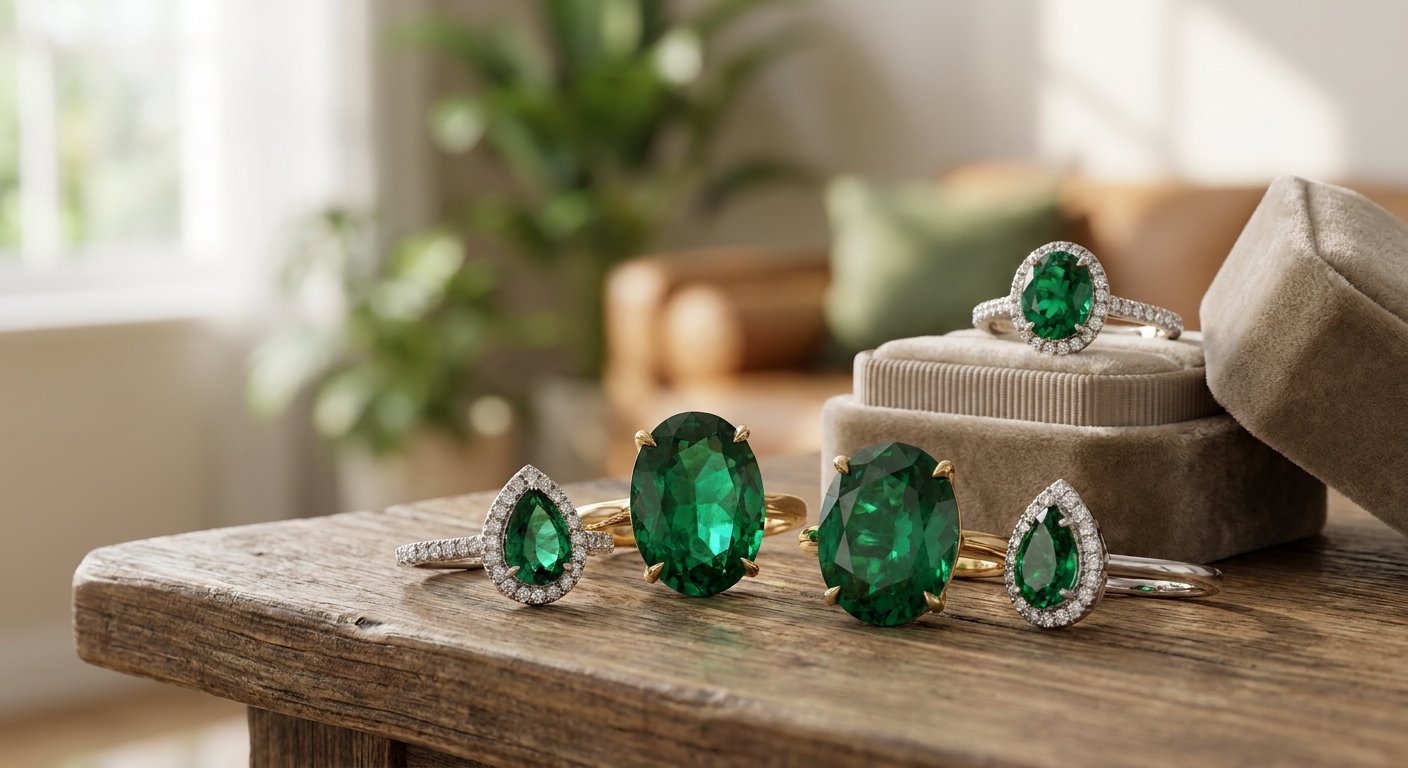
Emerald engagement rings turn a proposal into a statement piece, and getting the color, cut, and setting right decides whether that stone reads as intentional or accidental.
- Emerald engagement rings need bezel or halo settings to protect the stone's 7.5-8 Mohs hardness — buy protected, not exposed.
- Deep, saturated green with minimal visible jardin beats carat size for a bold emerald engagement ring look in 2026.
- Skip thin pave shanks and open prong tips — they chip a stone this soft within a year of daily wear.
- A colorful, non-diamond emerald engagement ring reads boldest paired with yellow or mixed metal, not plain white gold.
- Ask for treatment disclosure in writing — most emeralds are oiled, and that's normal, not a red flag.
Why This Matters
Diamonds still move the most volume, but 2026 is shaping up as another strong year for colored center stones, and emerald sits at the top of that shift for brides who want a ring that draws a question at dinner, not a nod. The stone carries centuries of association with royalty and old-world jewelry houses, which is exactly why it photographs differently than it wears and why buying one blind is a mistake. For a side-by-side on how emerald compares to sapphire, ruby, and morganite for durability and cost, the breakdown in how to choose a gemstone for an engagement ring covers the tradeoffs in more depth than this guide has room for.
The short version: emerald is softer than diamond, almost always includes visible internal structure, and rewards a buyer who values color and personality over textbook clarity grades.
Who This Is For
This guide is for the bride and the couple who already decided a diamond solitaire feels expected and want a ring that gets stopped-in-the-street reactions instead. It's for the buyer who's comfortable owning a stone with character \u2014 visible inclusions, some color variance from stone to stone \u2014 rather than chasing lab-graded perfection, and who's willing to see color in person at a boutique like Element 79 before committing five figures to a gem that shifts tone under different light.
What to Look For in a Bold Emerald Engagement Ring
Color saturation, not carat weight
A 1-carat emerald with deep, even, bluish-green saturation reads bolder in a room than a 2-carat stone that's pale or washed out. Color is graded on a spectrum from yellowish-green to bluish-green, and the most prized emeralds sit closer to a pure, vivid green with strong saturation and even tone edge to edge.
Clarity and the jardin reality
Emeralds form with internal fractures and mineral inclusions collectively called "jardin," French for garden, and almost none are eye-clean the way a diamond can be. Buying with diamond-clarity expectations sets you up to reject every real emerald you're shown; the goal is a stone where the jardin sits below the surface and doesn't compromise structural integrity, not one with zero visible character.
A setting built for a 7.5-8 Mohs stone
Diamond rates a 10 on the Mohs hardness scale; emerald sits at 7.5-8, and it's also more brittle, meaning a hard knock can crack it even without scratching it. A bezel or halo setting that wraps the girdle and protects the edges is non-negotiable for a ring meant to be worn daily, not just for photos.
Treatment disclosure in writing
Most emeralds on the market are oiled to fill surface-reaching fractures and improve apparent clarity \u2014 that's standard practice, not a defect, but it needs to be disclosed before purchase. Ask whether the treatment is minor, moderate, or significant, since that affects both care instructions and resale value down the line.
Metal pairing for maximum contrast
Yellow gold pulls warmth out of green emerald and reads the boldest against skin tone; white gold or platinum cools the stone down and can mute the drama you're paying for. Mixed-metal settings, popular again in 2026, split the difference and let the emerald carry the color story while the metal stays quiet.
See emerald color in person
Photos never show true saturation — book a visit at the Cherry Creek boutique.
Top Picks for a Bold Emerald Engagement Ring
The Colorful Proposal Pick
The hook here is contrast: a deep emerald center flanked by a thin diamond halo, so the ring still throws light without diluting the green. Look for a halo set close to the stone's girdle, not floating above it \u2014 that gap is where chips start. This style is the closest thing to a safe bold choice, and the full range of colorful, non-traditional proposal styles sits in gemstone engagement rings for a colorful proposal. Verdict: Buy for brides who want boldness with a little sparkle insurance.
The Non-Diamond Purist
No diamonds at all \u2014 just emerald, metal, and negative space. This works when the setting itself does the design work: a sculptural band, an asymmetric bezel, a slightly domed shank. It's the least forgiving pick if the cut or color is mediocre, because there's nothing else to look at. The dedicated roundup at best gemstone engagement rings for non-diamond brides breaks down which cuts hold up under this kind of scrutiny. Verdict: Buy if the color grade is strong; Skip if you're settling on saturation to get the minimalist look.
The Solitaire With a Bezel
A single emerald-cut or oval stone, fully wrapped in a bezel setting, no accent stones. This is the pick that ages best day-to-day, since the bezel edge takes the impact a prong setting would transfer straight into the stone. Aim for a bezel with a slightly raised lip rather than a flush-set edge; flush settings look sleek but offer less real protection. Verdict: Consider for anyone who wears rings hard \u2014 gardening, gym, kids \u2014 and needs the metal doing more of the protective work.
The Stacked Statement
Rather than one large center stone, this pairs a smaller emerald ring with sculptural gold bands designed to move and sit together, a look that's been building since Spinelli Kilcollin popularized asymmetric stacking. It reads bold through repetition and texture rather than size alone. Verdict: Consider for a bride who plans to add bands over time instead of buying the full look at once.
The Modern Bride's Wildcard
An unconventional cut \u2014 trapezoid, hexagon, or a rose-cut emerald \u2014 set in an architectural band with visible negative space around the stone. This is the pick that gets remembered, but it's also the hardest to resize or insure accurately because non-standard cuts complicate replacement sourcing. Verdict: Buy for a bride who wants a ring nobody else at the wedding will have; Wait if resale or easy resizing matters more to you than originality.
“An emerald that needs babying isn't a bold choice, it's a liability.”
What to Avoid
- Thin pave shanks under a heavy center stone. They look delicate in photos and bend out of round within a year of daily wear, throwing the emerald off-center.
- Open prong settings with no protective lip. Prongs that only grip the crown leave the girdle exposed to chips on contact with door frames, steering wheels, and countertops.
- "Eye-clean" emerald claims at a steep discount. A genuinely clean, richly saturated emerald commands a premium; a suspiciously affordable "clean" stone is usually a lower grade with hidden treatment, a synthetic, or a different gem entirely marketed as emerald.
Verdict Comparison
| Pick | Setting Protection | Best Metal | Verdict |
|---|---|---|---|
| Colorful Proposal Pick | High (halo hugs girdle) | Yellow or mixed | Buy |
| Non-Diamond Purist | Medium (depends on bezel design) | Yellow gold | Buy if color is strong |
| Solitaire With a Bezel | Highest | Any | Consider |
| Stacked Statement | Medium | Mixed metal | Consider |
| Modern Bride's Wildcard | Medium (cut-dependent) | Yellow or rose gold | Buy or Wait |
FAQ
Are emerald engagement rings durable enough for daily wear in 2026?
Yes, with the right setting. Emerald rates 7.5-8 on the Mohs hardness scale versus 10 for diamond, so a bezel or halo setting that protects the girdle and edges is what makes daily wear realistic, not the stone alone.
What's the best cut for a bold emerald engagement ring?
Emerald-cut and oval both showcase deep color well, but emerald-cut is the traditional pairing since the step facets highlight saturation better than brilliant cuts do on colored stones.
Is an emerald engagement ring more affordable than a diamond ring?
It depends heavily on color and clarity grade rather than following diamond pricing logic. A highly saturated, lightly included emerald can cost more per carat than a comparable diamond; pricing varies enough that checking current options directly is the only reliable way to compare.
Do emerald engagement rings need special care?
Yes. Avoid ultrasonic cleaners and steam cleaning, since both can worsen existing fractures or affect oil treatments. Warm water, mild soap, and a soft cloth are the safer routine for 2026 and beyond.
Can you wear an emerald engagement ring every day?
Many brides do, but the setting matters more than for a diamond. A protective bezel or halo reduces the risk of chipping during daily activities like typing, gardening, or gym work.
What does treated or oiled emerald mean?
Most emeralds are treated with oil or resin to fill surface-reaching fractures and improve clarity appearance. This is standard industry practice in 2026, not a sign of a lower-quality stone, but it should be disclosed at purchase.
How do emerald engagement rings compare to sapphire for a bold look?
Emerald delivers a warmer, more saturated color statement, while sapphire (especially in blue or teal) tends to show fewer visible inclusions and wears slightly harder at 9 on the Mohs scale. Choice comes down to color preference and how much visible character you want in the stone.
What metal looks best with an emerald engagement ring?
Yellow gold pulls the most warmth and contrast out of a green emerald. White gold and platinum cool the stone's tone down, and mixed-metal settings, popular in 2026, split the difference for a more layered look.
One Last Thing
The detail most first-time emerald buyers miss: the same jardin that would tank a diamond's clarity grade is often what makes an emerald look richer, not weaker \u2014 a completely clean emerald can actually appear glassy and flat next to one with subtle internal structure. Stop shopping for the absence of character and start shopping for depth of color; that's the difference between an emerald engagement ring that looks bold in a photo and one that looks bold across the table for the next 40 years.