Diamond stud earring size comes down to millimeter diameter, not carat weight alone — get that ratio wrong and you end up with studs that either disappear or overwhelm your ear.
- A 1.00 total carat weight pair of diamond studs measures about 5.6mm per stone, the most requested diamond stud earring size in 2026.
- Face shape and earlobe width matter more than carat weight — a 6mm stud reads bold on a petite lobe and modest on a fuller one.
- Two 1-carat round diamonds can differ in visible diameter by up to 20 percent depending on cut depth, so carat weight alone is a poor sizing guide.
- Buy 4-5mm studs for daily wear, 6mm or larger for statement occasions like a black-tie wedding.
Why this matters
Most shoppers walk in asking for "one-carat studs" and assume that number settles the size question. It doesn't. Total carat weight describes mass, not diameter, and two round diamonds both cut to 1.00 ctw can look noticeably different depending on how deep the stone is cut below the girdle.
A shallow-cut diamond spreads wider for the same weight; a deep cut hides weight below the surface and looks smaller. That's why a jeweler talks in millimeters first and carats second — and why picking a diamond stud earring size that flatters your face shape takes more than a spec sheet.
In 2026, the studs moving fastest at boutiques like Element 79 sit in the 4mm to 6mm range per stone — big enough to catch light, small enough for daily wear without snagging a scarf or a phone call.
What you'll need
- A millimeter ruler or a printable jewelry sizing gauge
- A mirror with good, even lighting
- Your current stud earrings, for a side-by-side comparison
- A note on your earlobe width (measure at the widest point)
- A sense of how often you'll wear them — daily versus special occasion
- Reference photos of your ear from a few feet away, not just up close
The steps
1. Measure your earlobe width
Hold a millimeter ruler flat against your earlobe and note the widest point, usually 10mm to 14mm for most adults. This number sets your ceiling — a stud diameter that's more than half your earlobe width will start to look oversized rather than balanced. Skip this step and you're guessing blind. Common mistake: measuring the whole ear instead of just the fleshy lobe where the earring sits.
2. Match carat weight to millimeter diameter
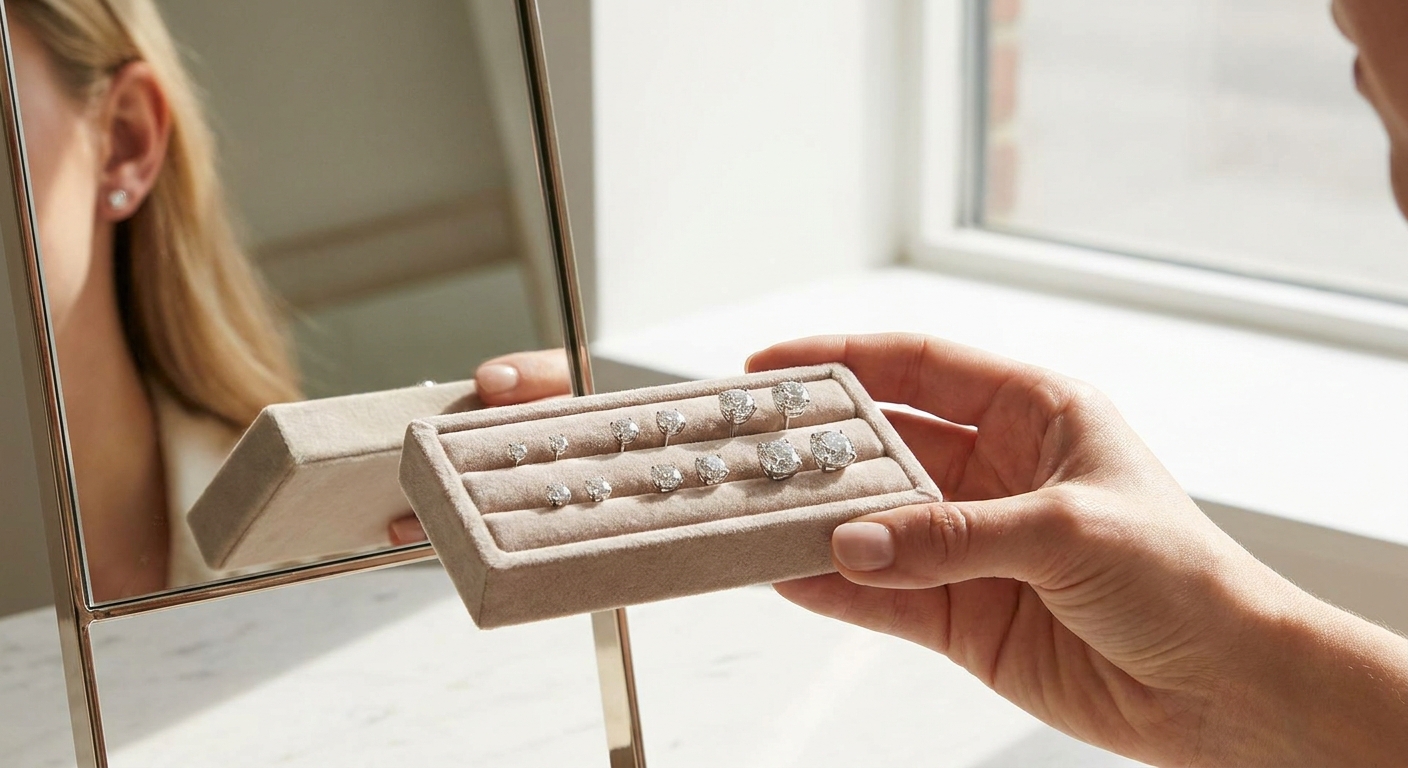
Use the mm-to-carat relationship as your starting math, not your final answer. A 0.25 ctw stone runs close to 4mm, a 1.00 ctw stone closer to 5.6mm, and a 2.00 ctw stone approaches 7mm. Cut quality shifts these numbers, so always ask for the actual millimeter measurement on the certificate, not just the carat weight printed on the tag.
3. Consider your face shape
Rounder faces tend to suit studs with more visual weight — closer to 5.5mm and up — because they add definition along the jaw. Angular or narrow faces often look best in smaller, cleaner studs around 4mm that don't compete with strong cheekbones. If you're unsure where you land, the designer diamond earrings for your face shape breakdown walks through it stone by stone.
4. Decide by occasion
Studs you'll wear five days a week need a different size than studs reserved for a wedding. For daily rotation, 4mm to 5mm studs from a line built for everyday luxury diamond earrings hold up under a coat collar or a workout without snagging. For a single big night, sizing up to 6mm-7mm reads intentional rather than accidental.
5. Check the setting style before the stone size
A martini or bezel setting can make the same millimeter diamond look larger or smaller depending on how much metal frames the stone. Prong settings expose more of the diamond's surface area and tend to read slightly bigger than a bezel at the same size. Ask to see both styles side by side before locking in a diameter.
6. Test the look at arm's length, not in a hand mirror
Hold the stud up to your ear and step back three to four feet from a full mirror — this is how other people will actually see them. Studs that look perfect six inches from your face often shrink to nearly invisible from across a room. Common mistake: deciding on size while holding the earring an inch from your eye.
7. Choose the right back for the size you pick
Anything above 5mm or 0.75 ctw per stone benefits from a screw-back or a locking push-back rather than a standard friction post — the added weight makes a loose stud more likely to slip out during the day. This isn't a cosmetic detail; it's the difference between wearing your studs for a decade and losing one at a dinner table.
8. Confirm total carat weight versus per-stone weight before you buy
A "1.00 ctw" pair means both stones together weigh one carat — each stone is closer to 0.50 ctw and around 5mm, not 5.6mm. Sellers who blur this distinction are the number one reason buyers end up with studs smaller than expected. Ask directly: "Is that 1.00 carat total weight, or 1.00 carat per stone?"
Not sure which size fits your ear?
Book a fitting at the Cherry Creek boutique and try sizes side by side.
Troubleshooting
- Studs disappear against your face. Size up by half a millimeter and consider a setting with more visible metal, like a halo, to add perceived diameter without changing carat weight.
- You confused per-stone weight with total weight at checkout. Always ask for the millimeter measurement on the invoice, not just the carat number — it's the only figure that won't be ambiguous.
- Your earlobes feel stretched after a full day. The stud is likely too heavy for your lobe thickness; a lighter setting or a slightly smaller diamond at the same shape will fix it without sacrificing sparkle.
- One stud looks bigger than its match. This happens when two diamonds of the same carat weight have different cut depths — insist on a matched pair measured to within 0.1mm of each other.
- Studs catch on hair or scarves. Switch from a basket setting to a low-profile bezel, which sits flatter against the lobe regardless of diameter.
- You're buying online and can't test the size in person. Print a millimeter ruler at 100% scale and hold it against your earlobe in a mirror before finalizing an order.
Tools and resources
- A printable mm gauge or a jeweler's loupe app for size verification
- A second opinion from a piercer if you're sizing studs for a second piercing, where smaller diameters usually fit better
- Photos of your ear in natural daylight and indoor lighting, since sparkle reads differently under each
- A jeweler who will show you the actual millimeter measurement on a certificate, not just estimate it
FAQ
What is the most popular diamond stud earring size in 2026?
The 1.00 total carat weight pair, measuring roughly 5.6mm per stone, remains the most requested diamond stud earring size in 2026 for everyday wear. Half-carat pairs around 4mm to 4.5mm follow closely for daily rotation.
How do I know what earring size fits my face?
Rounder faces generally suit larger studs starting around 5.5mm, while narrow or angular faces look balanced with smaller studs near 4mm. Testing the size at arm's length in a mirror gives a more accurate read than judging up close.
Is carat weight the same as millimeter size?
No, carat weight measures mass and millimeter size measures diameter, and the two don't move in lockstep because cut depth changes how a diamond spreads. Two 1-carat stones can differ in visible diameter by up to 20 percent.
What size diamond studs are best for everyday wear?
Studs between 4mm and 5mm, or roughly 0.25 to 0.50 carats per stone, hold up best under daily wear without snagging on clothing or hair. Larger sizes are better reserved for occasions where snagging risk is lower.
How much bigger should statement earrings be than everyday studs?
Statement studs for events typically run 6mm to 7mm per stone, roughly 1.5 to 2 carats, compared to 4mm to 5mm for daily pairs. The jump in size is what reads as intentional from across a room.
Do screw backs matter for earring size?
Yes, any stud above roughly 5mm or 0.75 carats per stone should use a screw-back or locking push-back rather than a standard friction post. Heavier stones are more prone to slipping loose with a basic post.
Can two diamonds of the same carat weight look different sizes?
Yes, cut depth is the reason — a shallow cut spreads a diamond wider for the same weight, while a deep cut hides more weight below the surface. Always confirm the millimeter measurement, not just the carat number.
What earring size works best for a second piercing?
Second piercings generally look best with smaller studs, often 3mm to 4mm, since the higher placement on the ear draws less attention to size. Larger stones can look disproportionate that close to the ear's edge.
One last thing
The detail most buyers miss in 2026 isn't the carat weight, it's the depth percentage on the certificate — two diamonds labeled identically at 1.00 ctw can sit half a millimeter apart in visible size, and that half millimeter is exactly what separates studs that read as noticeable from studs that vanish against the earlobe.