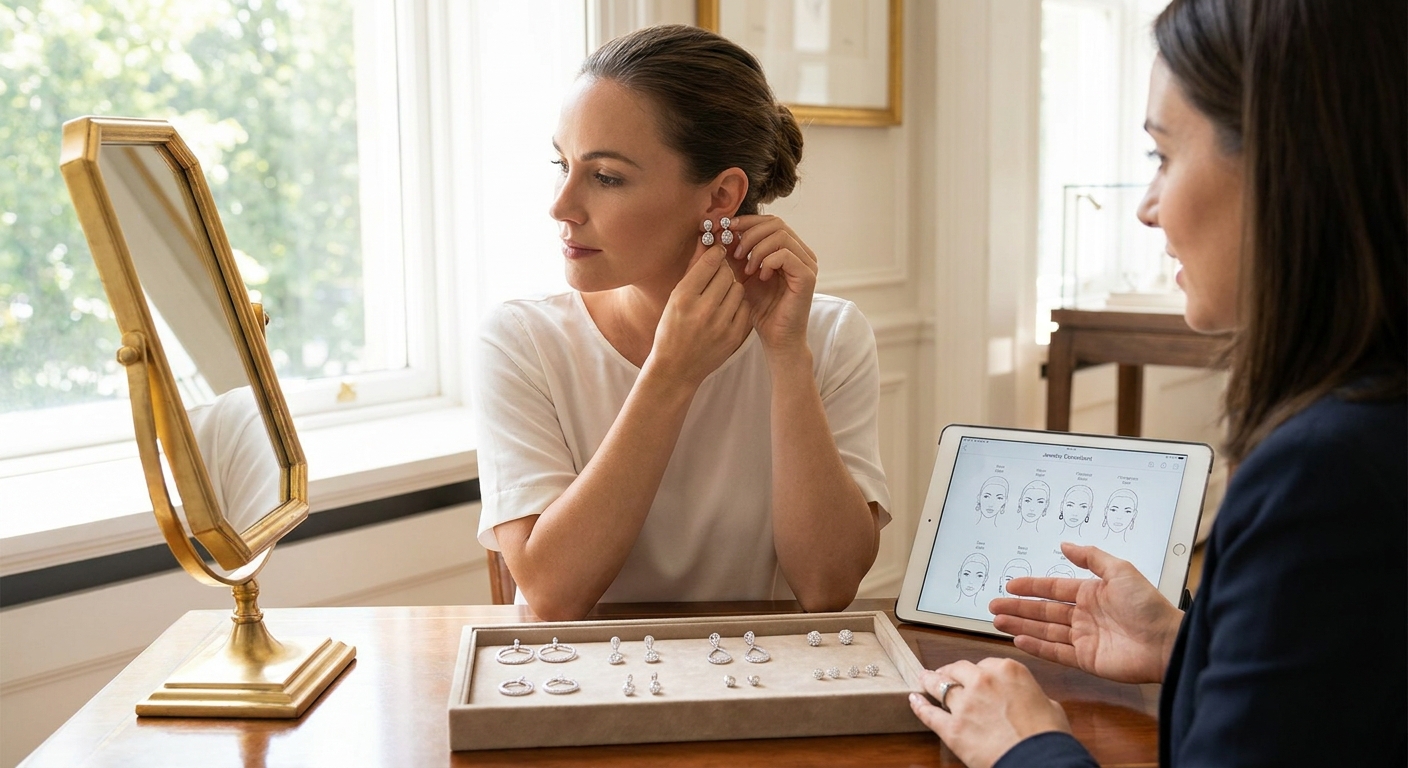
Your face shape decides whether a drop earring elongates your features or makes them look pinched — get the shape wrong and even a beautifully cut diamond looks off.
- Round faces need length: 1.5-inch drops from designers like Artëmer slim the face instantly.
- Square jawlines soften with curved hoops or teardrops, not geometric studs.
- Oval faces wear almost anything — Petra Class chandelier styles are the safe splurge for 2026.
- Long faces need width, not more length, so a rounded huggie beats a dangling drop.
- Heart-shaped faces balance a narrow chin with wider-top designs like chandelier or cluster earrings.
Why this matters
Earrings sit closer to your face than any other jewelry category, which means the wrong shape distorts your features every time someone looks at you, not just in photos. A pair that flatters a round face on your friend can visually widen a square jaw on you, and no amount of diamond clarity fixes that.
Designers like Artëmer, Petra Class, and Orly Marcel build their diamond earring collections around a range of silhouettes precisely because one shape does not serve every buyer. Knowing how to choose earrings for your face shape before you shop saves you from buying a beautiful pair you never actually wear — a common and expensive mistake in fine jewelry.
What you'll need
- A clear photo of your face, pulled back from your hair, taken in natural light
- A ruler or measuring tape to check your face's width at the forehead, cheekbones, and jaw
- A mirror and 10 minutes with no makeup on, so bone structure is visible
- A sense of your metal preference (yellow gold, white gold, or mixed metal)
- Access to a range of designer diamond earring shapes — designer diamond earrings built for wedding day wear is a good place to see drop, stud, and huggie styles side by side
The steps
1. Identify your actual face shape
Measure three points: forehead width at the widest point, cheekbone width, and jaw width. Compare all three to your face's length from hairline to chin.
If the three measurements are close and your face is roughly as long as it is wide, you're oval or round. If your jaw is close to your cheekbone width and your face reads as angular, you're square. A face that's noticeably longer than wide is oblong. Wider cheekbones with a narrow, pointed chin is a heart shape.
Common mistake: guessing from a downward-angle selfie. That angle compresses the jaw and makes almost every face shape look rounder than it is.
2. Match earring length to face length, not to trend
Round and square faces benefit from length because a vertical line breaks up horizontal width. Look for drop earrings that hit between 1.25 and 2 inches — anything shorter just sits as a horizontal accent and adds width instead of cutting it.
Oblong or long faces do the opposite: they need width and roundness, not more length. A huggie hoop or a cluster stud closer to 0.5 to 0.75 inch keeps the face from reading even longer.
3. Choose curved shapes for angular faces, angular shapes for soft faces
Square and rectangular jawlines soften visually against curved lines — teardrops, ovals, and rounded huggies. Straight-line chandelier styles with sharp geometric facets tend to double down on the angles you're trying to balance.
Round and oval faces can carry more geometric diamond work because there's no hard angle to compete with. This is where a faceted, architectural piece from Artëmer reads as sharp and intentional rather than harsh.
4. Balance a heart-shaped face from the top down
Heart faces are wide at the forehead and cheekbones and narrow at the chin, so the goal is visual weight lower down. Chandelier earrings, cluster studs, or anything with more width at the bottom third of the earring pulls the eye down and balances the narrow chin.
Avoid earrings that flare out at the top near the ear — that adds width exactly where the face already has the most.
5. Test your metal tone against your skin, not your hair color
Warm undertones (skin with a golden or peachy cast) generally read best in yellow gold, which is why Petra Class's warm-toned diamond settings sell well for that group. Cool undertones (pink or blue cast) tend to favor white gold or platinum settings.
If you genuinely can't tell your undertone, mixed-metal designs — a category Element 79 carries across several designer lines — sidestep the decision entirely and work on both.
6. Try the earring at the length you'll actually wear your hair
An earring that looks perfectly balanced against loose hair can disappear or look too small once hair is pulled back. If you wear your hair up more often than not, size up slightly and lean toward a shape with more visible outline, like an open hoop over a tight huggie.
Common mistake: buying based on a photo where the model's hair is down, then wearing the earrings up every day and feeling like they read smaller than expected.
7. Check the earring against your jawline in profile, not just head-on
Stand at a slight angle to the mirror. The bottom of a drop earring should generally land at or just above your jawline — past it, and the earring competes with your neck line instead of framing your jaw.
“The earring should end at your jawline, not fight it.”
Troubleshooting
- Earrings look too small in photos. Size up 0.25 to 0.5 inch — camera distance flattens perceived size more than it does in person.
- Studs disappear against thick hair. Switch to a huggie hoop with more visible outline, or a drop with movement.
- Drops swing too much and catch on clothing. Look for a shorter, more structured drop rather than a fully articulated chain style.
- Gold tone looks off against your skin. You likely misjudged undertone — test the exact piece against your wrist in daylight before buying.
- Everything looks the same in a case. Ask to try pieces against a mirror at eye level, not laid flat on a velvet tray, since flat display distorts scale.
- Uncertain between two shapes. Book a fitting — a stylist can angle pieces against your bone structure in ways a photo can't replicate.
Tools and resources
- Everyday luxury designer diamond earrings — a good range of stud and huggie shapes to test length and metal tone side by side
- A ruler and a well-lit mirror, ideally natural light rather than overhead fluorescent
- A second opinion — face shape self-assessment is notoriously unreliable when you do it alone
- If you're shopping for a matching engagement ring at the same time, how to choose a designer engagement ring walks through the same shape-matching logic for hands instead of faces
Try designer earrings in person
See drop, stud, and hoop shapes against your own face shape in Cherry Creek.
What to do next
Once you've settled on a shape, narrow by metal tone and then by occasion — a piece meant for daily wear should sit closer to the ear than one meant for a formal event. If diamonds aren't the only stone on your mind this year, the same balancing logic applies to colored stones and can change which cut flatters your face shape.
FAQ
What's the best earring shape for a round face?
Elongated drop earrings between 1.25 and 2 inches work best for a round face because the vertical line breaks up width. Geometric or angular diamond shapes also read well since there's no hard jawline to compete with.
Are hoop earrings good for square faces?
Yes, rounded hoops soften a square jawline more than geometric studs do. Look for a hoop with a smooth curve rather than a hoop with sharp facets or angular links.
How do I know my face shape?
Measure your forehead, cheekbone, and jaw width, then compare all three to your face length from hairline to chin. Close measurements with a face as long as it is wide usually means oval or round; a notably angular jaw close to cheekbone width means square.
What earrings suit an oval face?
Oval faces suit nearly every earring shape, from studs to chandeliers, since there's no dominant angle or width to balance. Petra Class's chandelier diamond styles are a strong pick for oval faces looking for something more architectural in 2026.
Do diamond studs work for every face shape?
Diamond studs work for oval and round faces well but tend to underwhelm on long or oblong faces, which need more visible width near the ear. A huggie hoop or cluster stud does more visual work for elongated faces.
What length should drop earrings be for a long face?
Long or oblong faces generally do better with shorter pieces around 0.5 to 0.75 inch rather than long drops, since more length exaggerates the existing proportion. Rounded huggie hoops add width instead of length.
How much do designer diamond earrings cost in 2026?
Pricing varies significantly by designer, carat weight, and metal, so check current pricing directly on the piece you're considering rather than relying on a category average. Designer names like Artëmer and Spinelli Kilcollin price based on construction and stone quality, not just carat count.
Can mixed-metal earrings work with any face shape?
Mixed-metal earrings solve the metal-tone question but don't change the shape-matching rules above. You still need to match length and silhouette to your face shape even if the metal question is settled.
One last thing
Most people judge earrings by holding them up to their ear in a store mirror at chest height — but that angle is nothing like how the earring actually sits once you're standing, talking, and moving your head. Ask to try the piece on and walk around the room before deciding; movement changes how a drop earring reads against your jawline more than any static photo will.