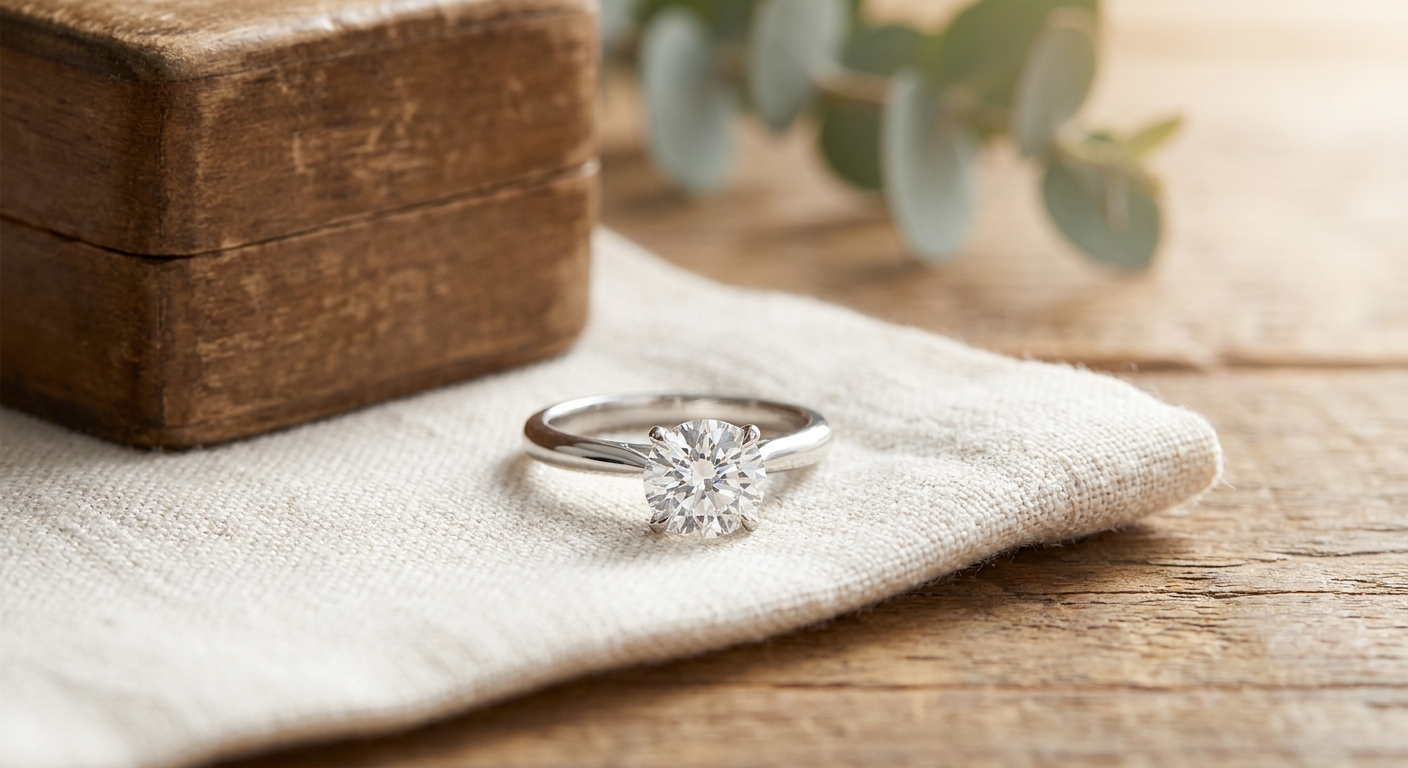
A solitaire engagement ring puts one stone front and center with no distractions — and in 2026, it's still the design that outlasts every trend cycle at Element 79's Cherry Creek boutique. This guide breaks down what actually matters when you're choosing one, and which approaches hold up over decades of daily wear.
- Solitaire engagement rings win on resale value and resizing ease compared to halo or pave styles in 2026.
- Platinum and 18k gold prong settings outlast lower-karat metals for daily wear over a 10+ year timeline.
- A shank under 1.6mm on a stone over 1.5 carats bends faster and needs more frequent inspection.
- Custom solitaire builds through Element 79 let you control stone shape, prong count, and metal without settling for a stock setting.
- Skip low-profile settings for active hands — they snag less but chip more against hard surfaces.
Why this matters
A solitaire isn't just "simpler" — it's a different engineering decision than a halo or three-stone ring. Fewer stones means every remaining design choice, the prong count, the shank width, the metal, carries more weight. Get one of those wrong and you're looking at a ring that snags on sweaters, wears thin at the shank by year eight, or catches light poorly no matter how good the diamond is.
The payoff for getting it right is real: a well-built solitaire from 2026 onward is the easiest style to resize, the easiest to re-set if the stone ever needs an upgrade, and the design least likely to look dated at a 20th anniversary. That's why it remains the most requested silhouette for engaged couples walking into Element 79.
Who this is for
This guide is for buyers who want a ring that reads as intentional rather than trend-driven — someone proposing in 2026 who wants the ring to still look right in 2036, and someone shopping for a partner whose taste leans toward clean lines over maximalism. It's also for buyers comparing a solitaire against a halo or three-stone setting and trying to figure out which trade-offs actually matter versus which are just marketing. If you're deciding between a designer build and a custom one, choosing a designer engagement ring is worth reading before you commit to a setting.
What to look for in a solitaire engagement ring
Prong count and grip
Four prongs is the standard for a reason: it shows more of the stone and cuts less light than six. But six prongs holds a stone more securely, which matters if the wearer works with their hands or plays sports. For anything over 1.5 carats, six prongs is the safer long-term call even though it covers slightly more of the girdle.
Shank width and thickness
A shank under 1.6mm looks delicate but bends out of round faster under daily impact — think gym bags, car doors, dish scrubbing. For a ring meant to be worn every day starting in 2026, 1.8mm to 2.2mm holds its shape for years longer without looking bulky.
Setting height
A cathedral or six-prong solitaire sits the stone 4mm to 6mm above the finger, which catches more light but also catches more doorframes and gloves. A low-profile or bezel-adjacent solitaire sits closer to 2mm to 3mm, trading some sparkle for a ring that survives an active lifestyle with fewer chips at the culet.
Metal purity
Platinum (typically 950) resists tarnish and holds prongs tighter over decades, but it's a denser metal that shows scratches as a soft patina rather than hiding them. 18k gold is more workable for intricate prong detail and comes in yellow, white, or rose — but white gold needs rhodium replating every 12 to 18 months to keep its bright finish. Neither is wrong; the choice depends on whether the wearer prefers a matte-wear look or a bright, maintained shine.
Stone cut and proportions
A solitaire lives or dies on the cut of its center stone since there's nothing else competing for attention. A round brilliant or cushion cut with well-matched table-to-depth proportions throws noticeably more light than the same carat weight in a poorly cut stone — this matters more in a solitaire than in a halo, where surrounding stones can mask a weaker cut.
Talk through your solitaire options
Book time at the Cherry Creek boutique to compare settings in person.
Top picks
The Modern Classic
A four-prong solitaire in 18k gold with a slightly tapered shank is the pick for someone who wants a ring that photographs well and wears comfortably from day one. It sits at a moderate 4mm profile height, which keeps sparkle high without making the ring impractical for someone who types or cooks daily. Designer engagement rings for a modern bride covers this category in more depth. Verdict: Buy for buyers who want timeless without going generic.
The Wildcard
A solitaire with an asymmetric or sculptural band — think an artisan build rather than a straight-shank classic — reads as a solitaire from across the room but shows unexpected detail up close. This is a harder sell for a traditional proposer but a strong pick for a partner whose everyday style already skews toward the unconventional. See best designer engagement rings for a unique proposal for options in this lane. Verdict: Consider if the recipient's existing jewelry collection already leans artisan.
The Custom Route
Building a solitaire from scratch — choosing the stone, the prong count, the metal, and the shank profile independently — is the only way to get all five criteria above exactly right instead of compromising on one. It takes longer than buying off a display case, but it's the pick for anyone who already knows their partner's ring size and preferences down to the millimeter. How to design a custom engagement ring walks through the process. Verdict: Buy if you have the lead time; Skip if you're proposing within a week.
What to avoid
- Ultra-thin shanks paired with a heavy center stone. A 2-carat solitaire on a 1.4mm shank looks elegant on a display card and bends out of round within a year of daily wear.
- Low-karat gold marketed as "solid gold." Anything under 14k wears down faster at the prong tips, the exact spot holding your stone in place.
- Settings with no room to resize. Some sculptural or fused-band solitaire designs can't be resized more than half a size without reworking the whole setting — ask before you buy if the ring size isn't confirmed yet.
Verdict comparison
| Style | Prong Count | Setting Height | Best For | Verdict |
|---|---|---|---|---|
| Classic four-prong | 4 | ~4mm | Everyday wear, active hands | Buy |
| Six-prong secure | 6 | ~5mm | Stones over 1.5 carats | Buy |
| Low-profile / bezel-leaning | 4-6 partial bezel | ~2-3mm | Manual work, sports | Consider |
| Sculptural / artisan band | Varies | ~4-6mm | Non-traditional style | Consider |
| Custom-built | Client choice | Client choice | Full control over fit | Buy (with lead time) |
FAQ
What is the most popular solitaire engagement ring setting in 2026?
Four-prong settings in platinum or 18k gold remain the most requested solitaire style in 2026 because they balance sparkle, security, and resizing ease. Six-prong settings follow closely for stones over 1.5 carats.
Is a solitaire engagement ring better than a halo?
A solitaire shows more of the center stone and is easier to resize or re-set later, while a halo makes a smaller stone look larger. Neither is objectively better — it depends on whether you prioritize stone visibility or perceived size.
How much does a solitaire engagement ring cost in 2026?
Cost depends heavily on stone size, cut, and metal choice, so pricing varies widely by design. Check current pricing directly with the boutique for an accurate range on a specific setting.
Does a solitaire ring need a higher prong count for a bigger stone?
Yes — stones over 1.5 carats generally hold more securely with six prongs instead of four. The extra prongs distribute daily impact across more contact points.
Can a solitaire engagement ring be resized easily?
Most classic solitaire settings resize easily because the band is a simple, continuous shank. Sculptural or fused-band solitaires can be harder to resize, so confirm ring size before ordering one of those.
What metal holds up best for a solitaire worn every day?
Platinum resists tarnish and holds prong tips tighter over years of daily wear compared to lower-karat gold. 18k gold is a strong second choice, though white gold needs periodic rhodium replating to stay bright.
Should I buy a solitaire or go custom?
Buy an existing solitaire setting if you're on a tight proposal timeline and like a display option as-is. Go custom if you know exact preferences on stone, prong count, and metal and have the lead time to build it.
One last thing
The detail most buyers skip: ask about the prong metal specifically, not just the shank metal. Some solitaire settings use a lower-karat alloy at the prong tips for hardness even when the band is a higher-karat gold — it's a small spec that determines how the ring holds up at the exact point doing all the work.