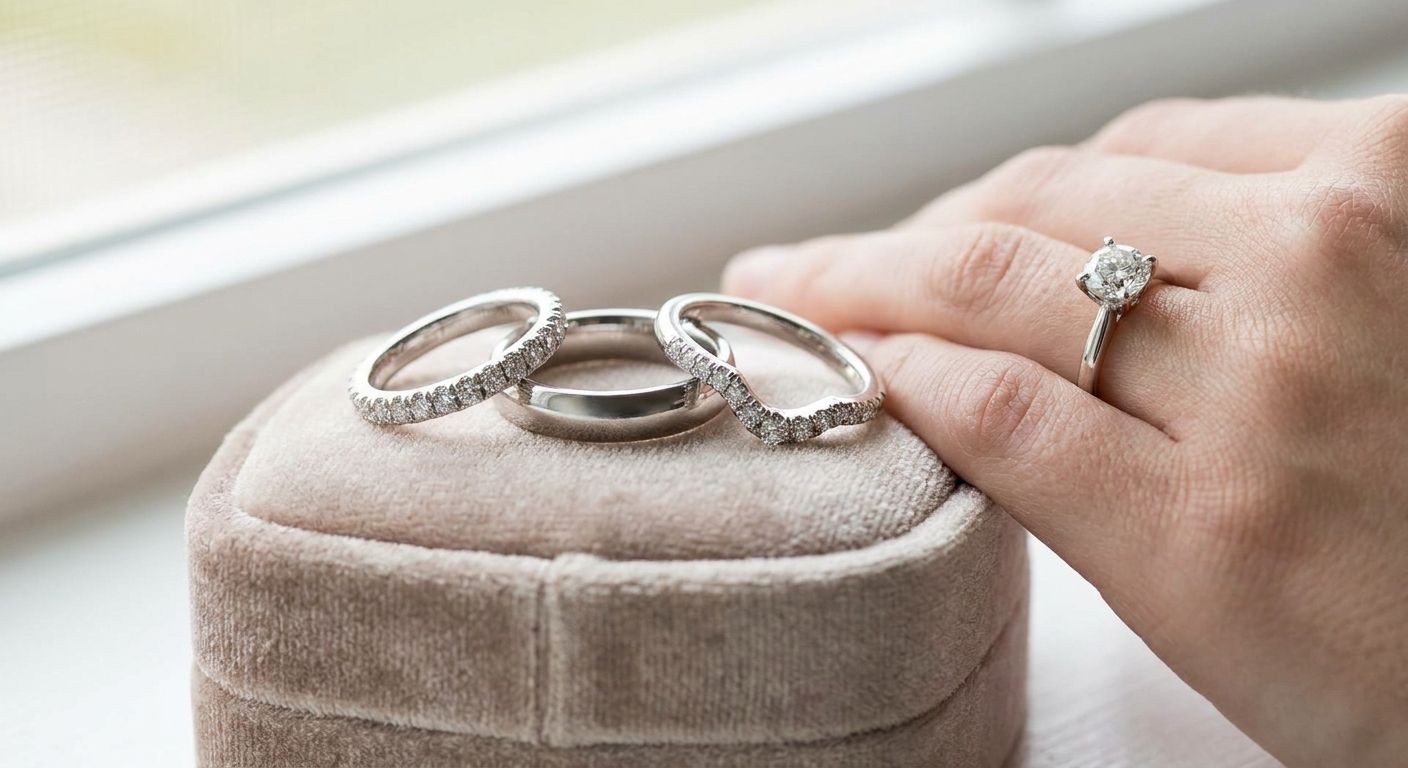
A solitaire engagement ring is the easiest ring to pair badly with the wrong wedding band — and the easiest to get right once you know which four or five band shapes actually work with a single raised stone. This guide ranks the wedding band styles that pair with a solitaire in 2026, with a verdict on each so you're not guessing at the counter.
- A curved contour band is the safest match for a solitaire with prongs — Buy.
- Diamond eternity bands add the most sparkle per dollar but need a jeweler to check gap clearance first.
- Skip a wide flat band on a 4-prong solitaire under 1.5mm shank width — it will crowd the setting.
- Spinelli Kilcollin linked bands work best on low-profile solitaires, not high-set six-prong styles.
Why this matters
The wrong wedding band doesn't just look off — it physically doesn't sit flush against a solitaire, which means a visible gap, a rocking band, or metal that catches on sweaters for the next 20 years. A solitaire's whole design is one stone, minimal metal, maximum negative space around the setting. That negative space is exactly what a wedding band has to negotiate.
Get the shape wrong and you'll be back at the jeweler within a year asking for a resize or a swap. Get it right and the two rings read as one design, which is the whole point of a bridal set. If you're still deciding on the solitaire itself, solitaire engagement rings built for a timeless look is worth a read before you shop bands.
How this list was ranked
Band styles here are ranked on three things: how cleanly they sit against a raised solitaire setting, how they wear day-to-day (does the profile snag, does it need resizing more often), and how much they add stylistically without competing with the center stone. Contemporary and designer bridal lines from studios like Artëmer, Orly Marcel, Spinelli Kilcollin, and Petra Class informed the shape categories, since these are the houses most commonly stacked against solitaires in 2026 boutique bridal orders. Straight comparisons of width, profile, and wearability across styles anchor each verdict.
The ranked list
1. Curved contour band — the shape-matcher
A contour band is cut with a notch or curve that follows the base of the solitaire's prongs, so the two rings sit flush with zero gap. This is the single most reliable fix for a 4-prong or 6-prong solitaire, because it's built to hug that exact setting shape rather than force a straight line against a round one. Widths typically run 1.5mm to 2.5mm to stay proportional to a solitaire shank. Buy — this is the default pairing for most solitaires and the one a jeweler will recommend first.
2. Classic straight (flush) band — the safe pick
A straight band with a flat or slightly domed profile is the no-drama option: it sits below the solitaire without touching the setting, leaving a small visible gap between the two rings. It works cleanly on a bezel-set or low-profile solitaire where there's less prong structure to clear. On a high 6-prong setting, the gap can look wider than intended. Consider — good for low-set solitaires, weaker match for high-prong styles.
3. Cathedral band — the bridge builder
Cathedral bands rise slightly at the point where they meet the solitaire, echoing the arched shoulders many cathedral-set solitaires already have. If your solitaire has a cathedral setting, this band continues that line instead of cutting across it. On a plain flat-shank solitaire, a cathedral band can look mismatched because there's no corresponding rise to meet it. Buy — for cathedral-set solitaires specifically; Skip for flat-shank styles.
4. Diamond eternity band — the sparkle multiplier
A full or half eternity band lines the shank with pavé or channel-set stones, typically 1.3mm to 1.8mm each, running partway or fully around the ring. It's the pick for anyone who wants the wedding band to carry visual weight of its own rather than disappear next to the solitaire. The tradeoff: a full eternity band needs enough clearance to sit flush without the solitaire's prongs biting into the stones, so a jeweler needs to check fit before cutting. For a deeper look at how these work as stackable pieces beyond the wedding day, see eternity bands built for a stackable anniversary gift. Buy — with a fit check first.
5. Pavé half-eternity band — the everyday-wear pick
Half-eternity bands set stones only across the top half of the shank, leaving the bottom plain metal. That means less material touching your palm and less snagging during daily wear, which matters if you're not used to wearing rings constantly. It reads almost identically to a full eternity band from the front but wears noticeably lighter. Buy — best balance of sparkle and comfort for daily wear in 2026.
6. Spinelli Kilcollin linked band — the modern stacker
Spinelli Kilcollin's linked-ring construction connects two or more bands with mobile joints instead of fusing them into one solid shank. On a low-profile solitaire, this creates a stacked, architectural look that reads as intentionally modern rather than traditional. On a high six-prong solitaire, the extra structure competes with the setting instead of complementing it. Consider — a strong pick for minimalist or bezel-set solitaires, a weaker one for tall prong settings.
7. Toi et moi or mixed-metal band — the wildcard
A two-stone or mixed-metal band pulls attention away from a strict match and toward an intentionally asymmetric pairing — gold next to platinum, or a small second stone offsetting the solitaire. It's a distinct style choice, not a default, and works best for couples who already know they don't want a matched set. It's the hardest style to resize later without disrupting the design. Consider — only if mismatched is the actual goal.
“If the band doesn't sit flush against the setting in the store, it won't sit flush at home either.”
Comparison table
| Band style | Best for | Typical width | Verdict |
|---|---|---|---|
| Curved contour | 4- or 6-prong solitaires | 1.5-2.5mm | Buy |
| Classic straight | Low-profile or bezel solitaires | 1.5-3mm | Consider |
| Cathedral | Cathedral-set solitaires | 2-2.5mm | Buy for match / Skip otherwise |
| Diamond eternity | Anyone wanting added sparkle | Full shank | Buy with fit check |
| Pavé half-eternity | Daily wearers | Top-half shank | Buy |
| Spinelli Kilcollin linked | Low-profile, minimalist solitaires | Stacked, varies | Consider |
| Toi et moi / mixed metal | Intentional asymmetry | Varies | Consider |
What to avoid
- Wide flat bands on high-prong solitaires. A wide flat band pushed against a tall 6-prong setting creates a visible wedge of empty space instead of a flush line.
- Matching metal without matching prong height. Same gold tone doesn't guarantee fit — a mismatch in setting height is what actually causes gapping, not metal color.
- Full eternity bands without a fit check. Skipping the clearance check before cutting a full eternity band is the single most common reason couples end up resizing within the first year.
Where to buy
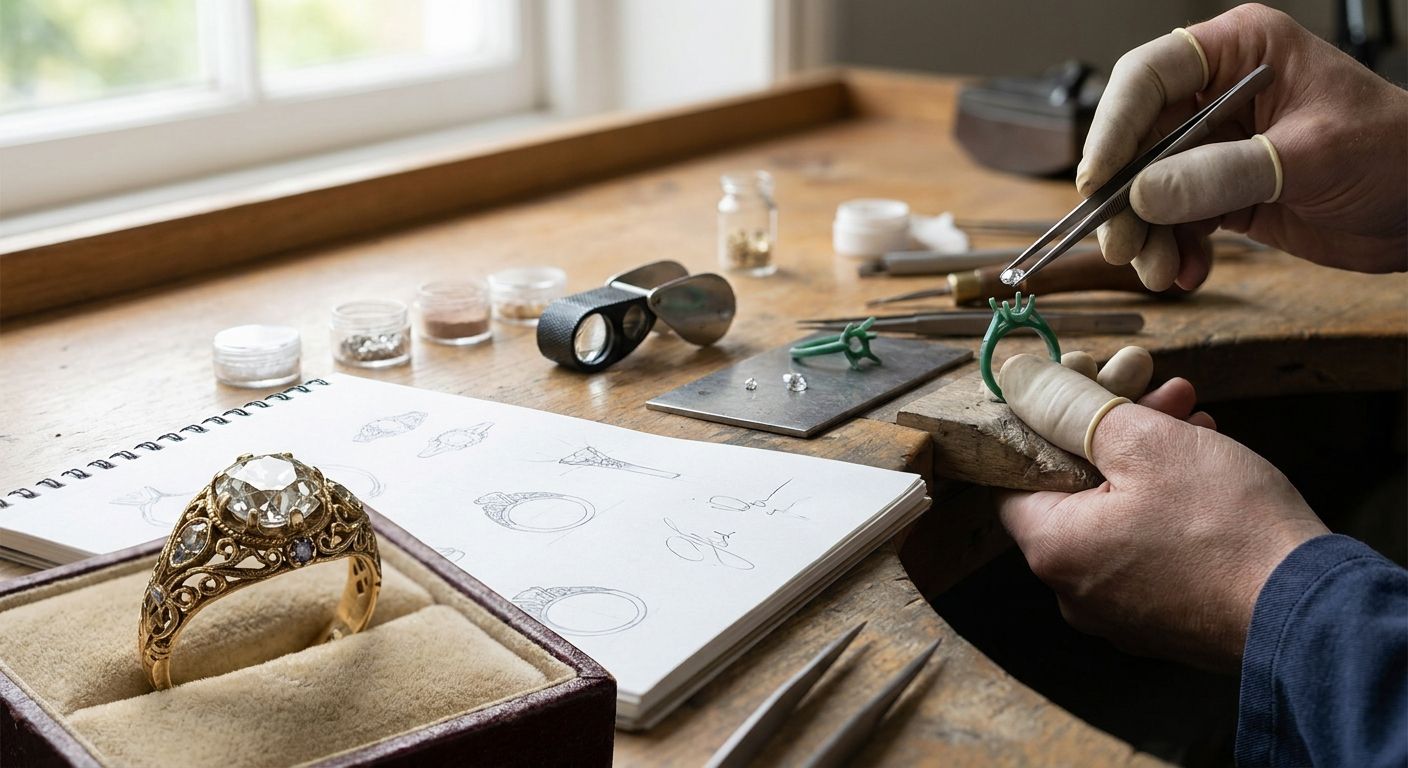
Fit-check any eternity or contour band against the actual solitaire before ordering — a jeweler measuring both rings together catches gap and clearance problems a photo never will. For a fully custom pairing built around your specific solitaire, best contemporary bridal designers for a custom ring covers what to expect from a made-to-match process. If your solitaire is already set and you just need the band designed around it, how to design a custom wedding band walks through that process step by step.
Find your solitaire's perfect band
Book an appointment to fit-check bands against your ring in person.
FAQ
What is the best wedding band for a solitaire ring?
A curved contour band is the best wedding bands for solitaire ring pairing in most cases, because it's cut to hug the prong base and sit flush with no gap. Cathedral bands come second, but only when the solitaire itself has a cathedral setting.
Should a wedding band match the solitaire's metal?
Matching metal helps but doesn't guarantee fit — prong height and band profile matter more than metal color. A mismatched metal with the right contour still sits better than a matched metal in the wrong shape.
Can you wear a straight band with a solitaire?
Yes, a straight band works well with low-profile or bezel-set solitaires where there's minimal prong structure to clear. On a high 6-prong solitaire, a straight band tends to leave a visible gap.
Do eternity bands work with solitaire engagement rings?
Diamond eternity bands pair well with solitaires and add the most visual sparkle of any band style, but they need a clearance check first so the solitaire's prongs don't press into the set stones.
What width wedding band pairs best with a solitaire?
Most solitaire pairings land between 1.5mm and 2.5mm, proportional to the shank width of the center ring. Wider bands over 3mm risk crowding a delicate solitaire setting.
Is a curved or straight wedding band better for stacking?
Curved contour bands stack more securely against prong-set solitaires because the notch locks the two rings in place. Straight bands can shift slightly since there's no matching curve to hold position.
How do you know if a wedding band fits a solitaire correctly?
Try both rings on together before purchase — if there's a visible gap or the band rocks against the solitaire, the fit is wrong regardless of how the pairing looks separately in photos.
Can a Spinelli Kilcollin band work as a wedding band?
Spinelli Kilcollin's linked bands pair best with low-profile or bezel-set solitaires, where the stacked construction reads as intentional rather than crowded against a tall prong setting.
One last thing
The fit check matters more than the style choice — a curved contour band that hasn't been checked against your specific solitaire's prong height can still gap, and a straight band that has been checked can sit perfectly flush. Try the actual pairing on before you commit to either.
If you're building out a full stack rather than a single wedding band, how to stack diamond rings without them shifting covers the mechanics of keeping multiple bands in place through 2026 and beyond.