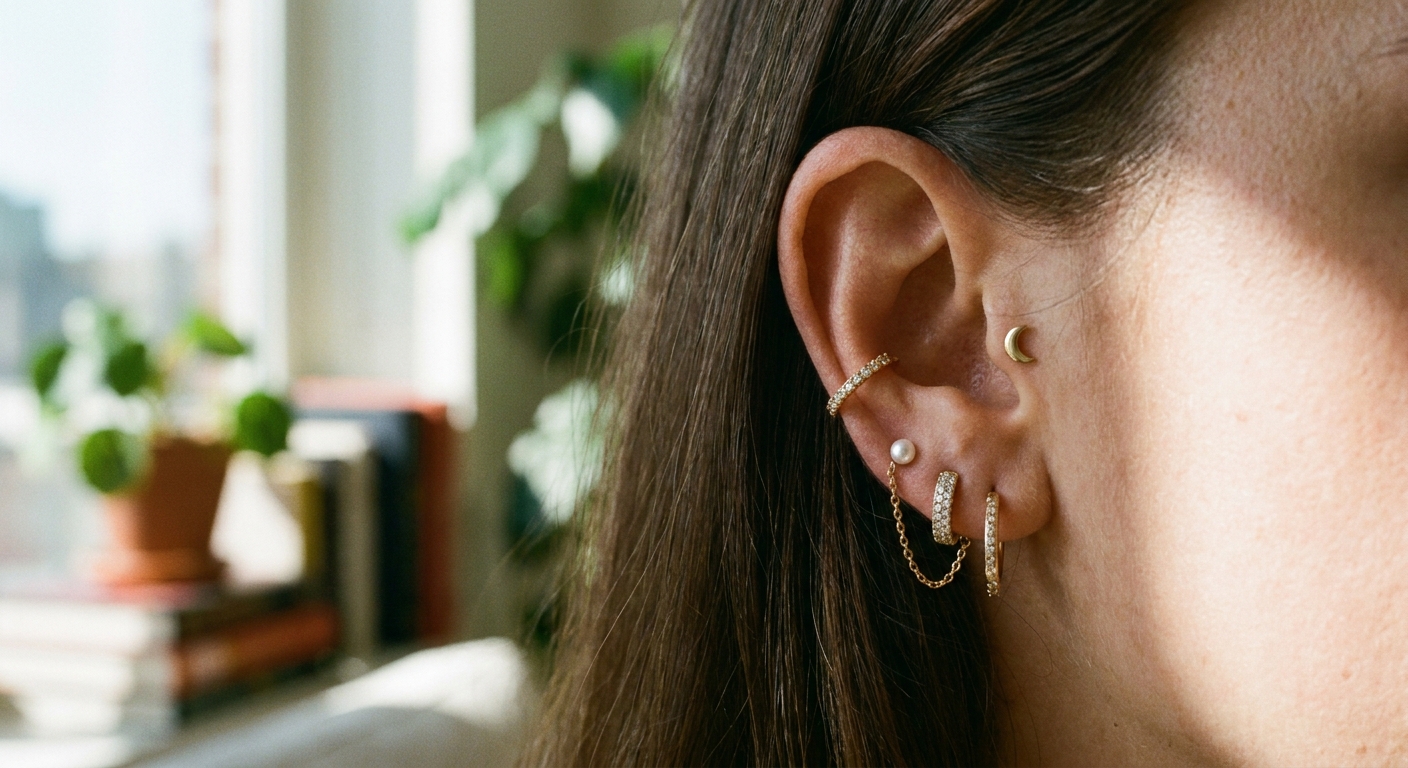
Building a curated ear stack means layering three to five earrings per ear with intentional variation in size, texture, and placement so the whole look feels assembled, not accidental. This guide walks through the exact process, from mapping your piercings to choosing metals that won't visually compete.
- A curated ear stack works with 3-5 earrings per ear, mixing at least two sizes and one texture change.
- Element 79 recommends anchoring the lobe first, then building upward toward the helix or cartilage.
- Gold hoops for everyday wear pair well as the anchor piece before adding studs or huggies above.
- Mixing metals in one stack works in 2026 as long as one metal tone dominates at roughly 70 percent.
- Skip earrings under 2mm post thickness for cartilage; they shift and irritate healing piercings.
Why this matters
A single stud pair reads as an afterthought. A curated ear stack reads as a decision.
The difference between a messy ear and a styled one isn't more jewelry, it's better spacing. Most people who buy five earrings and still look cluttered made one mistake: they matched everything instead of layering contrast. Fine jewelry designers like Artëmer and Orly Marcel build pieces specifically meant to sit next to each other in scale-graduated sets, which is why a considered stack looks intentional even at first glance in 2026.
What you'll need
- 3 to 5 earrings per ear (studs, hoops, huggies, or cartilage pieces)
- At least one piercing beyond the standard lobe (helix, tragus, or second lobe piercing)
- A mix of at least two sizes: one anchor piece and one to two smaller accents
- One metal-tone decision made before you shop, not after
- 10 minutes in front of a mirror with good lighting to test placement before committing to new piercings
If you're planning a second or third piercing to support the stack, read best earrings for a second piercing before booking, since post length and back type change depending on where the piercing sits.
The steps
1. Map your existing piercings first
Start with what you already have before buying anything new. Count your piercings per ear and note where they sit: lobe, second lobe, helix, tragus, or conch.
This matters because a stack plan built around imaginary piercings falls apart the moment you try to wear it. Most curated ears use two to three lobe piercings plus one cartilage point, which gives you enough real estate for five pieces without overcrowding a single spot.
Common mistake: planning a five-piece stack around a single lobe piercing. One hole can hold one earring at a time, not a layered look.
2. Choose your anchor earring
The anchor is the largest, most visible piece, and it sits in your primary lobe piercing. This is the earring people notice first, so it sets the tone for everything else.
A gold hoop between 12mm and 18mm works as an anchor for most face shapes and outfits. Browse gold hoops for everyday wear if you don't already own a versatile pair, since a well-proportioned hoop does more visual work than three small studs combined.
Expected outcome: one earring that could stand alone if you removed everything else and the stack would still look finished.
3. Add a mid-size contrast piece
Once the anchor is set, add a second earring in your secondary lobe or upper lobe piercing that's roughly 40 to 60 percent smaller than the anchor. This is where texture contrast matters most.
If your anchor is a smooth hoop, this piece should have some texture: a twisted band, a small pave line, or a sculptural shape. Designers like Spinelli Kilcollin build pieces specifically for this kind of layered contrast, and their design language translates from rings to ear stacking surprisingly well.
Common mistake: choosing a second piece that's nearly identical in size to the anchor. Without a size drop, the eye can't tell where one earring ends and the next begins.
4. Place your smallest accent close to the ear
The smallest earring in the stack, usually a stud between 2mm and 4mm, sits closest to the face, either as a third lobe piece or a helix stud. Its job is to fill visual gaps without pulling focus.
This step is where most people either skip entirely or overdo it with a piece too large for the spot. A stud this size should almost disappear from a few feet away and only reward someone looking closely.
Expected outcome: from across a room, your ear reads as one cohesive shape rather than three separate decisions.
5. Decide your metal palette before adding cartilage pieces
Before you add a helix or tragus piece, lock in your metal tone. Pick one dominant metal, gold or platinum, for roughly 70 percent of the stack, and treat the remaining 30 percent as your contrast metal.
Mixing metals in a stack works fine in 2026, but only when one tone leads. For the exact ratio and pairing logic, how to mix metals in a jewelry stack breaks down which combinations hold up and which read as mismatched rather than intentional.
Common mistake: buying pieces in three different metal tones with no dominant color, which makes the whole ear look like separate purchases instead of a stack.
6. Add the cartilage or helix piece last
Cartilage earrings finish the stack and draw the eye upward. A small huggie or curved barbell in the helix completes the vertical line your eye traces from lobe to cartilage.
Healed cartilage piercings tolerate slightly heavier pieces, but a stud or small hoop under 8mm keeps the proportion correct relative to the smaller lobe accent below it.
Expected outcome: a continuous visual line from the anchor hoop at the bottom to the cartilage piece at the top, with no awkward gaps in between.
7. Step back and check the full profile
Look at your ear from the front, the side, and at a three-quarter angle in a mirror. A stack that looks balanced straight-on can look lopsided from the side if spacing between piercings is uneven.
Adjust one piece at a time rather than swapping the whole stack. Small changes, moving a stud 2mm closer to the anchor, usually fix an off-balance look faster than starting over.
Book a fitting for your ear stack
See pieces in person and get sizing help at the Cherry Creek boutique.
Troubleshooting
- The stack looks too busy. Remove one piece, usually the second-smallest, and reassess. Five earrings is a ceiling, not a target; three well-chosen pieces often outperform five mismatched ones.
- Metals look mismatched instead of intentional. Recheck your ratio. If gold and silver each make up close to 50 percent, one needs to drop to a supporting role, closer to 20-30 percent of the total pieces.
- The anchor hoop keeps flipping or twisting. This usually means the hoop gauge is too thin for the piercing. Size up in post thickness rather than switching styles entirely.
- New cartilage piercing is irritated by the earring choice. Titanium or 14k gold flat-back studs reduce irritation better than standard butterfly-back earrings during the first 8-12 weeks of healing.
- The stack looks unbalanced from the side. Check spacing between piercings rather than the earrings themselves; uneven piercing placement is the more common culprit than earring choice.
- You can't decide which earring should be the anchor. Default to whichever piece has the most visual weight, largest size or brightest finish, since that's the one your eye will land on first regardless of intent.
Tools and resources
- A well-lit mirror for placement testing before committing to new piercings
- Best designer diamond earrings for everyday luxury for anchor pieces that hold up to daily wear
- How to choose designer diamond earrings for your face shape if you're still deciding on your anchor style
- A jeweler or piercer who can confirm post length and back type for existing piercings before you buy new pieces
What to do next
Once your ear stack is built, the same layering logic applies to bracelets and necklaces. If you're building beyond the ear, best bracelets for a minimalist wardrobe covers the same anchor-and-accent approach for the wrist.
FAQ
How many earrings should be in a curated ear stack?
Three to five earrings per ear is the range that reads as curated rather than cluttered in 2026. Fewer than three looks sparse for a stacked look; more than five usually needs a second piercing to support the visual weight.
Is it okay to mix gold and silver in an ear stack?
Yes, mixing metals works as long as one tone makes up roughly 70 percent of the stack. An even 50/50 split between gold and silver tends to look unplanned rather than intentional.
What earring should go in the lobe versus the cartilage?
The largest, most visible piece belongs in the primary lobe piercing as the anchor. Smaller studs and huggies work best in cartilage or helix piercings, since heavier pieces there can cause discomfort.
Do I need multiple piercings to build a curated ear stack?
Most curated stacks use two to three lobe piercings plus one cartilage point. A single lobe piercing can only hold one earring at a time, so building a five-piece look usually requires at least one additional piercing.
How much does it cost to build a full ear stack in 2026?
Cost depends heavily on materials and designer, since fine jewelry pieces vary widely by metal and gemstone. Check current pricing on individual pieces rather than assuming a flat cost across a five-earring stack.
What's the best anchor earring for a curated ear stack?
A gold hoop between 12mm and 18mm works as an anchor for most face shapes because it's visible enough to set the tone without overwhelming smaller pieces layered above it.
Can a curated ear stack work with just lobe piercings?
Yes, a three-piece stack across two to three lobe piercings still reads as curated if sizes and textures vary. Cartilage pieces add height to the look but aren't required to build a cohesive stack.
How long should I wait before adding a new piercing to my stack?
Lobe piercings typically heal in 6-8 weeks, while cartilage piercings need 3-6 months before switching earrings comfortably. Adding a new piece too early risks irritation and can disrupt the healing process.
One last thing
The stacks that photograph best aren't the ones with the most expensive single piece, they're the ones with the clearest size gradient from anchor to accent. If you only fix one thing in an existing stack, fix the size jump between your two largest earrings first. That single adjustment does more visual work in 2026 than adding a sixth piece ever will.