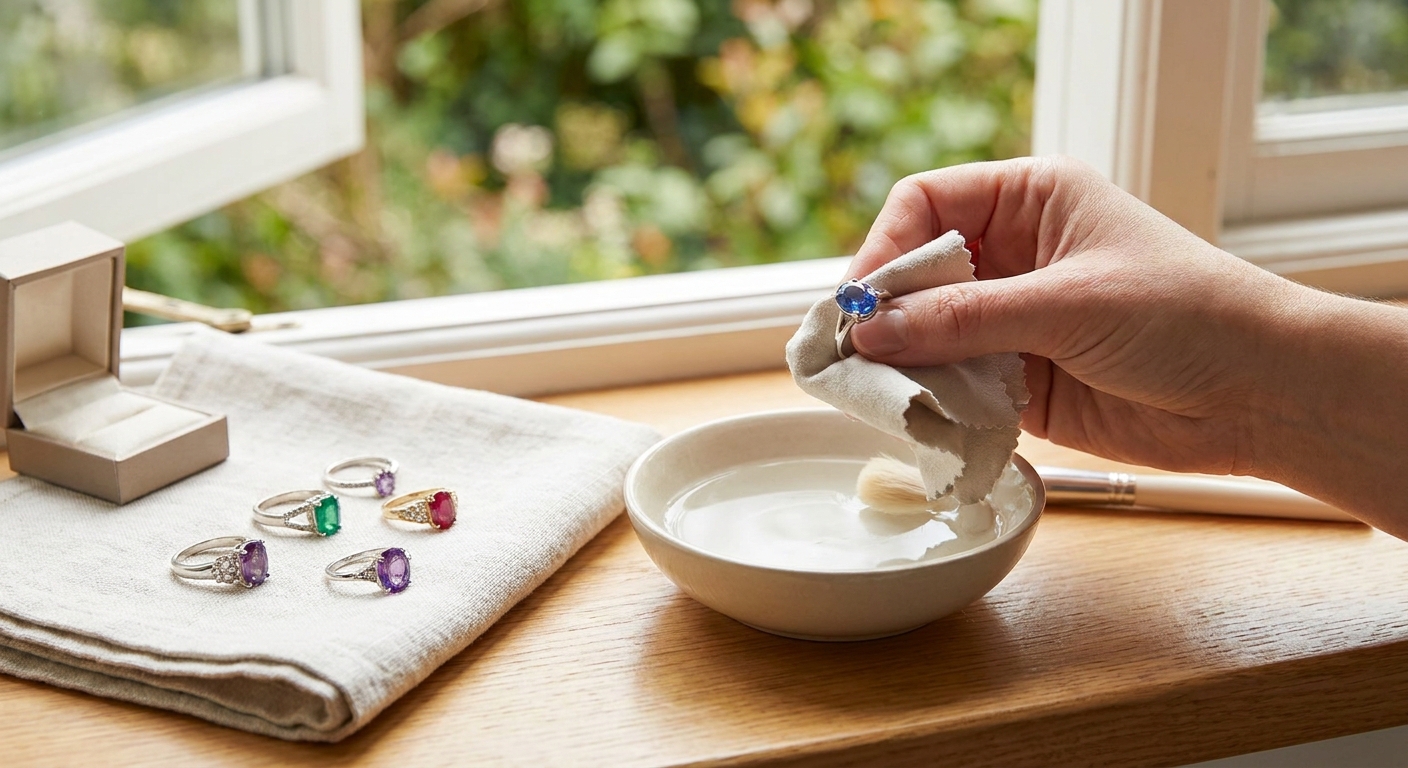
Gemstone rings don't play by diamond rules. A ruby can handle a gym session; an opal cannot. If you're wearing a colored stone from Artëmer, Orly Marcel, or Petra Class every day, the care routine has to match the stone's actual hardness, not a generic "take it off before bed" tip.
- Daily care for gemstone rings starts with removing them before water, heat, or impact — not just polishing later.
- Emeralds and opals sit far below sapphire on the hardness scale and chip if treated the same way.
- Rinse gemstone rings weekly with warm water and mild soap; skip ultrasonic cleaners on fracture-filled stones.
- Get prongs checked every 6 months in 2026 — that's when most loosening goes unnoticed.
- Store each ring in its own lined slot; piled rings scratch each other overnight.
Why this matters
Gemstones sit at wildly different points on the Mohs hardness scale. Sapphire and ruby rank 9, just under diamond's 10. Emerald sits at 7.5 to 8 on paper, but almost every emerald on the market is oiled or resin-filled to mask internal fractures, so in practice it behaves closer to a 5 or 6. Opal ranks 5.5 to 6.5. Pearl and tanzanite sit lower still.
That spread means a care routine built around diamonds will damage a colored stone ring fast. Heat cracks opals. Chlorine dulls emerald oil treatments. Ultrasonic cleaners — the kind jewelers use on diamond bands — can shatter a fracture-filled emerald in seconds. If you're deciding how to choose a gemstone for an engagement ring, the hardness question isn't cosmetic — it decides how the ring survives 2026 and every year after.
What you'll need
- Warm water and a drop of mild dish soap (no ammonia, no bleach)
- A soft-bristled toothbrush reserved only for jewelry
- A lint-free microfiber cloth
- A lined ring box or a case with individual compartments
- A jeweler's loupe or a strong phone camera zoom, for checking prongs at home
- An annual inspection appointment with a jeweler who handles colored stones, not just diamonds
The steps
1. Take rings off before anything that isn't gentle
This sounds obvious and gets skipped constantly. Dish soap, hand sanitizer, sunscreen, and gym chalk all build a film on a stone's surface that dulls its brilliance within days. Lotion and sanitizer are the two biggest offenders because people apply them multiple times a day without thinking about the ring underneath.
Expected outcome: stones stay clear and reflective instead of going hazy after a week of normal use. Common mistake: leaving the ring on for a single "quick" chore, then repeating that quick chore five times a day.
2. Rinse weekly, deep-clean monthly
Warm water, a drop of mild soap, and a soft toothbrush handle 90% of daily buildup. Work the brush gently behind the stone and around the prongs, where soap residue and skin oils collect fastest. Rinse under running water and pat dry with a microfiber cloth.
For a monthly deep clean, soak the ring for 10 minutes in the same soap-and-water mix before brushing. Skip ultrasonic and steam cleaners entirely for emerald, opal, pearl, or tanzanite — the vibration and heat can widen existing fractures. Sapphire and ruby generally tolerate ultrasonic cleaning better, but a jeweler should confirm the specific stone hasn't been treated in a way that makes it heat-sensitive.
3. Check the prongs every 3 to 6 months
Hold the ring under bright light and look at each prong tip. A prong that's worn thin, bent outward, or missing its rounded tip is a stone about to fall out, not eventually — often within weeks. This is the single most common way people lose a center stone, and it's almost always preventable.
If you're stacking multiple bands, prong wear accelerates because rings knock against each other all day. Anyone building a stack should read how to stack diamond rings without them shifting before adding a third or fourth band, because shifting rings wear down settings faster than a single ring worn alone.
4. Store every ring in its own space
Tossing rings into one drawer compartment is the fastest way to scratch soft metals and chip vulnerable stones. Gold is soft enough to mark from contact with another ring's prong. A lined box with individual slots, or even small fabric pouches, keeps each piece from touching the next.
Expected outcome: no new surface scratches after 30 days of proper storage, compared to visible dulling within a week of loose drawer storage.
5. Keep rings away from heat and chemicals
Hot tubs, pools, and household cleaners are the top three environments that damage gemstone rings. Chlorine breaks down the oil or resin used to stabilize emeralds and can discolor gold alloys over time. Hot water in a shower or tub speeds up the same breakdown in oiled stones and can cause thermal shock in opals if the temperature swings fast.
The fix is simple: take rings off before swimming, hot tubs, or cleaning with anything stronger than dish soap. A ring dish by the sink or shower solves this in one motion.
6. Rotate softer gemstones out of daily rotation
If you wear an opal, pearl, or emerald ring, it doesn't need to be the one you reach for every single day. Save it for lower-impact days and default to a sapphire, ruby, or diamond piece for gym days, cooking, or yard work. This one habit extends a soft stone's life by years, not months.
7. Book a professional inspection once a year
Home checks catch obvious problems, but a jeweler's loupe finds hairline prong wear and micro-fractures you'll miss with a phone camera. An annual appointment, timed around a birthday or anniversary, keeps this from falling off the calendar entirely.
Book a ring care appointment
Get your gemstone rings inspected and cleaned by hand in Cherry Creek.
Troubleshooting
Stone looks cloudy after cleaning. Soap film is still on the surface — rinse longer under running water and dry with a clean microfiber cloth instead of a paper towel, which leaves fibers behind.
Stone feels loose when you tap the ring. Stop wearing it immediately and get the prongs re-tipped before the stone falls out. A loose stone rarely fixes itself and almost never waits politely until your next appointment.
Metal band looks scratched despite careful storage. Gold rings worn alongside a watch, keys, or a phone in a pocket pick up scratches from daily friction, not just other rings. Consider a matte or brushed finish next time, which hides fine scratching better than high polish.
Opal or pearl developed a crack or chip. These stones are porous and soft; once cracked, they need a jeweler's assessment rather than a home fix. Superglue and clear nail polish are not repairs — they trap moisture and make the damage worse.
Ring snags on sweaters or hair. A worn or bent prong is usually the cause. Get it checked before it catches on something and bends further, which is how many stones eventually get knocked loose.
Tools and resources
For colored stone selection before you buy, best colored gemstones for an engagement ring breaks down which stones hold up best to daily wear versus which need gentler treatment from day one. If you're local to Denver, working with the best custom jewelers in Cherry Creek means someone familiar with designer settings from Artëmer, Spinelli Kilcollin, and Petra Class handles the inspection instead of a generalist who mainly sees diamond solitaires.
Keep a simple maintenance calendar: weekly rinse, monthly deep clean, prong check every 3 to 6 months, professional inspection once a year. Set the annual appointment for the same month every year in 2026 and beyond so it never gets skipped.
What to do next
If you're planning to stack multiple gemstone and diamond rings together, read how to stack diamond rings without them shifting before adding pieces, since stacking changes how fast prongs wear down and how often you'll need inspections.
FAQ
How often should I clean a gemstone ring?
Rinse a gemstone ring weekly with warm water and mild soap, and do a 10-minute soak once a month. Softer stones like opal and pearl need gentler handling and should skip ultrasonic cleaners entirely.
Can I use an ultrasonic cleaner on a gemstone ring?
Skip ultrasonic cleaners on emerald, opal, pearl, and tanzanite, since the vibration can widen internal fractures. Sapphire and ruby usually tolerate it, but confirm with a jeweler first since some stones are treated in ways that make heat or vibration risky.
Is it safe to shower or swim with a gemstone ring on?
No. Chlorine and hot water break down the oil or resin treatments used in emeralds and can cause thermal stress in opals. Take gemstone rings off before pools, hot tubs, and showers.
How do I know if a stone is about to fall out?
A loose stone will wiggle when you gently tap the ring against a hard surface, and worn prongs look thin or flattened under bright light. Stop wearing the ring and get it inspected the same week you notice either sign.
Are emeralds harder to care for than sapphires?
Yes. Sapphire ranks 9 on the Mohs hardness scale while emerald sits closer to 7.5 in practice once you account for the oil treatments nearly every emerald receives. Emeralds need gentler cleaning and more frequent prong checks.
How much does professional ring inspection cost?
Costs vary by jeweler and the complexity of the setting, so check directly with a jeweler for current pricing. An annual inspection is worth booking regardless of cost, since it catches loose prongs before a stone is lost.
Can I wear a gemstone ring every day?
Sapphire, ruby, and diamond rings hold up well to daily wear. Softer stones like opal, pearl, and emerald last longer if you rotate them out for gym days, cooking, and yard work instead of wearing them nonstop.
What's the biggest mistake people make caring for gemstone rings?
Treating every gemstone like a diamond. Diamonds tolerate heat, chemicals, and ultrasonic cleaning that will damage softer or treated stones, so the cleaning method has to match the specific gem.
One last thing
Most people assume a lost stone means a manufacturing defect. In reality, it's almost always a worn prong that went unchecked for a year or more — a five-minute fix that gets skipped because nobody looks. Set a reminder on your phone for the same week every year in 2026, pair it with your birthday or anniversary, and the prong check happens automatically instead of by accident.