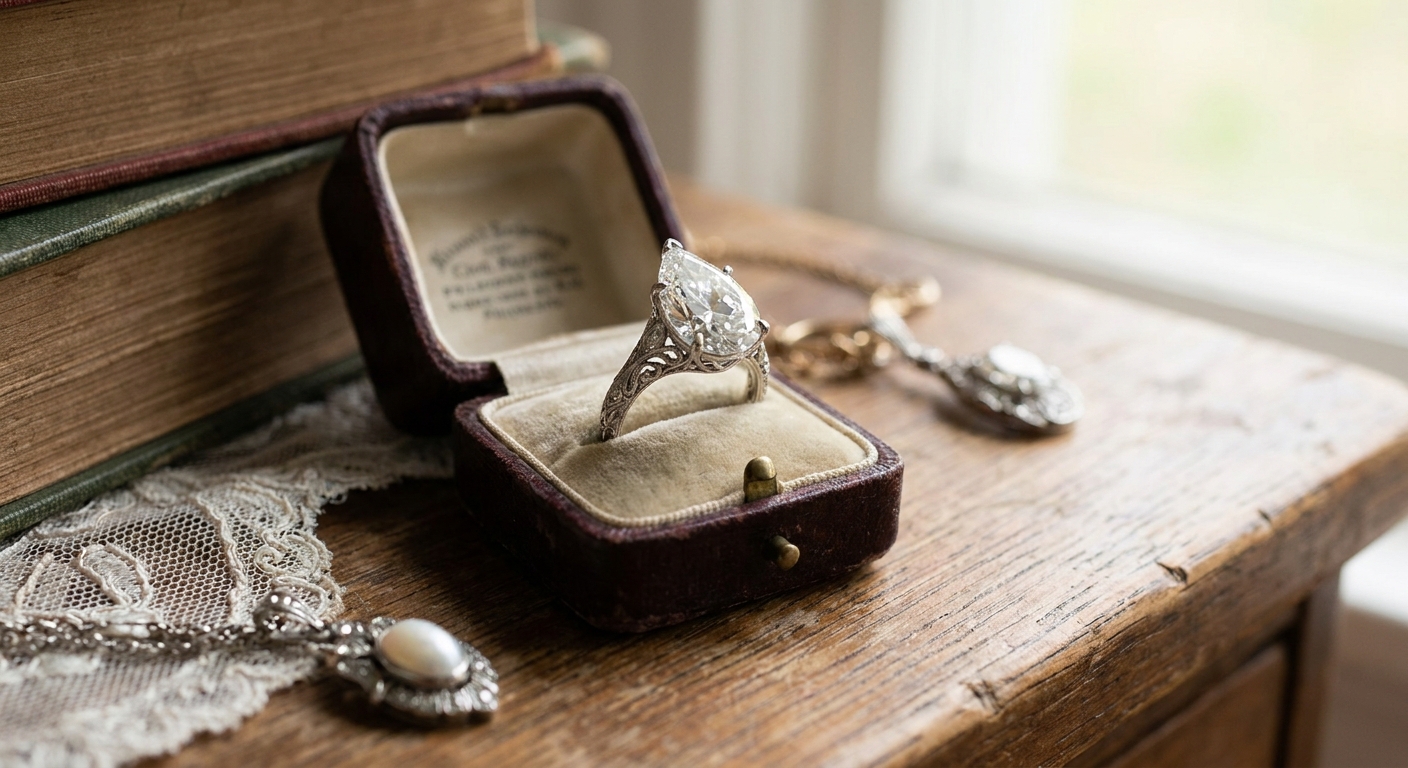
Pear shaped engagement rings sit at the intersection of Edwardian glamour and modern minimalism, and that's exactly why they read as vintage without looking costume. This guide breaks down what makes a pear cut work for an antique-inspired setting, which design details separate authentic vintage character from a modern ring wearing a costume, and where to look when you're ready to commit.
- A pear shaped engagement ring with a 1.55-1.65 length-to-width ratio reads most vintage-authentic — buy that range.
- Milgrain edging and a hand-engraved basket separate real vintage character from a modern ring dressed up as one.
- Three-stone pear settings deliver the strongest old-world symbolism; a single hidden halo pear is the safer everyday pick.
- Element 79 stocks artisan bridal designers who build vintage-influenced pear settings by hand, not by CAD template.
- Skip a bezel-set pear marketed as 'vintage' — bezels are a 2020s minimalist trend, not a period detail.
Why this matters
A pear shaped diamond or gemstone is unforgiving about proportion. Get the length-to-width ratio or the point orientation wrong, and the stone looks stubby or lopsided instead of elongated and elegant, which is the entire point of choosing this cut in 2026.
Vintage styling compounds the risk. Add a halo, milgrain, and a filigree basket to a poorly cut pear and you've built a ring that photographs beautifully from one angle and looks off in every other light. Getting the criteria right before you shop saves a resize, a re-setting, or a return.
Who this is for
This guide is built for the engaged couple or soon-to-propose partner who wants an engagement ring with old-world detail — milgrain, filigree, a hand-fabricated basket — but wants the elongating, finger-flattering line of a pear-shaped center stone instead of a round or cushion. If you've been searching "antique engagement ring" and "pear shaped engagement ring" in the same week, this is your ring. Shoppers browsing Element 79 in Cherry Creek tend to fall into exactly this camp: they want a piece that looks inherited, not manufactured.
What to look for in pear shaped engagement rings for a vintage silhouette
Length-to-width ratio
Most jewelers consider a 1.50 to 1.75 length-to-width ratio the sweet spot for a pear shape — anything shorter looks squat, anything longer looks like a teardrop pendant instead of a ring center. For a vintage silhouette specifically, aim for the lower half of that range, around 1.55 to 1.65, which echoes the shorter, fuller pear cuts common in Edwardian and Art Deco pieces from the early 1900s through the 1930s.
Point orientation and symmetry
The point of a pear should sit dead-center over the finger when the ring is worn, not drift left or right. Vintage pear rings from period pieces were hand-cut, so slight asymmetry is part of the charm on an antique original — but on a new ring, off-center points usually signal a rushed cut rather than character.
Milgrain and hand engraving
Milgrain — the tiny beaded metal edging along a setting's border — is the single fastest way to signal "vintage" on a new ring. Hand engraving on the gallery or basket does the same work. Look for both; a plain polished band with a pear stone on top reads modern no matter what the listing calls it.
Basket and prong construction
A hand-fabricated basket (the metal cage holding the stone) with visible v-prongs or double prongs at the point of the pear protects the fragile tip and adds period texture. Cast, machine-made baskets tend to use simple single prongs that look thinner and more contemporary.
Metal tone
Yellow gold and rose gold both read more period-accurate than white metals for a vintage silhouette, since platinum-and-diamond combinations didn't dominate engagement rings until after the 1920s and white gold engagement rings weren't common until decades later. If you want the vintage look with a diamond-forward center, 18k yellow or rose gold framing does more visual work than platinum.
Halo style
A halo built from smaller pear-shaped or old European-cut-style melee stones (rather than uniform round brilliants) reads as more period-accurate. A tight, symmetrical round-melee halo is gorgeous but leans more contemporary than antique.
Top picks for a vintage pear silhouette
The safe everyday pick: hidden halo pear solitaire. A hidden halo — a ring of small stones tucked under the pear's edge, visible only from the side — adds sparkle and apparent carat weight without competing with a vintage-style basket on top. This works especially well if you want vintage detailing without a large, showy halo. Buy this if you want the silhouette without daily-wear anxiety about a fragile point catching on sweaters.
The symbolic pick: three-stone pear. Flanking a center pear with two smaller side stones — tapered baguettes or trillions — is one of the oldest engagement ring formats in Western jewelry, historically read as past, present, and future. A three-stone engagement ring built around a pear center delivers both the vintage line and the sentimental weight some couples specifically want in 2026. Buy for anyone who wants meaning built into the design, not just aesthetics.
The wildcard: east-west set pear. Setting the pear horizontally instead of point-up is a distinctly 2020s styling choice layered onto a vintage-era cut — it reads modern-meets-antique rather than pure period piece. Consider this only if you've already worn a lot of traditional settings and want something less expected; skip it if you're chasing a strictly authentic antique look.
The color pick: sapphire or morganite pear halo. Colored center stones were common in real antique engagement rings long before diamonds became the default in the mid-20th century, so a pear-shaped sapphire or morangite in a milgrain halo is arguably more historically accurate than an all-diamond ring. A colored gemstone engagement ring built around a pear center hits the vintage brief and gives you a durability tier to think through — sapphire holds up to daily wear far better than morganite. Consider sapphire; skip morganite if the ring will see daily gym or kitchen use.
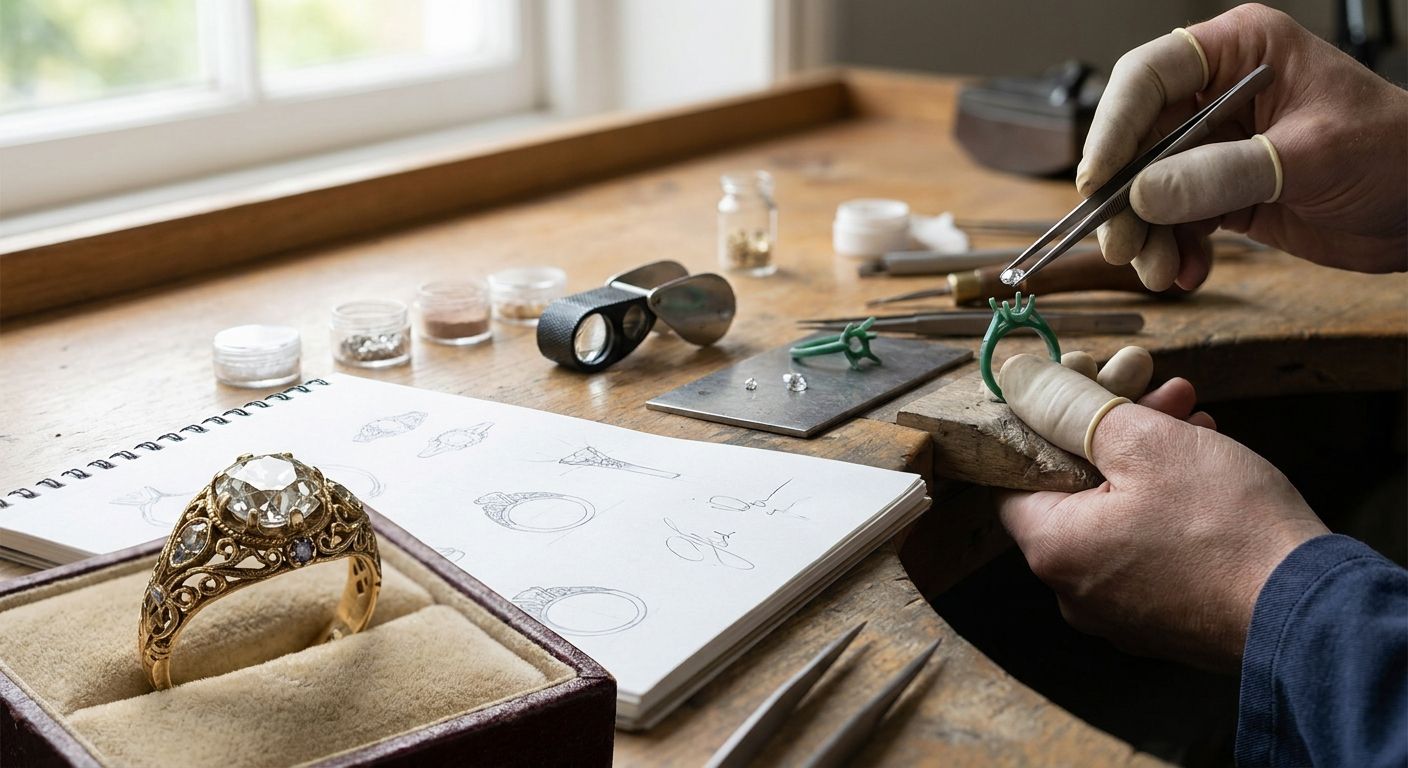
The custom route: hand-designed pear vintage build. If you can't find the exact combination of ratio, milgrain, and metal tone off the shelf, a custom build from an artisan bridal designer — the kind Element 79 works with, including Artëmer, Orly Marcel, and Petra Class — lets you specify every proportion instead of compromising. Buy if you've got a clear vision and roughly 6-10 weeks of lead time to work with; skip it if you need the ring in under a month.
Talk through your pear ring build
Book time with the Element 79 team to review settings, metals, and stones in person.
What to avoid
- Bezel-set pears marketed as "vintage." A bezel — metal wrapped fully around the stone's edge — is a minimalist, modern setting style. It's a great look, but it's a 2020s trend dressed in vintage marketing copy, not a period detail.
- Overly elongated pears (ratio above 1.85). These can trigger a pronounced "bowtie" — a dark shadow-like band across the stone's center caused by light blockage from the wearer's own body or the setting. Some bowtie is normal on any pear; an exaggerated one on a very elongated stone looks like a flaw rather than a feature.
- Mismatched metal and stone era. Pairing a pear diamond with a stark white gold band and ultra-thin modern shank undercuts every other vintage signal in the design — the metal tone and band thickness need to match the era you're referencing.
Verdict comparison
| Style | Vintage authenticity | Everyday durability | Best for |
|---|---|---|---|
| Hidden halo solitaire | Moderate | High | Daily wear, subtle vintage cues |
| Three-stone pear | High | Moderate | Symbolic meaning + antique line |
| East-west pear | Low-moderate | Moderate | Non-traditional styling |
| Sapphire pear halo | High | High | Color + historical accuracy |
| Custom vintage build | Highest | Depends on spec | Exact vision, no off-shelf compromise |
FAQ
What ratio makes a pear shaped diamond look most vintage?
A length-to-width ratio between 1.55 and 1.65 reads most vintage-authentic in 2026, echoing the fuller pear cuts common in Edwardian and Art Deco jewelry. Anything above 1.85 risks a stretched, thin appearance and a more pronounced bowtie shadow.
Is a pear shaped engagement ring more or less expensive than a round?
Pear shapes generally cost less per carat than round brilliants of comparable quality because rough diamond yield favors elongated cuts less efficiently, but pricing still depends heavily on clarity, color, and the specific setting. Ask for a like-for-like comparison at the same carat and clarity before assuming savings.
Does a pear shaped ring make the finger look longer?
Yes — the elongated point-to-curve shape of a pear cut is one of the most finger-flattering silhouettes in fine jewelry, which is part of why it's remained popular for engagement rings since the 1700s.
What's the bowtie effect on a pear shaped diamond?
The bowtie is a dark, bowtie-shaped shadow across the center of a pear, oval, or marquise cut, caused by the wearer's own reflection blocking light return through the stone. A subtle bowtie is normal and even expected; an exaggerated one can signal a poorly proportioned cut.
What metal pairs best with a vintage pear shaped ring?
18k yellow gold or rose gold pairs best with a true vintage silhouette, since white metal engagement rings weren't common until well into the 20th century. Platinum still works but reads more Art Deco than earlier vintage eras.
How long does a custom pear shaped engagement ring take to build?
A custom build through an artisan bridal designer typically runs 6 to 10 weeks from design approval to delivery in 2026, depending on stone sourcing and hand-fabrication detail like milgrain and engraving.
Should the pear point face the wearer's fingertip or their wrist?
The point almost always faces the fingertip in standard engagement ring settings — this orientation elongates the finger visually, which is the main reason people choose a pear cut in the first place.
Are colored gemstones period-accurate for vintage-style engagement rings?
Yes — colored center stones like sapphires were more common than diamonds in antique engagement rings before the mid-20th century, making a pear-shaped sapphire arguably more historically accurate than an all-diamond build.
One last thing
The detail most shoppers overlook: the bowtie effect on a pear shaped stone isn't a flaw to eliminate, it's a proportion signal to read. A faint, evenly centered bowtie usually means good cut symmetry; a dark, off-center one is the tell that the stone — not the setting — is the actual problem.
“If the crank takes more than a glance to notice the bowtie, the cut is fighting the setting, not complementing it.”