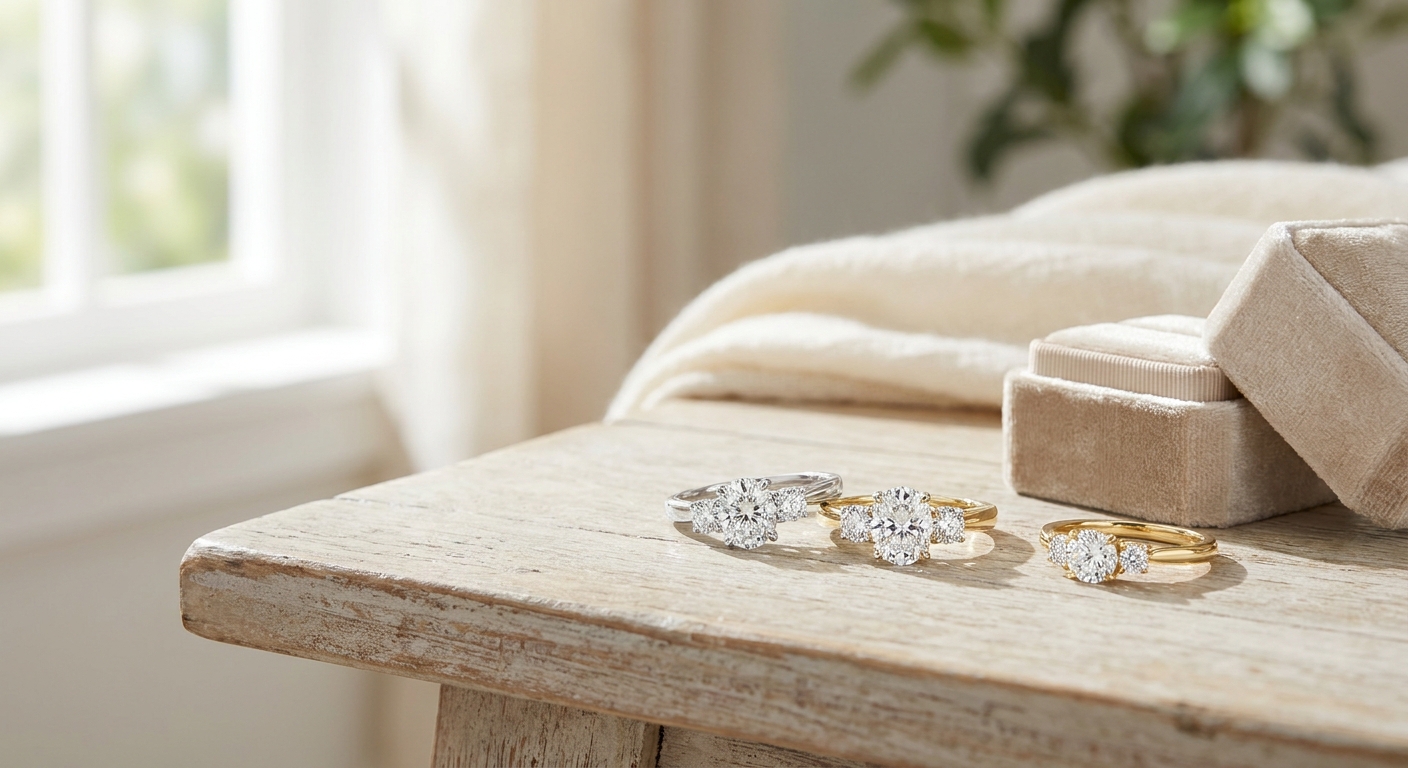
A three stone engagement ring turns one gem into three: a stone for your past, a stone for your present, and a stone for whatever comes next. That symbolism is the whole point of the style — but only if the proportions, cut pairing, and setting actually hold up under daily wear in 2026.
- A 1:1.5 side-to-center stone ratio reads as balanced; wider gaps make side stones look like afterthoughts.
- Colored gemstone trilogies need bezel or halo protection on the side stones, or they chip faster than diamond.
- Custom-designed three stone rings let each stone carry literal meaning; ready-made trilogies rarely do — best pick for 2026 symbolism-first buyers.
- Vintage-inspired trilogies with old-mine cuts resize poorly; confirm with a jeweler before buying one secondhand.
Why this matters
Three stone rings sell on story, not carat weight. Couples choosing engagement rings in 2026 are leaning harder into meaning over trend, which means a poorly proportioned trilogy undercuts the exact thing it's supposed to communicate. Get the ratio, the cut pairing, and the setting security right, and the ring still reads as intentional five years and a hundred handshakes later.
Who this is for
This guide is for couples who want an engagement ring with narrative weight — past, present, future — rather than a single solitaire or a scattered cluster of stones. It's also for anyone upgrading an anniversary ring with a meaningful three stone design, or a bride who wants something more considered than "three diamonds in a row." Element 79 fields this exact question in the Cherry Creek showroom on a near-weekly basis.
What to look for in a three stone engagement ring
Side-to-center stone ratio
The center stone should carry roughly 50 to 60 percent of the total visual weight, with side stones at a 1:1.5 ratio to the center. Go much wider than that and the side stones start to look like accents rather than equal parts of the story. This ratio is the single biggest factor in whether a trilogy photographs and wears as balanced.
Cut pairing between center and side stones
Matching cuts (round with round, cushion with cushion) reads cohesive; mismatched cuts (a round center flanked by baguettes) can work but only when the setting is designed around that contrast on purpose. Accidental mismatches — a jeweler squeezing in whatever side stones were on hand — break the eye line and look unfinished. This is where a lot of mass-market trilogies fall apart under close inspection.
Setting security for the side stones
Side stones sit lower and take more daily impact than a center stone, especially on a hand that types, cooks, and does dishes. Prong height and metal gauge around the side stones matter more here than on any other ring style, because two extra stones mean two extra failure points. Ask specifically how the side stones are secured, not just how the center stone is set.
Whether the design stacks with a wedding band
A three stone ring with a wide, domed profile can fight a straight wedding band at the base of the finger. Flatter galleries and slightly curved bands solve this, but it's worth checking before you fall for a silhouette that won't sit flush against a companion band.
Gemstone meaning and color choice
Diamond-only trilogies keep the symbolism classic and durable for daily wear. Colored gemstone trilogies — sapphire for the present, a family heirloom stone for the past, a diamond for the future — carry a more literal, personal story, but they ask more of the setting to protect softer stones long-term.
Build a Trilogy That Means Something
Talk through stone choice and proportions with Element 79's Cherry Creek bridal team.
Top picks for a three stone engagement ring
The Classic Diamond Trilogy — the safe pick. Round brilliant or cushion-cut diamonds at a 1:1.5 side-to-center ratio give you the most durable, most resizable version of this style, and it's the easiest to match to a plain wedding band later. It photographs well under any lighting and doesn't ask the wearer to think about gemstone hardness. If you want the symbolism without adding maintenance to your life, start with choosing a designer engagement ring built around this structure. Buy.
The Colored Gemstone Trilogy — the colorful pick. Sapphire or emerald side stones around a diamond center turn the past-present-future story into something you can actually see, especially when the side stones reference a family gemstone or birthstone. Sapphire rates a 9 on the Mohs scale and holds up to daily wear reasonably well; emerald sits closer to 7.5–8 and needs more protective setting work. Read through colored gemstones for an engagement ring before locking in a stone choice. Consider.
The Custom-Designed Trilogy — the personal pick. This is the only version where each stone can carry a specific, literal meaning: a reset heirloom diamond, a birthstone, a stone chosen for the year you met. Nothing off a case shelf does this as well as a piece built stone-by-stone with a jeweler. If symbolism is the entire reason you're considering a three stone ring, designing a custom engagement ring is the more honest path in 2026. Buy for symbolism-first buyers.
The Vintage-Inspired Trilogy — the wildcard. Old European or old-mine cut side stones set in filigree galleries look genuinely romantic and read as one-of-a-kind. But those cuts and gallery styles resize far less predictably than modern settings, and a jeweler needs to confirm the ring can move up or down a size without disturbing the side stone settings. Beautiful on the hand, riskier on the resizing bench. Skip unless a jeweler confirms it resizes safely.
What to avoid
- Mismatched cuts with no design intent. A round center flanked by two leftover princess-cut side stones isn't a stylistic choice, it's inventory management, and it shows.
- Low-set prongs on colored side stones. Emerald and other softer gemstones chip at the girdle when prongs sit low and unprotected — ask for bezel or protective gallery settings instead.
- "Trilogy" rings where side stones are under 20 percent of total carat weight. At that ratio the side stones read as accents, not as equal parts of a past-present-future story, which defeats the entire premise of the style.
Trilogy style comparison
| Style | Ideal stone ratio | Everyday durability | Best for | Verdict |
|---|---|---|---|---|
| Classic Diamond Trilogy | 1:1.5 | High | First-time buyers, daily wear | Buy |
| Colored Gemstone Trilogy | 1:1.5 | Medium (setting-dependent) | Personal, literal symbolism | Consider |
| Custom-Designed Trilogy | Varies by stone | Depends on design | Heirloom stones, birthstones | Buy for symbolism |
| Vintage-Inspired Trilogy | Often uneven | Lower, resizing risk | Collectors, confirmed resizing | Skip unless confirmed |
FAQ
What's the best three stone engagement ring style in 2026?
The classic diamond trilogy with a 1:1.5 side-to-center ratio is the most durable and easiest to resize in 2026, which makes it the safest starting point. Colored gemstone and custom-designed trilogies suit buyers prioritizing literal symbolism over daily-wear durability.
How much does a three stone engagement ring cost compared to a solitaire?
Cost depends on total carat weight spread across three stones rather than one, so a direct comparison varies by gemstone choice and ratio. Ask a jeweler for a like-for-like quote based on the specific stones you're considering.
Does a three stone ring really symbolize past, present, and future?
Yes, that's the traditional reading — one stone for the relationship's past, one for the present, one for the future. Custom-designed trilogies let you assign that meaning literally, using specific stones tied to milestones.
Can you use colored gemstones instead of all diamonds?
Yes, sapphire and emerald are common choices for the side stones or center in a three stone ring. Sapphire holds up well to daily wear at a 9 on the Mohs hardness scale; emerald needs more protective setting work.
Is a three stone ring harder to resize than a solitaire?
It can be, especially with vintage-inspired settings that use filigree galleries around the side stones. A jeweler should confirm resizing feasibility before you buy, particularly on antique or antique-style pieces.
Do three stone rings stack well with a wedding band?
Flatter galleries and slightly curved wedding bands stack more cleanly against a three stone ring than a straight band would. Check the ring's profile at the base before assuming any wedding band will sit flush.
What's the ideal stone ratio for a three stone ring?
A 1:1.5 side-to-center ratio is the standard benchmark for a balanced trilogy in 2026. Going wider than that makes the side stones read as minor accents rather than equal parts of the design.
One last thing
Three stone settings actually predate the solitaire diamond ring as the dominant engagement style — sentimental Victorian-era jewelry favored multi-stone designs long before diamond marketing standardized the single center stone in the 20th century. If symbolism is your reason for considering this style in 2026, that history is on your side, not against it.