Art deco engagement rings pull their geometry, symmetry, and metalwork from the 1920s and 1930s, and in 2026 that period aesthetic is one of the most requested looks for engaged couples who want a ring with history baked into the design. This guide breaks down what actually reads as art deco versus what's just "vintage-inspired," and which settings hold up under daily wear.
- Art deco engagement rings favor emerald and pear-cut centers framed by milgrain and geometric halos. Buy that combination for authenticity.
- Platinum outlasts white gold for fine filigree work over decades of daily wear. Buy platinum for a period-accurate band.
- Three-stone and halo settings signal true deco framing; plain round solitaires without geometric detail miss the era entirely. Skip the plain solitaire.
- Custom design rebuilds 1920s motifs like sunburst haloes and stepped facets that mass production skips. Consider a custom build for real authenticity.
Why this matters
Art deco isn't a marketing label slapped on any ring with a bit of sparkle around the edges. The style emerged after the 1925 Paris Exposition Internationale des Arts Décoratifs and ran through roughly 1935, built on strict geometry, symmetry, and platinum's strength as a metal that could hold impossibly fine filigree without bending.
Buy a ring that only borrows the name and you get a modern halo with rounded edges pretending to be historic. Buy the real geometry, and the ring reads correctly in every photo, not just under studio light. That distinction matters more in 2026 than it did a decade ago, because "vintage-inspired" has become a catch-all term retailers use loosely.
Who this is for
This guide is for the bride or couple who wants a ring that looks like it survived the Gatsby era, not a contemporary round brilliant with a decorative border. If your Pinterest board is full of stepped facets, sunburst haloes, and old European cuts, keep reading. If you just want "something a little different," a designer engagement ring from Element 79's contemporary lineup will serve you better and cost less to source.
What to look for in art deco engagement rings for a vintage aesthetic
Geometric center-stone cuts
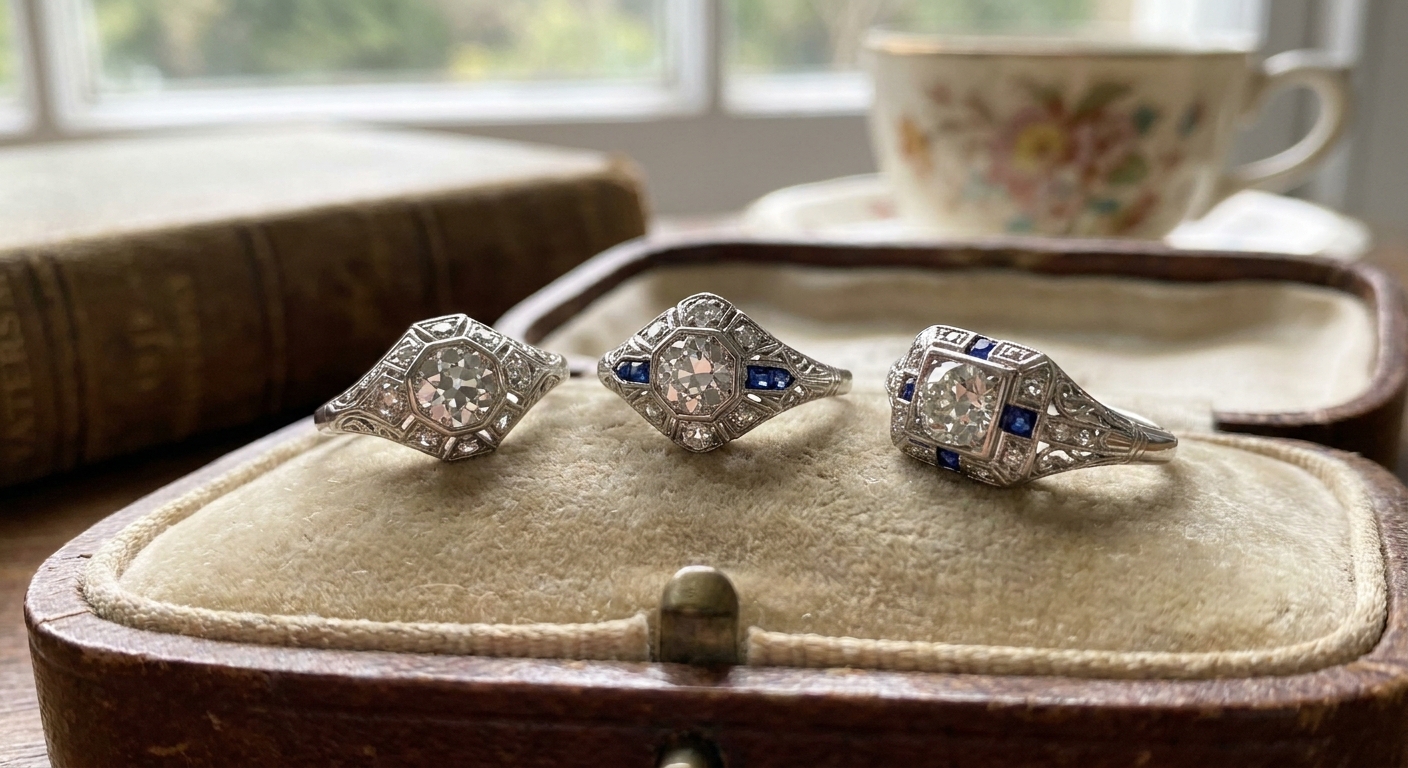
Emerald, asscher, and pear cuts dominate the period because their step-cut facets show off geometry instead of pure fire. A round brilliant, however sparkly, doesn't carry the same architectural line and reads as modern no matter what setting surrounds it.
Milgrain and filigree metalwork
Milgrain is the tiny beaded edging that traces a setting's outline, and filigree is the openwork metal lacing that fills the shoulders. Both require hand-finishing, and both are the fastest visual tell for whether a ring is genuinely period-accurate or just has a plain polished band underneath a fancy stone.
Platinum over white gold
Platinum was the metal of choice in the 1920s because it's dense enough to hold fine detail without the metal fatigue that eventually cracks rhodium-plated white gold. If you want a band that keeps its filigree crisp after 2026's tenth anniversary and beyond, choosing platinum for the ring band is the single decision that protects the whole design.
Symmetrical three-stone or halo framing
Deco settings are built around strict symmetry: a center stone flanked by matching baguettes, or ringed by a tight geometric halo. Asymmetric or clustered designs, however trendy, break the visual rule that defines the whole era.
Contrast color accents
Sapphire, onyx, and emerald side stones against a white diamond or colorless center were a signature deco move, adding graphic contrast instead of relying on sparkle alone. A ring with zero color contrast can still be well-made, but it won't carry the same period signature.
“If the ring reads modern under warm light, it's not art deco, it's art deco-inspired.”
Top picks
The Purist's Pick: emerald-cut with a milgrain halo. Step-cut facets plus a tight geometric halo is the closest a ring gets to a museum-piece silhouette, and the milgrain edging is what separates it from a generic halo setting. Emerald cuts also show inclusions more readily, so clarity above VS2 matters here. Emerald rings for a bold engagement look is the category to start browsing. Buy.
The Vintage Silhouette Pick: pear-shaped with a three-stone flank. The elongated pear cut was a favorite deco silhouette for its length-to-width drama, and flanking it with tapered baguettes locks in the symmetry the era demanded. It also elongates the finger more than a round or oval center. Pear-shaped engagement rings for a vintage silhouette covers sizing and proportion in more depth. Buy.
The Symmetry Pick: three-stone with tapered baguettes. A round or cushion center flanked by two step-cut baguettes gives you deco geometry without the full commitment of an emerald or pear center stone. It reads slightly more contemporary than the two picks above, so treat it as the safer entry point. Consider.
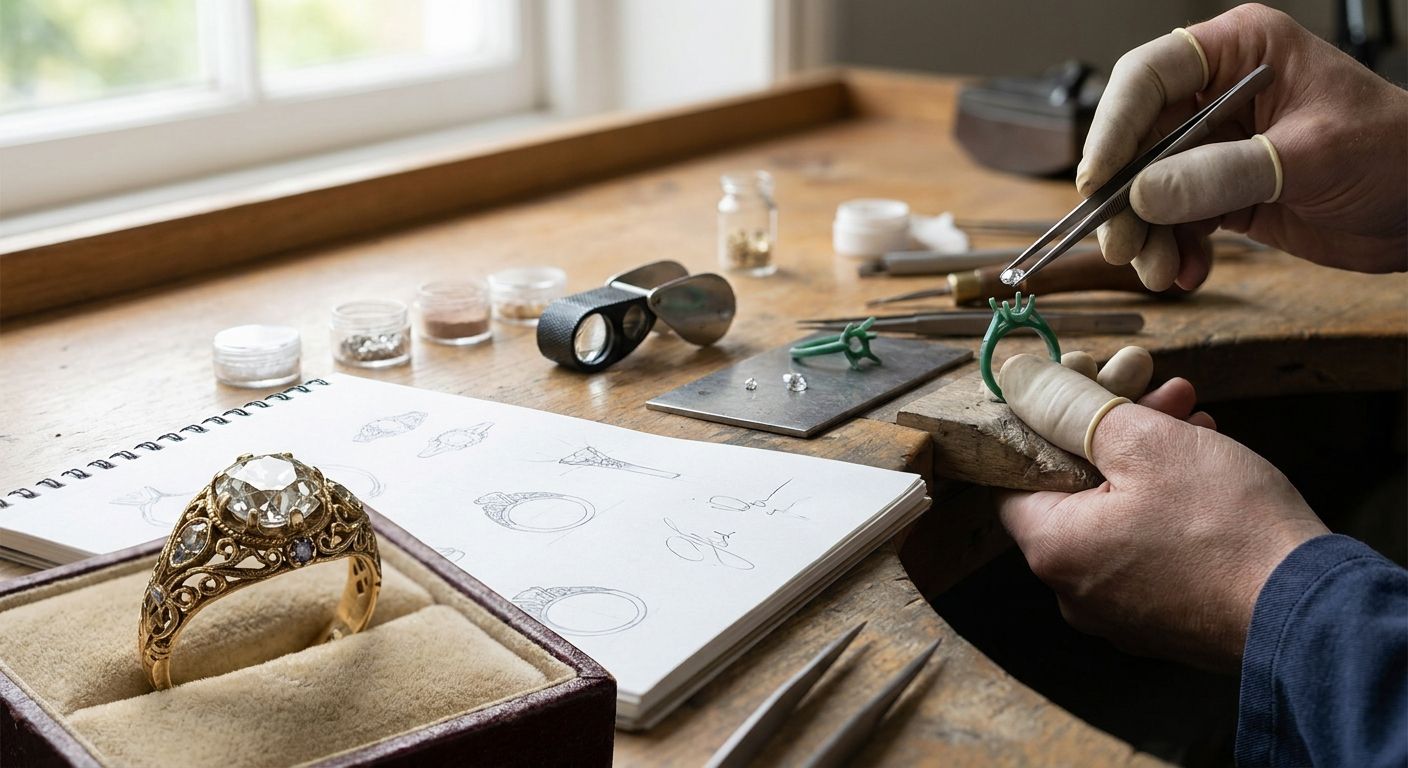
The Bespoke Pick: a fully custom deco build. Sunburst haloes, stepped facet patterns, and engraved shoulder work rarely exist off-the-shelf in exact period proportions, so a custom build is the only path to a truly museum-accurate piece. It takes longer and costs more in labor, but it's the only pick on this list where you control every geometric line. Consider.
What to avoid
- A plain round solitaire marketed as "art deco." Round brilliants without step-cut geometry or milgrain detailing don't carry the era's visual language no matter what the listing title says.
- Cast yellow gold with no filigree. Yellow gold existed in the 1920s, but the signature deco pieces were platinum and white gold specifically because those metals held fine detail. A smooth yellow gold band with no openwork is a different aesthetic entirely.
- Art nouveau pieces mislabeled as deco. Nouveau's flowing floral lines predate and directly contrast with deco's strict geometry. If the design curves like a vine instead of stepping like a staircase, it's the wrong era.
Talk to a Cherry Creek jeweler
Book an appointment to see deco-style settings and discuss a custom build in person.
Verdict comparison
| Style | Center cut | Metal | Verdict |
|---|---|---|---|
| Emerald milgrain halo | Emerald | Platinum | Buy |
| Pear three-stone | Pear | Platinum | Buy |
| Round three-stone baguette | Round or cushion | Platinum or white gold | Consider |
| Fully custom sunburst | Varies | Platinum | Consider |
| Plain round solitaire | Round | Any | Skip |
FAQ
What makes a ring art deco versus just vintage-inspired?
An authentic art deco ring pairs geometric step-cut stones (emerald, asscher, pear) with milgrain edging and strict symmetry, usually in platinum. A ring is only vintage-inspired if it borrows a rounded halo or filigree motif without the underlying geometric structure of the 1920s-1930s period.
Is platinum required for an authentic art deco look?
Platinum isn't strictly required, but it's the historically accurate choice because the metal's density let 1920s jewelers cut fine filigree that white gold couldn't hold as cleanly. White gold can approximate the look but tends to wear down detailed edging faster over decades.
What's the best cut for an art deco engagement ring?
Emerald and asscher cuts are the most period-accurate because their step facets echo deco's architectural lines. Pear and marquise cuts also worked well in the era for their elongated, symmetric silhouettes.
How much does an art deco-style engagement ring cost in 2026?
Cost depends heavily on center stone carat weight, metal choice, and how much hand-finished filigree or milgrain work the piece requires. Custom builds with hand-engraved detailing generally run higher than a comparable plain-band ring because of the added labor time.
Can an art deco-style ring be resized later?
Yes, but rings with heavy filigree or milgrain along the shank need a jeweler experienced with fine detail work to avoid distorting the pattern during resizing. Ask about resizing tolerance before you buy if the band has continuous engraving.
Is a halo setting the same as art deco?
Not automatically. A halo only reads as deco when it's geometric and tightly milgrain-edged rather than a simple round pave ring, since plain rounded haloes are a modern design, not a period one.
What's the difference between art deco and art nouveau rings?
Art deco is built on strict geometry and symmetry from the 1920s-1930s, while art nouveau (roughly 1890-1910) favored flowing, asymmetric floral and vine motifs. The two styles predate and contrast each other rather than overlap.
Are lab-grown diamonds appropriate for an art deco setting?
Yes, a lab-grown emerald or pear-cut diamond carries the same step-cut geometry as a mined stone and reads identically in a deco setting. The era's design language is about cut and metalwork, not stone origin.
One last thing
The detail most buyers miss in 2026: true deco filigree was almost always hand-pierced, not cast, which is why the undergallery (the part of the setting under the stone) on an authentic-style piece often shows more engraving than the visible top. Flip any ring you're considering and check the underside before you check the sparkle.