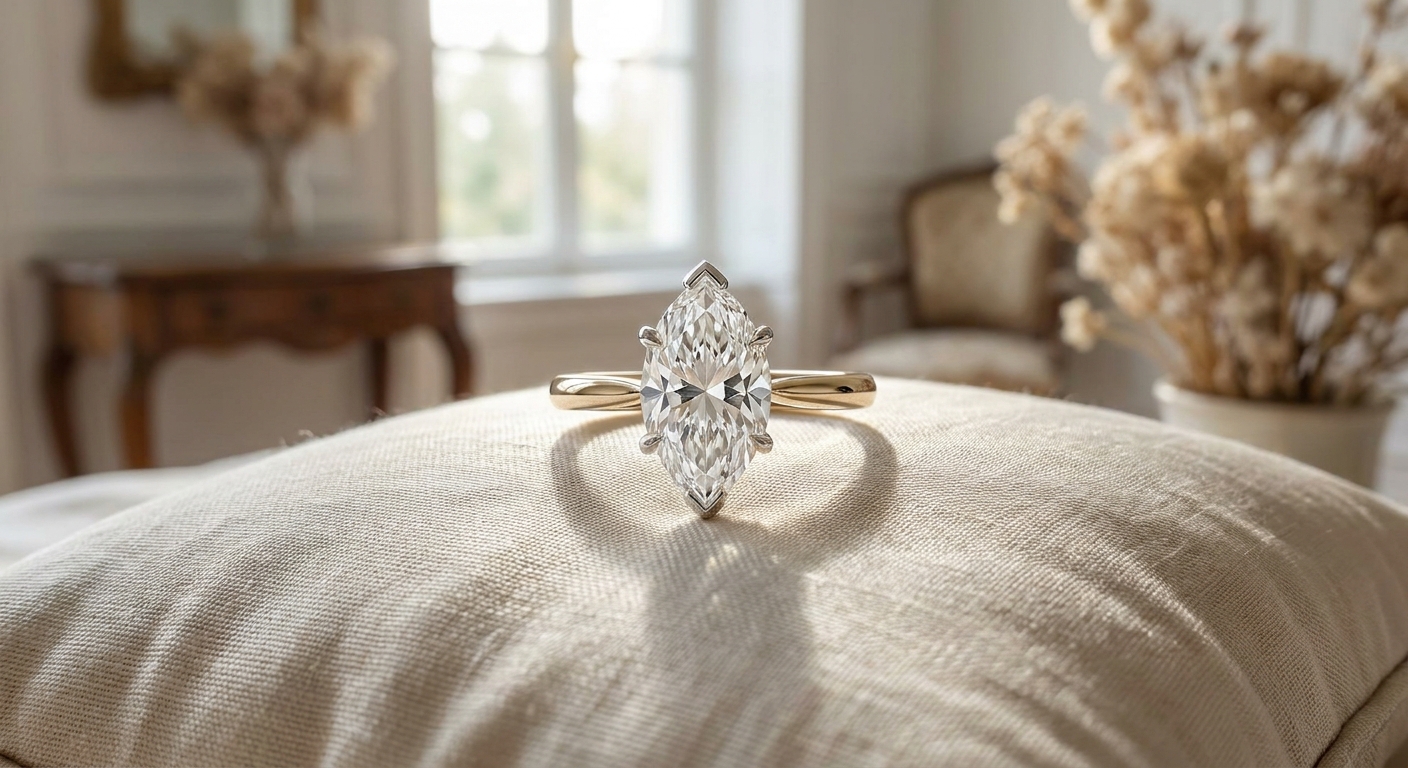
Marquise engagement rings elongate the finger like no other cut, and that's exactly why brides who want a statement without a huge carat jump reach for one. This guide breaks down what actually matters when you're shopping the shape — ratio, prong count, metal, and where the bowtie effect can wreck an otherwise gorgeous stone.
- Marquise engagement rings look 10-15% larger than round stones of the same carat weight because of the elongated shape.
- A 2:1 to 2.25:1 length-to-width ratio gives the classic elongated silhouette without looking pinched.
- Six-prong settings protect the pointed tips better than four-prong mounts on a marquise diamond.
- Stones under 1 carat with shallow cuts are the most prone to bowtie shadowing across the center.
- Element 79 designs custom marquise settings in Cherry Creek, Denver through a private consultation, not a catalog pick.
Who this is for
Marquise engagement rings suit buyers who want a ring that reads bigger on the hand and photographs dramatically without going oversized in carat weight. It's the pick for brides with a strong personal style who don't want the same round or cushion everyone else has, and for anyone shopping on a budget who still wants visual size. If elongation and a slim, vintage-leaning silhouette matter more than a boxy modern look, keep reading — this is your shape.
What to look for in marquise engagement rings for an elongated statement
Length-to-width ratio
The ratio is the single number that decides whether the ring looks elegant or awkward on the finger. A ratio between 2:1 and 2.25:1 is the sweet spot most jewelers recommend for 2026 — anything closer to 1.5:1 starts to look more oval, and anything past 2.5:1 can look thin and fragile. Ask for the exact millimeter length and width before you commit, not just the carat weight.
Bowtie effect control
Every marquise, pear, and oval diamond has some degree of "bowtie" — a dark shadow across the center caused by light blocking itself as it passes through the pointed ends. A well-cut stone with good depth minimizes it; a shallow, poorly proportioned cut makes it look like a gray stripe across the middle. This is the number one reason a marquise diamond can look cheap even at a decent carat weight, so ask to see the stone in hand and tilt it before buying.
Prong count and tip protection
The pointed tips on a marquise are the most vulnerable part of the stone — they're the first thing to chip on a doorframe or a gym bag. Six-prong settings, with a prong tucked at each point, distribute pressure better than a basic four-prong mount. If a setting only protects the sides and leaves the tips exposed, that's a repair bill waiting to happen.
Metal choice and band width
Platinum and 18k white gold hold a V-tip prong more securely than softer alloys because they resist bending under daily wear. A band that's too thin relative to the stone's length can also flex, which loosens tip prongs over time. If you want the elongated look and a metal that won't need re-tipping every few years, ask about platinum specifically.
How it compares to other elongated cuts
Marquise isn't the only shape that elongates the finger — oval and pear do similar work with softer outlines. The distinction is that marquise gives the sharpest, most dramatic point-to-point silhouette of the three, while oval engagement rings for an elongated look trade some drama for a rounder, lower-maintenance edge. If you've narrowed it to "elongated but not sure which shape," comparing the two side by side on your own hand settles it faster than any spec sheet.
Sizing without guessing
Marquise rings show more visual size relative to actual finger width than round cuts, which means a stone that looks perfect in a photo can sit oddly on a narrower finger. If this is a surprise proposal and you don't have her exact size, work from a sibling ring or a printable sizer rather than guessing off a stock chart — the elongated shape magnifies any sizing mismatch.
Why this matters
Getting the cut and setting details wrong on a marquise engagement ring is expensive to fix after the fact — resizing a pointed shape safely takes more skill than resizing a round band, and a bad bowtie can't be polished away. The gemstone quality underneath the cut matters just as much as the shape itself; if you're still deciding between a diamond and a colored stone for the center, the breakdown on how to choose a gemstone for an engagement ring covers clarity and durability trade-offs specific to elongated cuts. Element 79 walks Cherry Creek, Denver clients through these calls in person, which catches problems a photo never will.
Top picks
The solitaire marquise — the safe pick. A single marquise stone on a plain shank keeps the eye on the elongation with nothing competing for attention. Look for a 2:1 ratio minimum and a six-prong setting on the tips. Buy if you want a ring that photographs cleanly and never looks dated.
The halo marquise — the sparkle amplifier. A ring of pavé diamonds around the center stone adds perceived size and covers a slightly weaker bowtie by breaking up the light pattern. It works best on stones between 0.75 and 1.5 carats where the extra sparkle does real visual work. Consider it if your center stone has a mild bowtie you want camouflaged.
The three-stone marquise — the meaningful pick. Flanking the marquise with two smaller side stones (round or trapezoid) adds width at the shoulders and balances a longer center stone visually. Buy if the ring needs to carry symbolism — past, present, future readings are common with this layout — as well as elongation.
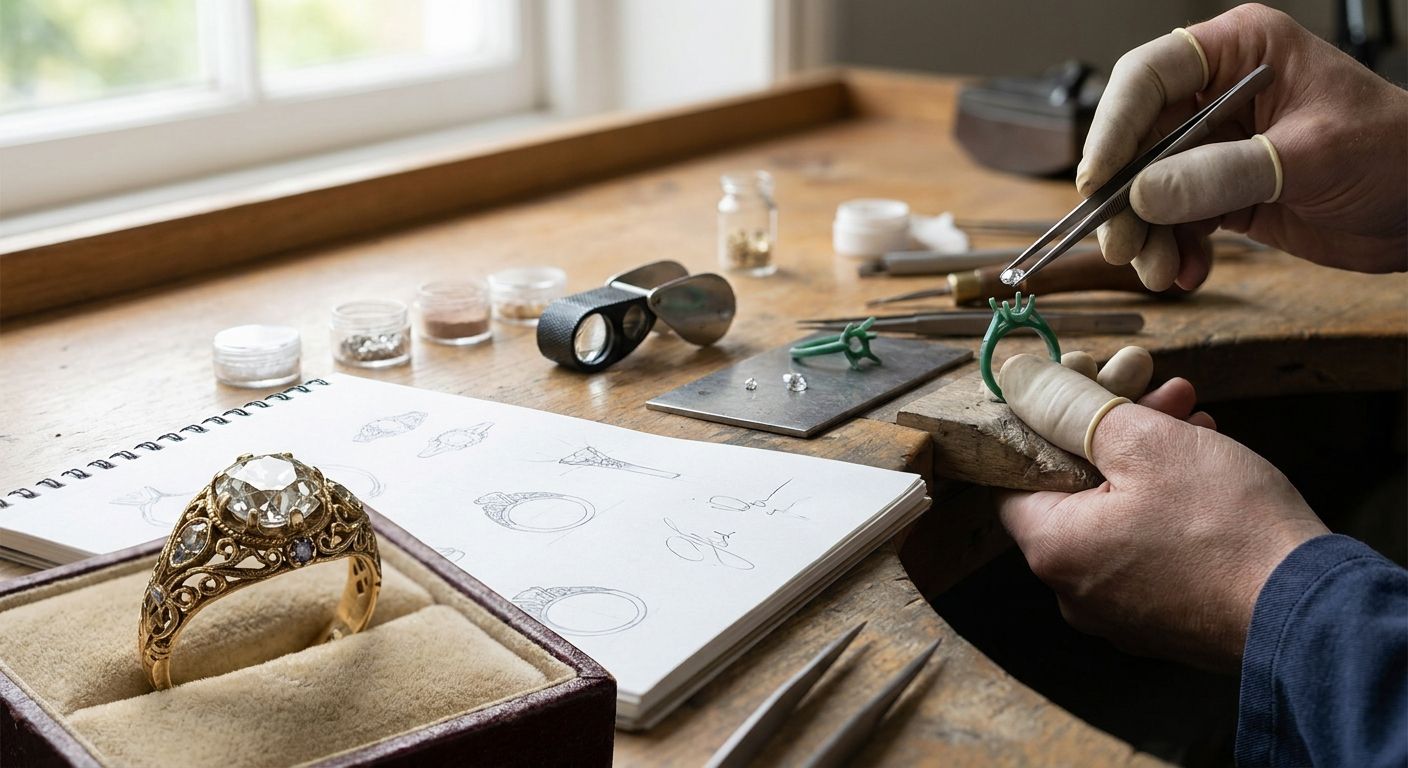
The custom marquise — the wildcard. If none of the standard ratios or prong configurations feel right for your finger shape or your stone, a made-to-order build lets you dial in the exact length-to-width ratio and metal weight before it's cast. Element 79 handles this through how to design a custom engagement ring, which is the route most second-time buyers and non-standard sizes end up taking anyway. Buy if you've tried on three or more marquise rings and none felt quite right.
“If the bowtie shadow shows before you even move your hand, skip the stone.”
Book a marquise ring consultation
See ratios and settings in person at the Cherry Creek boutique.
What to avoid
- Extreme ratios past 2.5:1. These look striking on paper but read as brittle and thin on an actual finger — the visual drama isn't worth the durability trade-off.
- Four-prong tip settings on a thin band. This combination is the most common reason marquise rings need repair within the first two years of daily wear.
- Buying off carat weight alone. Two 1-carat marquise diamonds can look wildly different in size depending on the ratio and depth — always ask for the millimeter dimensions, not just the weight.
Verdict comparison
| Criteria | Solitaire marquise | Halo marquise | Three-stone marquise | Custom marquise |
|---|---|---|---|---|
| Best ratio | 2:1-2.25:1 | 2:1 | 2:1-2.25:1 | Made to your hand |
| Bowtie risk | Moderate, visible | Lower, camouflaged by pavé | Moderate | Controlled at design stage |
| Tip protection | Six-prong recommended | Six-prong plus halo frame | Six-prong plus side stones | Built to spec |
| Verdict | Buy | Consider | Buy | Buy |
Marquise sits alongside oval and pear as the three shapes buyers compare most for elongation, and each trades a bit of drama for a bit of durability as you move down that list.
FAQ
What is a marquise engagement ring?
A marquise engagement ring features a football-shaped diamond or gemstone with two pointed ends, cut to maximize length and visual size. It's one of the oldest fancy cuts, dating back to 18th-century European royal commissions, and remains a top pick in 2026 for buyers who want an elongated look.
Is a marquise cut good for an engagement ring?
Yes, a marquise cut works well for an engagement ring when the ratio sits between 2:1 and 2.25:1 and the setting protects the pointed tips with six prongs. It looks larger than a round stone of the same carat weight, which makes it a strong choice for buyers balancing size and budget.
How much bigger does a marquise diamond look?
A marquise diamond can look 10-15% larger than a round diamond of the same carat weight because the elongated shape covers more surface area on the finger. The exact effect depends on the length-to-width ratio, so a well-proportioned 1-carat marquise reads noticeably larger than a poorly proportioned one.
What is the bowtie effect on a marquise diamond?
The bowtie effect is a dark shadow that crosses the center of a marquise, pear, or oval stone, caused by light blocking itself as it passes through the pointed ends. A well-cut stone with good depth minimizes it; a shallow cut makes the shadow more visible.
What metal works best with a marquise cut?
Platinum and 18k white gold hold the pointed tip prongs on a marquise more securely than softer metals because they resist bending under daily wear. This matters more on a marquise than on round or cushion cuts, since the tips are the most exposed part of the stone.
Is marquise or oval better for an elongated look?
Marquise gives a sharper, more dramatic elongated silhouette with pointed ends, while oval gives a softer, rounder elongation with fewer vulnerable edges. Choose marquise for maximum drama and oval for a lower-maintenance daily-wear option.
How many carats should a marquise engagement ring be?
Most marquise engagement rings in 2026 range from 0.75 to 2 carats, with 1 carat and up recommended to minimize bowtie shading on shallower cuts. Smaller stones under 0.75 carat can still work if the ratio and depth are well proportioned.
Can Element 79 custom design a marquise engagement ring?
Yes, Element 79 designs custom marquise engagement rings through a private consultation in Cherry Creek, Denver, where ratio, metal, and prong configuration are dialed in before casting. This route suits buyers who haven't found the right proportions in a standard catalog piece.
One last thing
The detail most buyers skip: ask to see the marquise stone tilted under three different light sources before you buy, not just under the jeweler's spotlight. Bowtie shadowing that's invisible under a diamond-grading lamp can show up plainly under office fluorescents, and that's the light your ring will live under most days in 2026.