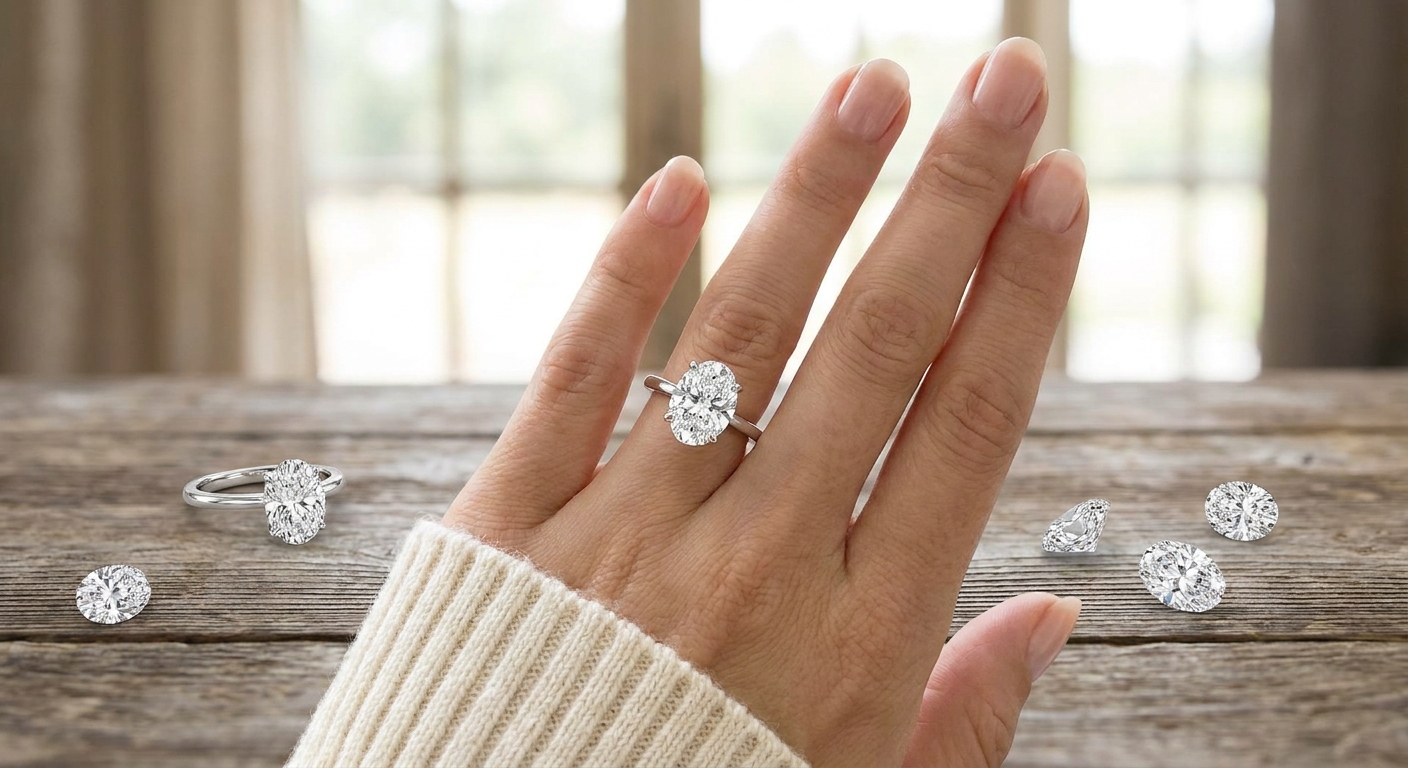
An oval engagement ring elongates the finger and reads larger than a round diamond of the same carat weight, because the shape spreads its surface area lengthwise instead of stacking it into a circle. Get the ratio right — and choose a setting that protects the pointed ends — and that elongating effect holds up through everyday wear in 2026.
- Oval engagement rings look longer and larger than round diamonds at equal carat weight — buy a 1.30-1.50:1 ratio for the cleanest elongation.
- Oval halo settings soften the bow-tie shadow that plagues thin, elongated ovals — Consider before committing to a bare solitaire.
- Three-stone oval rings stretch the finger on both sides, not just down the center — Buy for meaning plus length.
- Skip ratios above 1.60:1 unless the hand is naturally long; past that point the stone reads narrow, not elongated.
- Four prongs minimum on the points of any oval over one carat — fewer than that risks chipping at the tips.
Why this matters
Ovals have held a spot near the top of engagement ring searches for years because they solve a problem round cuts don't: they visually lengthen short or wide fingers without the sharp, easy-to-chip points of a marquise. Jewelers have used the 1.30-1.50:1 length-to-width ratio as the benchmark for a balanced oval for decades, and that guidance still holds in 2026 — stray past it and the stone starts to look like a stretched round rather than a deliberately elongated cut. If you're weighing an oval engagement ring against other shapes, understanding how to choose a designer engagement ring before you fall for a specific stone saves you from buying the wrong ratio for your hand.
The shape also plays well with almost every setting style — solitaire, halo, three-stone, colored-stone accent — which is why it shows up across so many bridal collections rather than sitting in one narrow lane.
Who this is for
This guide is for anyone with slender or shorter fingers who wants a diamond that visually lengthens the hand, and for anyone who wants a stone that reads bigger than its carat weight suggests without paying for extra size. It's also for couples comparing an oval against a round or cushion cut and trying to figure out if the elongation is worth the different prong and setting requirements.
What to look for in an oval engagement ring
Length-to-width ratio
This single number determines whether the ring elongates your finger or just looks like an odd round. Most jewelers treat 1.30 to 1.50:1 as the sweet spot — below 1.30 the stone edges toward round, above 1.60 it starts to look narrow rather than elongated. Ask for the exact ratio before you buy; a GIA or lab report will list it, and reputable dealers will hand it over without hesitation.
Prong count and metal coverage
Oval diamonds have two vulnerable points at the ends of the stone, and those points chip if they're under-protected. Four prongs is the practical minimum for anything over one carat, with the two end prongs doing the real work of holding the tips. Skimping here to save on a minimalist look is the fastest way to end up back at the jeweler for a repair.
Bow-tie effect visibility
A bow-tie is the shadow that sometimes appears across the center of an oval, caused by the way light bounces through the pavilion. It's not a flaw in every stone, but it shows up more in elongated ratios and shallow cuts, and it's easiest to spot by looking at the stone under a few different light sources before you commit. A well-cut oval minimizes it; a poorly cut one makes the shadow the first thing anyone notices.
Setting style
Solitaires show off the elongation with nothing competing for attention. Halos add sparkle but can visually shorten the stone if the halo sits too close to the ends. Understanding how to choose a gemstone for an engagement ring matters here too, since colored center stones behave differently under a halo than a diamond does.
Hand and finger shape
Ovals are the go-to recommendation for shorter or wider fingers because the length draws the eye up the finger instead of across it. If your hand is already long and slender, an oval still works, but the elongating effect is less dramatic and you may prefer a wider ratio for more presence.
Explore oval styles in person
See ratios and settings side by side before you decide.
Top picks for an oval engagement ring
The classic pick — Oval Solitaire. A plain band with a single oval stone puts the entire elongation effect on display with nothing competing for attention. The spec that matters: a 1.35:1 ratio reads as the most universally flattering length without drifting into narrow territory. Buy if you want the shape to do all the talking.
The sparkle pick — Oval Halo. A ring of smaller diamonds around the center stone adds brightness and can visually round out a thinner oval, softening any bow-tie shadow at the ends. The tradeoff: a halo set too low toward the tips shortens the visual length instead of extending it. Element 79's take on this style, oval halo engagement rings, sits the halo higher on the shoulders of the stone specifically to preserve the elongation. Buy if sparkle matters as much as length to you.
The meaningful pick — Oval Three-Stone. Two side stones flanking the oval center add length on both sides of the finger rather than concentrating it down the middle, and the three-stone format carries the past-present-future symbolism a lot of couples want. Look at three-stone engagement rings for a meaningful symbol if you want that story built into the design. Buy for anyone who wants symbolism and elongation in the same ring.
The wildcard pick — Oval with a colored gemstone accent. Pairing an oval diamond with a sapphire or emerald side stone breaks from an all-diamond look and adds a personal touch, but it changes how the stone reads next to a diamond of similar size — colored stones can visually compete with the diamond's brilliance rather than support it. Consider this if you want a signature detail; Skip it if you want the oval's elongation to be the sole focus.
The stacking pick — Oval in a modern band stack. An oval solitaire paired with slim, interlocking bands from a brand like Spinelli Kilcollin builds a stacked look around the center stone rather than isolating it. This works best on hands that already wear multiple rings comfortably. Consider if you already stack; Skip if you want one ring that stands alone.
What to avoid
- Ratios above 1.60:1 on short fingers. Past that point the oval reads narrow rather than elongated, which defeats the entire purpose of choosing the shape.
- Low-set halos. A halo that wraps too close to the pointed ends shortens the visual length instead of extending it — the opposite of what you're buying an oval for.
- Under-pronged settings on stones over one carat. A bezel or two-prong minimalist setting looks clean in photos but leaves the tips of the oval exposed to chips during daily wear.
Verdict comparison
| Style | Ratio sweet spot | Best for | Verdict |
|---|---|---|---|
| Oval Solitaire | 1.30-1.50:1 | Letting the shape speak for itself | Buy |
| Oval Halo | 1.30-1.45:1 | Extra sparkle without losing length | Buy |
| Oval Three-Stone | 1.30-1.50:1 | Symbolism plus elongation | Buy |
| Oval with Colored Accent | 1.30-1.50:1 | A personal, non-traditional detail | Consider |
| Oval Stack | 1.35-1.55:1 | Hands already wearing multiple rings | Consider |
FAQ
What's the best length-to-width ratio for oval engagement rings?
A ratio of 1.30 to 1.50:1 is considered the ideal range for oval engagement rings in 2026. Below 1.30 the stone starts looking round; above 1.60 it looks narrow instead of elongated.
Do oval engagement rings look bigger than round diamonds?
Yes, an oval diamond generally reads larger than a round diamond of the same carat weight because its surface area spreads across a longer, narrower shape. This is one of the main reasons buyers choose oval over round when budget is fixed.
What causes the bow-tie effect on an oval diamond?
The bow-tie effect is a shadow that appears across the center of an oval diamond, caused by how light travels through the pavilion at that length-to-width ratio. It's more visible in shallow-cut or heavily elongated stones and is worth checking under multiple light sources before buying.
How many prongs does an oval engagement ring need?
Four prongs is the practical minimum for an oval diamond over one carat, with the two end prongs protecting the pointed tips. Fewer prongs on a large oval increases the risk of chipping at the ends.
Is an oval halo setting better than a solitaire?
Neither is objectively better; a halo adds sparkle and can soften a bow-tie shadow, while a solitaire puts the full elongation effect on display with nothing competing for attention. The right choice depends on whether you want maximum sparkle or maximum shape emphasis.
Can a hidden halo hide the bow-tie effect on an oval diamond?
A hidden halo adds sparkle beneath the center stone without changing the visible outline, but it does little to reduce a bow-tie shadow since that effect comes from the stone's own cut and depth, not the setting around it.
What hand shape suits an oval engagement ring best?
Oval engagement rings are most often recommended for shorter or wider fingers because the elongated shape draws the eye up the finger. On naturally long, slender hands the elongating effect is less dramatic, though the shape still works well.
Is moissanite a good option for an oval engagement ring?
Moissanite can work well in an oval cut and is a common lower-cost alternative to diamond in 2026, though it displays more fire and rainbow flash under direct light than a diamond of the same shape. Whether that reads as a pro or a con depends on personal taste.
One last thing
The bow-tie effect on an oval diamond doesn't show up the same way under every light source — a stone that looks perfectly clean under warm indoor lighting can show a faint shadow under fluorescent light or direct sun. Before you finalize an oval engagement ring in 2026, look at the stone under at least two different light conditions, not just the jeweler's display case lighting, which is engineered to make every stone look its best.
“If the length-to-width ratio drifts past 1.60:1, the oval starts reading narrow instead of elongated.”