Picking a diamond color grade sounds like a technical chore until you realize it's the single choice that decides whether your center stone reads icy-white or warmly golden under Denver's afternoon light. This guide breaks down the GIA scale, matches grades to metal and carat weight, and tells you exactly where to stop spending for a difference nobody will see.
- GIA grades diamonds D (colorless) to Z (light yellow) across 23 letter grades.
- G-H diamond color grade is the sweet spot for platinum or white gold settings in 2026 — buy here.
- Below 1 carat, color differences are nearly invisible to the eye; above 2 carats, drop no lower than H.
- Yellow gold and rose gold settings mask warmth, so I-J grades still look bright — save the money.
- Fluorescence can make a lower grade face up whiter — ask to see it under UV before you decide.
Why this matters
Color grade is one of the four Cs, but it's the one buyers get wrong most often because the difference between letters is subtle on paper and dramatic in your bank account. A jump from H to F color grade can add 15-20% to the price of the same size stone with barely any visible change once it's mounted.
At Element 79, custom bridal clients walk in asking for "the whitest diamond" and walk out with something in the G-H range because that's where brilliance, budget, and metal choice actually align in 2026. Get the grade wrong and you either overpay for whiteness no one will notice or underpay and end up with a stone that looks dull against platinum.
What you'll need
- A GIA or AGS grading report for any stone over 0.50 carats — never buy a graded diamond without one
- A clear idea of your metal: platinum and white gold show color more than yellow or rose gold
- Your carat weight target, since color visibility scales up with size
- A jeweler's loupe or a trip to a designer engagement ring consultation where you can compare stones side by side
- A budget range, because color grade is often the easiest C to adjust without shrinking the stone
- Good lighting — north-facing daylight or a jeweler's color-corrected lamp, never yellow incandescent bulbs
Start with Element 79 if you want to see graded stones in person before committing to a number on paper.
The steps
1. Understand the D-to-Z scale before you shop
GIA's scale runs from D (completely colorless) to Z (noticeably yellow or brown), with 23 letter grades in between. Most engagement diamonds sold in 2026 fall between D and K, because anything past K starts showing visible tint to the naked eye in a standard setting.
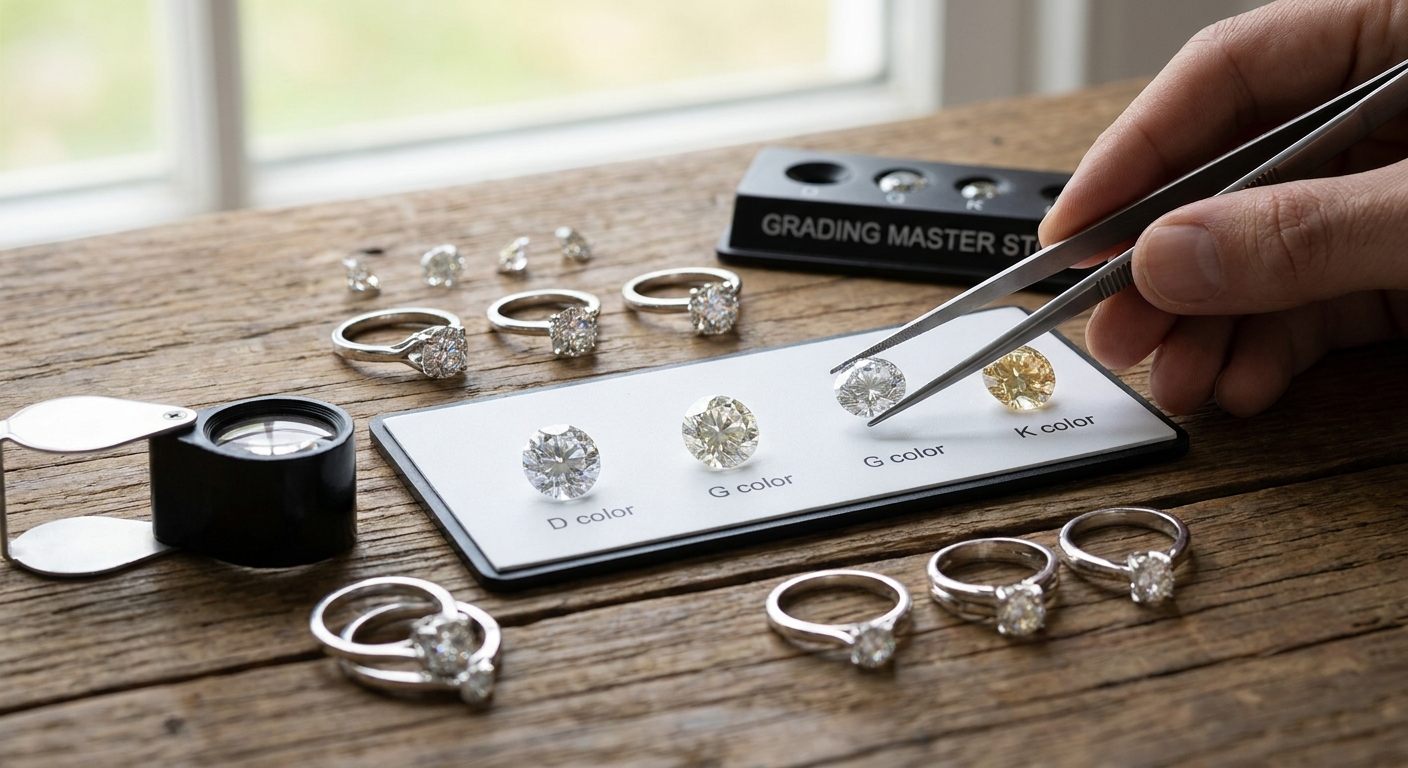
The scale groups into five ranges: colorless (D-F), near-colorless (G-J), faint (K-M), very light (N-R), and light (S-Z). Knowing which range you're shopping in tells you immediately whether you're paying for a marginal upgrade or a real visual difference.
Common mistake: treating D-F as the only "good" range. Most trained eyes can't tell D from G once the stone is mounted and viewed from arm's length.
2. Match the grade to your metal choice
White metals expose color because there's no warm tone competing with the stone. If you're set on platinum or white gold, stay in the G-H range minimum — I and below can look faintly yellow against the cool metal, especially in a solitaire or halo setting with lots of visible stone.
Yellow gold and rose gold do the opposite: they reflect warmth back into the diamond, so an I or J grade can look nearly as bright as a G in the same setting. This is the single biggest money-saving move in this whole guide — pair a warmer metal with a lower grade and put the savings toward carat weight or a better cut.
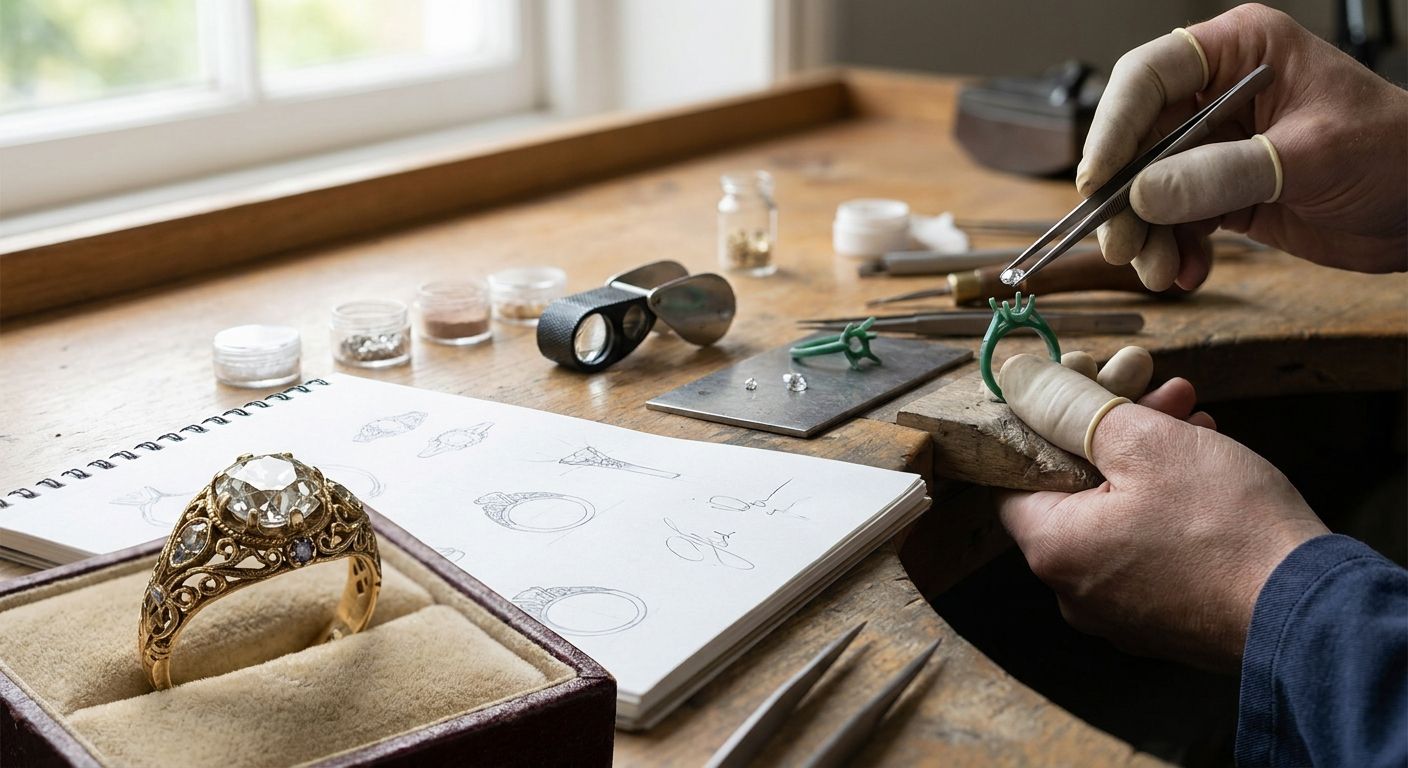
If you're building a custom engagement ring, decide on metal first, then let that decision guide your color grade budget.
3. Factor in carat weight before you lock a grade
Color becomes more visible as the stone gets larger, because a bigger table shows more of the diamond's body color. Under 1 carat, the difference between G and J is genuinely hard to spot without a loupe. Above 2 carats, that same J can start reading warm even in white gold, so pros generally recommend staying at H or better once you cross the 2-carat mark.
This is why two rings with the "same" color grade can look completely different — a 0.75-carat J and a 2.5-carat J are not the same visual experience.
4. Check fluorescence before ruling out a lower grade
Some diamonds carry medium or strong blue fluorescence, which can make an I or J grade face up whiter than its paper grade suggests, particularly outdoors or under UV-heavy lighting. This is a legitimate way to get a brighter-looking stone for less money in 2026 — but only your jeweler can show you side by side, since fluorescence doesn't show up in a photo.
Ask to see the stone under both daylight-equivalent lighting and a UV lamp before you rule a grade in or out based on the report alone.
5. Prioritize cut over color if you're on a fixed budget
A well-cut J color diamond will out-sparkle a poorly cut F color diamond every time, because cut controls how light returns to your eye and color only controls the base tone. If you have to choose one C to compromise on, color is almost always the safer trade than cut.
Common mistake: obsessing over the letter grade while accepting a shallow or overly deep cut that leaks light out the sides or bottom of the stone.
6. Compare stones in person, not on a screen
Online diamond photos are shot under studio lighting designed to make every stone look colorless. The only reliable way to judge how a G compares to an I is to hold both under the same light source, ideally next to the metal you're planning to use.
Book a consultation where multiple grades sit side by side in the same setting style — that comparison tells you more in five minutes than an hour of scrolling grading charts.
Compare diamond color grades in person
See G, H, and I grades side by side before you commit to a stone.
Troubleshooting
The stone looks yellow under store lighting but fine at home. Store lighting is often warm-toned incandescent, which flatters lower grades. Always ask to view the stone under neutral or daylight-corrected lamps before buying.
Two G-color diamonds look different next to each other. Cut quality, fluorescence, and even the surrounding metal can shift perceived color more than a single letter grade. Compare cut grade and fluorescence notes on both reports, not just the color letter.
The grading report lists a range instead of one letter. This usually happens with fancy shapes or older reports — ask your jeweler to clarify which single grade the current market treats it as, since pricing depends on the specific letter.
You can't decide between G and H to save money. At most carat weights and in most settings, this difference is invisible to anyone but a trained grader with a loupe. Put the savings toward a better cut grade or a larger stone instead.
The diamond looks warmer after resizing or cleaning. Residue, oils, or a dirty setting can make any grade look duller. A professional cleaning almost always restores the original brilliance before you assume the grade was misrepresented.
You're choosing between a diamond and a colored stone entirely. If color grading feels like more decision than you want to make, a gemstone engagement ring sidesteps the whole D-to-Z conversation.
Tools and resources
- GIA or AGS grading report — non-negotiable for any diamond over half a carat
- A jeweler's loupe (10x magnification minimum) for in-person comparisons
- A daylight-equivalent lamp or a north-facing window for honest color viewing
- A written comparison of at least two grades in your target metal before you decide
- A consultation appointment where multiple color grades are shown mounted, not loose
What to do next
Once you've settled on a color grade, the next decision is usually the setting itself, since prong count, metal, and stone shape all interact with how white the diamond reads day to day. If budget is still the driving factor, look at how lab-grown diamond engagement rings let you buy a higher color grade for the same spend as a lower-grade natural stone in 2026.
FAQ
What is the best diamond color grade for an engagement ring?
G to H is the best diamond color grade for most engagement rings in 2026 because it looks colorless to the naked eye in white metal settings while costing noticeably less than D-F. Below 1 carat, even I or J can look nearly identical to a G.
Is H color grade good for a diamond?
Yes, H color grade sits in the near-colorless range and looks white in platinum, white gold, and yellow gold settings alike. It's one of the most popular grades sold in 2026 because it balances brightness with price.
Does color grade matter more than clarity?
Color grade generally matters more visually than clarity in the VS1-SI1 range, since color affects the overall tone of the stone while minor clarity inclusions are often invisible without magnification. Cut, however, outranks both for visible sparkle.
Can you see the difference between D and G color diamonds?
Most people cannot see the difference between D and G color diamonds once mounted, even side by side, without a jeweler's loupe. The visual gap widens only at larger carat weights or in stones with poor cut quality.
What color grade should I choose for yellow gold?
I or J color grade works well in yellow gold and rose gold settings because the warm metal tone masks the diamond's faint yellow tint. This lets you save on color grade and put the difference toward carat weight or cut quality.
Does fluorescence affect diamond color grade?
Strong blue fluorescence can make a lower color grade, like I or J, appear whiter than its paper grade suggests, especially in daylight. It doesn't change the certified letter grade, but it can change how the stone actually looks on your hand.
Is it worth paying for a D or E color diamond?
D and E color diamonds are worth the premium mainly for large, unmounted stones or collectors focused on absolute colorlessness. For most engagement rings, the price jump over G-H buys a difference that's invisible once the stone is set.
How much does diamond color grade affect price?
Moving from H to F color grade in the same carat weight and clarity can raise the price 15-20% in 2026, based on aggregated market pricing across major diamond retailers. The jump is steeper at larger carat weights.
One last thing
The biggest surprise for most first-time buyers isn't the price difference between grades — it's how much a single grade can shift depending on the diamond's fluorescence and the metal it sits in. A J color stone with strong blue fluorescence set in platinum can genuinely out-white a fluorescence-free I color stone in the same setting, which is exactly the kind of comparison a grading report alone won't show you.
Verdict at a glance
| Color Range | Grades | Best For | Verdict |
|---|---|---|---|
| Colorless | D-F | Large solitaires over 2 carats in platinum | Buy if budget allows |
| Near-colorless | G-H | Most settings, most carat weights | Buy — best value |
| Near-colorless (warm) | I-J | Yellow gold, rose gold, under 1.5 carats | Buy for warm metals |
| Faint | K-M | Vintage-style or heavily colored metal settings only | Consider with caution |
| Very light to light | N-Z | Rarely used in fine bridal jewelry | Skip |